
Executive Summary
A VC term sheet may look like a short legal document full of boilerplate, yet it ranks among the most consequential documents in a startup’s life. Its clauses define valuation, investor returns, governance, and exit dynamics, shaping the company’s path well beyond the current round.
This article walks through the 20 most common terms in a venture capital term sheet, grouped into economic rights, control and governance provisions, and binding closing terms. Founders, CFOs, and early investors will find worked examples, negotiation guidance, and a clear view of the trade-offs behind each clause.
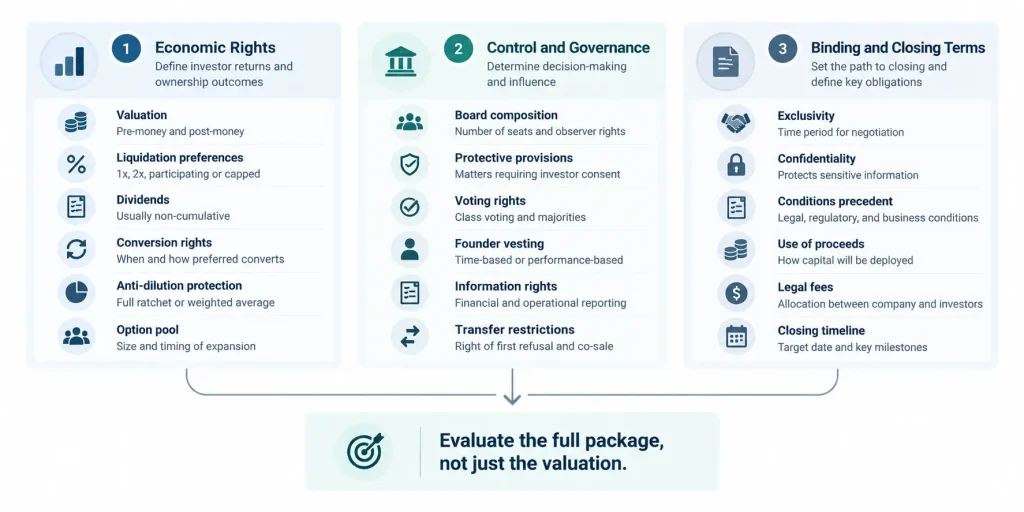
What a VC Term Sheet Does
A term sheet is largely non-binding, but it works as a handshake agreement that frames the definitive documents to follow, including the stock purchase agreement, investor rights agreement, and voting agreement. Exclusivity and confidentiality are usually the only enforceable provisions. The balance of power in any VC term sheet depends on company stage, competitive dynamics, and the relative leverage of founders and investors.
Valuation and Capital Structure in a Venture Capital Term Sheet
Valuation draws the most attention in any venture capital term sheet, but its mechanics hide important subtleties. Pre-money valuation is the company’s value before new capital arrives and sets the price per share, while post-money valuation equals pre-money plus new capital and determines investor ownership.
A Worked Valuation Example
With a $10M pre-money valuation and a $2M raise, post-money valuation reaches $12M and the new investor owns 16.67% of the company. Founders should check whether any option pool expansion sits inside the pre-money figure, since that choice shifts dilution onto existing holders. Building the capital strategy and investor narrative for a pre-Series A AI governance platform reinforced how much clarity on these definitions strengthens a founder’s negotiating position.
Preferred Stock and Its Rights
Venture investors typically receive preferred stock rather than common, and the term sheet defines how it sits on the cap table and converts at an IPO or acquisition. Preferred stock usually carries several rights that common shareholders lack:
- Liquidation preference
- Dividends, often non-cumulative and rarely paid
- Conversion rights
- Anti-dilution protection
Economic Terms That Shape Investor Returns
The economic section of a VC term sheet decides who gets paid, in what order, and how much. Small drafting differences in a venture capital term sheet can move millions of dollars at exit.
Liquidation Preference
The liquidation preference determines who gets paid first in a sale, merger, or bankruptcy. The standard clause grants one times (1x) the original purchase price plus declared but unpaid dividends. More aggressive versions include 2x or 3x multiples, participating preferred that collects its preference and then shares in remaining proceeds, or capped participation that limits the total return multiple.
Consider a $10M acquisition where an investor holding 30% has a $3M participating preference, which produces the following waterfall:
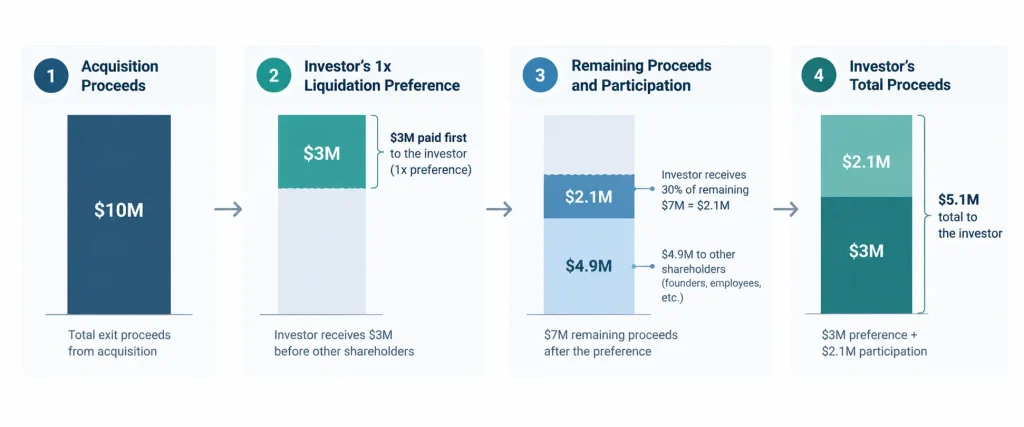
Founders should push for non-participating preferred or a participation cap to limit this downside skew.
Dividends
Startups rarely pay dividends, yet the dividend clause still affects structure and signaling. Non-cumulative dividends accrue only if declared, while cumulative dividends accrue annually and become payable at exit. An 8% cumulative dividend on a $5M investment accrues $400K per year, adding $2M to the liquidation amount over 5 years, so founders should favor non-cumulative terms to avoid bloating the preference stack.
Conversion Rights and Anti-Dilution Protection
Holders can convert preferred into common at their option, typically at an IPO or when sale proceeds exceed the preference. Automatic conversion usually occurs on a qualified IPO, for example a $30M raise at a $100M+ valuation, or by majority vote of preferred holders. The conversion ratio starts at 1:1 but can shift under anti-dilution protection.
Anti-dilution clauses protect investors in a down round. A full ratchet resets the conversion price to the new, lower price and can devastate founder ownership. Broad-based weighted average protection offers a more balanced approach using a standard formula:
- New Conversion Price = Old Price x (A + B) / (A + C)
- A equals shares outstanding before the new issue
- B equals shares the new money would buy at the old price
- C equals shares actually issued in the new round
Founders should resist full ratchet provisions in favor of weighted average terms.
Other Economic Provisions
| Term | What It Does | Founder Guidance |
| Pay-to-play | Investors who skip future pro-rata participation lose rights, often converting to common | Often welcome as a filter for committed capital |
| Option pool | Reserves 10% to 20% of shares for hires, usually inside pre-money | Push for post-money expansion to share the dilution |
| Participation (pro-rata) rights | Lets investors buy into future rounds to maintain ownership | Model dilution under different participation levels and resist super pro-rata |
| Redemption rights | Lets investors force a buyback after 5 to 7 years | Resist or require board discretion, since cash may be tight |
The option pool in a VC term sheet deserves extra attention: in a $2M round at a $10M pre-money valuation with a required 10% pool, placing the pool inside the pre-money figure benefits the investor at the founders’ expense. Raising $36.5M across Series A through C at a venture-backed digital marketing company showed how pool sizing and pro-rata rights compound across successive rounds.
Control and Governance Terms in a VC Term Sheet
Economic terms decide who gets paid, while control terms decide who makes decisions, and in startups control can matter more than cash. Investors fund the business without running it, so they need mechanisms to monitor and protect their interests, while founders need room to innovate and lead.
Board Composition
An early-stage board often holds three seats, with one founder seat, one investor seat, and one mutually agreed independent. As the company matures, boards expand to five or seven members, new investors seek seats, and founder control can erode. The VC term sheet specifies seat numbers, appointment rights, and any decisions that require supermajority or unanimous consent. Founders should secure neutral independent directors early and avoid boards weighted heavily toward investor appointees.
Protective Provisions
Protective provisions give preferred holders veto power over structural decisions without conferring operational control. Common triggers in a VC term sheet include the following actions:
- Amending the charter or bylaws
- Issuing new stock
- Incurring debt above set thresholds
- Selling the company or its assets
- Declaring dividends
Exit and Transfer Rights
Drag-along rights let a majority force minority holders to join an acquisition, preventing small stakeholders from blocking a clean exit. Founders should confirm that triggering thresholds, dissenter rights, fair market value requirements, and fiduciary duties are addressed. The right of first refusal lets the company or existing investors buy shares that others plan to sell, and co-sale rights let investors sell alongside founders, which together keep unwanted parties off the cap table.
Information Rights and Founder Vesting
Investors typically require quarterly and annual financials, board materials, budget forecasts, and the right to inspect the books. Running monthly board reporting and audit committee engagement during a $37M raise at a mission-driven education institution showed how early, high-quality reporting builds investor confidence. Term sheets also commonly re-impose founder vesting over 4 years with a 1-year cliff, sometimes with single or double trigger acceleration on a change of control, and clawbacks may reclaim unvested shares if a founder leaves.
Binding Clauses and Closing Terms
| Term | Purpose | Typical Terms |
| Exclusivity and no-shop | Stops the company soliciting other investors so diligence can proceed | Binding, often for 30 days |
| Confidentiality | Keeps term sheet contents private | Binding on both parties |
| Legal fees | Company covers investor counsel costs | Capped at $25K to $50K and conditional on closing |
| Conditions precedent | Lists requirements before funds transfer | Diligence, approvals, definitive documents, IP and employment agreements |
Breaching a no-shop clause can damage trust and collapse a deal, so founders should treat the binding provisions with the same care as the economics.
Negotiating a VC Term Sheet as a Strategic Blueprint
Every VC term sheet is part legal document and part psychological contract. Each clause signals priorities, balances risk, and allocates influence between founders and investors. A strong valuation paired with harsh control provisions can leave founders worse off than a slightly lower valuation with clean governance, so the full package matters more than any headline figure. Signing the term sheet marks the true beginning of the negotiation, and mastery of its terms helps both sides align incentives and avoid future conflict.
Three Key Takeaways
- A VC term sheet should be judged as a complete package, because liquidation preferences, cumulative dividends, and option pool placement can outweigh a higher headline valuation.
- Founders should model every economic term, from participating preferred to weighted average anti-dilution, before signing, since small drafting choices move millions at exit.
- Board composition, protective provisions, and founder vesting define long-term control, so governance terms in a venture capital term sheet deserve the same scrutiny as price.
Disclaimer: This article is intended for informational purposes only and does not constitute legal, tax, or accounting advice. You should consult your own tax advisor or counsel for advice tailored to your specific situation.
Hindol Datta is a four-time CFO and senior finance executive with over 25 years of leadership experience across cybersecurity, SaaS, gaming, logistics, digital marketing, medical devices, consumer products, and nonprofit organizations. He has led more than $120M in fundraising and over $150M in M&A transactions while building the financial and operational systems that let complex businesses scale with confidence. He is the author of seven books in the Systems CFO Series and holds active CPA, CMA, and CIA credentials.
AI-assisted insights, supplemented by 25 years of finance leadership experience.