
Executive Summary
Variance analysis is often treated as a monthly ritual of explaining why actuals missed the budget. Used well, it becomes something far more useful: an early warning system for strategic initiatives, showing where the plan and the business have drifted apart. Every deviation carries information about assumptions, culture, incentives, and markets that no strategy document captured.
Variance works as a strategic mirror, yet its value depends on how teams receive it and whether finance separates signal from noise. Incentive design and adaptive planning then decide whether an organization learns from deviation or fears it.
Why Variance Analysis Is a Strategic Signal, not a Scorecard
Every enterprise produces a steady hum of deviation, and most finance teams explain it away as noise. Sales land a few points short, or operating costs creep past their limits. None of these moments arrives with alarm bells, yet together they form the first tremor of misalignment.
The orthodox view defines variance as a gap between plan and actual, but a more useful view treats it as a mirror held up to strategy. Every budget, however carefully built, remains an informed guess. When variance recurs in a patterned form, strategy is talking back, and the CFO has to learn its language.
KPIs report what leadership chose to measure, while variance analysis reveals what leadership missed. That distinction turns budget vs actual review into a form of organizational diagnosis. A travel overrun, for instance, may point to a dispersed sales force struggling for relevance.
When Variance Exposes a Gap Between Plan and Culture
A technology firm pivoting from hardware to cloud subscriptions shows how this works in practice. R&D spending holds steady, yet capitalized development costs fall quarter after quarter against a forecast that expected both to rise. Finance first reads it as a timing delay, but the pattern persists for a year. Deeper inquiry reveals engineers still working in a hardware mindset, slow to adopt the modular discipline cloud products require.
The variance was never a financial error; it was a symptom of cultural inertia inside a major strategic initiative. A professional services firm scaling from $12M to $63M offers a similar lesson. Engagement-level profitability analytics across its five business units showed where margin was quietly leaking. Those leaks surfaced first as small, persistent variances that summary reports had smoothed away. Good variance analysis therefore asks two questions of every recurring gap: what went wrong in execution, and whether the context has changed in ways the plan never contemplated.
The Psychology Behind How Teams Receive Variance
The real theatre of variance is emotional, not financial. A seven percent revenue shortfall caused by a delayed partner certification can turn a boardroom heavy. In that moment, executives stop debating numbers and start defending identities.
Leaders build forecasts to tame uncertainty, then experience any breach of those forecasts as a personal affront. Organizations tend to respond to that discomfort in one of two unhealthy ways:
- Overreaction, through emergency task forces, panicked emails, and sudden budget freezes
- Indifference, through explanations so intricate they begin to resemble fiction
Both responses share a root cause, which is a cultural inability to absorb uncertainty. Three persistent myths reinforce that inability across most finance cultures:
- Omniscient planning, the belief that good forecasts should never deviate
- Perfect execution, the habit of blaming the field and never the assumptions at the top
- Pure randomness, the instinct that dismisses all variance as noise below an arbitrary threshold
The modern CFO replaces these myths with a Bayesian mindset, where beliefs update as new data arrives and deviation prompts collective inquiry. Board reporting at a mission-driven education and research institution showed the value of framing. Variance analysis landed better with finance and audit committees when presented as context, not as a verdict on management.
When a shortfall is presented as feedback instead of failure, people lean in and share context, not excuses. They begin revising assumptions as well as numbers, and the truth becomes a shared responsibility.
Separating Signal from Noise in Variance Analysis
Numbers suggest certainty, yet many variances are statistical dust with no deeper meaning. Effective variance analysis depends on telling apart the two principal sources of deviation.
Systematic Bias Versus Random Fluctuation
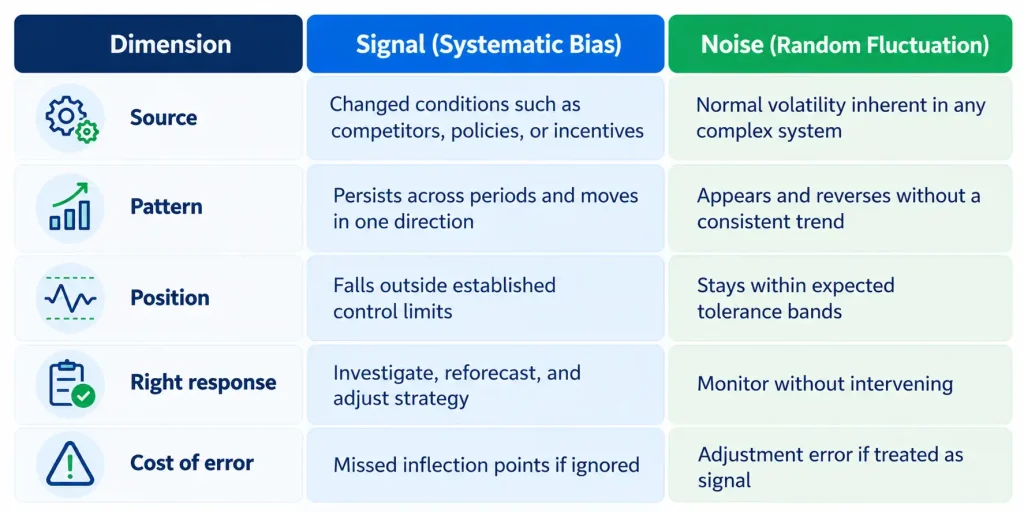
Control limits are the most practical tool for variance analysis at this stage. When an expense spikes, the first question is whether the movement sits outside expected volatility. At a cybersecurity and identity access management company with roughly $30M in ARR, a driver-based forecasting engine held actuals within plus or minus five percent for 8 consecutive quarters. That stable band made true deviations easy to spot.
The Cost of Misreading a Variance
Overreacting to noise means fixing what was never broken, while underreacting risks missing an early strategic inflection point. A regional marketing budget running 17% over plan shows the danger. Finance cuts agency fees and headcount, only to watch engagement and sales collapse six months later. The overspend had signaled latent demand from early adopters, and the reaction turned a promising trend into a self-inflicted contraction.
Monte Carlo simulations and confidence intervals guard against both errors, reminding finance teams that five data points do not make a pattern. Variance analysis works best as a continuous Bayesian loop:
| Stage | Bayesian Role | What Finance Does |
| Plan | Prior belief | Sets the forecast and its confidence range |
| Variance | Observed evidence | Tests whether the gap sits outside control limits |
| Reforecast | Posterior belief | Updates assumptions and resource allocation |
| Next cycle | New prior | Carries the lesson into the following period |
How Incentives Distort Variance Signals in Strategic Initiatives
Every incentive system carries a theory of human behavior, and every scorecard eventually teaches lessons it never intended. The variances that result often say more about incentive design than about the market.
A sales team that shatters quarterly targets can mask serious damage underneath. Contracts loaded with discounts, trial periods, and easy cancellation clauses produce a favorable revenue variance alongside poor retention and weak margin. During a scale-up from $9M to $180M in revenue at a venture-backed digital marketing company, contribution margin analytics guarded against this trap. Tracking CAC and LTV alongside revenue kept the business from rewarding volume that destroyed value.
Variance analysis should watch for these common tactical distortions:
- Cost centers that beat forecast by quietly cutting training
- Business units that inflate their pipeline just before quarter-end
- Divisions that hoard budget to manufacture a future underspend
- Teams that spend 98% of budget every year, because landing just right means no one asks questions
Strategic Variance Versus Tactical Variance
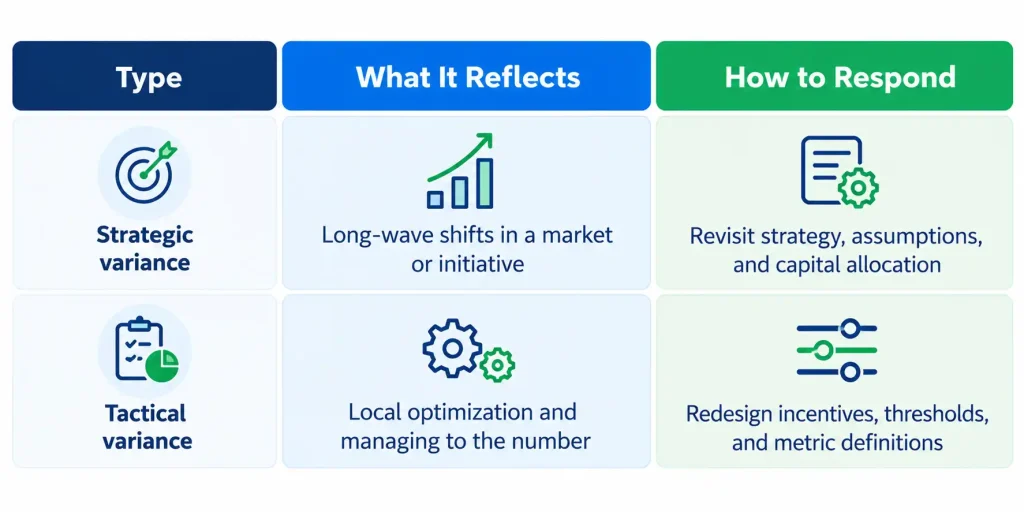
Rewarding growth without profitability invites revenue inflation, while rewarding cost containment without context hollows out capability. The remedy is a broader canvas of balanced scorecards, rolling forecasts, quality metrics, engagement, and customer NPS. When the music sounds off-key, the fault may lie with the score and not the players.
Designing Variance Analysis into Adaptive Planning
Living systems evolve because of deviation, not in spite of it, and the true function of planning is learning. A new pricing model forecast to deliver a six percent uplift shows the cost of rigidity. Pilot variances hint at failure by week two, yet leaders treat the plan as gospel and wait for confirmation.
Adaptive planning treats the plan as a hypothesis, variance analysis as feedback, and adjustment as evidence of intelligence. Finance teams can build this posture through several practices:
- Elastic budgets that flex with defined business drivers
- Forecasts that carry confidence intervals rather than single points
- KPIs with tolerance bands that absorb normal noise
- Leadership incentives that reward speed and quality of response, not only outcomes
- Governance rituals such as monthly business reviews that favor understanding over justification
At a $127M global consumer products company, demand planning and SKU rationalization lifted inventory turns from 3x to 7x. That gain came from treating forecast variance as data for continuous adjustment, not as a periodic embarrassment.
Psychological safety completes the design, because a team that can report bad news without penalty will report it early. Systems without variation turn brittle and break under novelty. Organizations that respond to deviation build resilience, and their strategic initiatives grow wiser with every cycle.
Three Key Takeaways
- Variance analysis works best as a diagnostic mirror for strategic initiatives, revealing hidden gaps in assumptions, culture, and execution. Recurring deviations deserve inquiry into context, not just correction of the numbers.
- Control limits, confidence intervals, and a Bayesian reforecasting loop help separate true signal from random noise. This discipline prevents both costly overreaction and missed inflection points.
- Incentive design shapes the variances an organization produces, so favorable numbers deserve the same scrutiny as adverse ones. Planning systems built to expect deviation turn every surprise into a source of learning.
Disclaimer: This article is intended for informational purposes only and does not constitute legal, tax, or accounting advice. You should consult your own tax advisor or counsel for advice tailored to your specific situation.
Hindol Datta is a four-time CFO and senior finance executive with over 25 years of leadership experience across cybersecurity, SaaS, gaming, logistics, digital marketing, medical devices, consumer products, and nonprofit organizations. He has led more than $120M in fundraising and over $150M in M&A transactions while building the financial and operational systems that let complex businesses scale with confidence. He is the author of seven books in the Systems CFO Series and holds active CPA, CMA, and CIA credentials.
AI-assisted insights, supplemented by 25 years of finance leadership experience.



