
Executive Summary
A piece of code gets written in one country. It is refined in another, licensed in a third, and sold in a fourth. The price a customer pays is easy to record. The price each internal entity pays the next one is not. That internal price is set by design, not by an open market. Getting it wrong carries real financial and reputational cost.
This article sets out a practical transfer pricing strategy. It covers what transfer pricing actually governs, and where the arm’s length principle breaks down. It also covers what it costs a company to treat pricing as an afterthought. And it covers how AI and BEPS Pillar Two are reshaping the discipline.
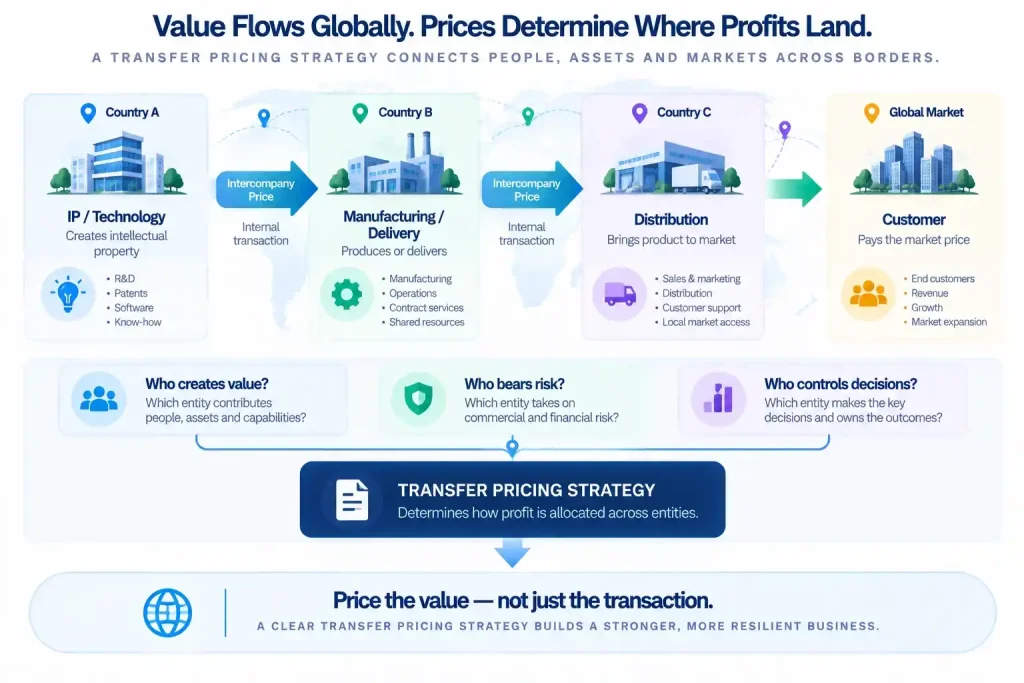
What Transfer Pricing Actually Governs
Transfer pricing answers one question. When a company trades with itself across a border, what is the fair price? One subsidiary may own the intellectual property. Another may manufacture. A third may distribute. Revenue moves in, costs move out, and tax authorities want to know who gets to claim the resulting profit.
This is not a small-dollar question. Trillions of dollars move through intercompany transactions every year. The rate a manufacturing entity charges a distribution entity can shift profitability across entire regions. That is why regulators pay close attention to it.
The Arm’s Length Principle, and Where It Breaks Down
The governing standard is the arm’s length principle. Related entities should price a transaction as if they were unrelated parties negotiating in an open market. The standard is rational and widely accepted. It is also difficult to apply to anything that does not have an obvious market comparison.
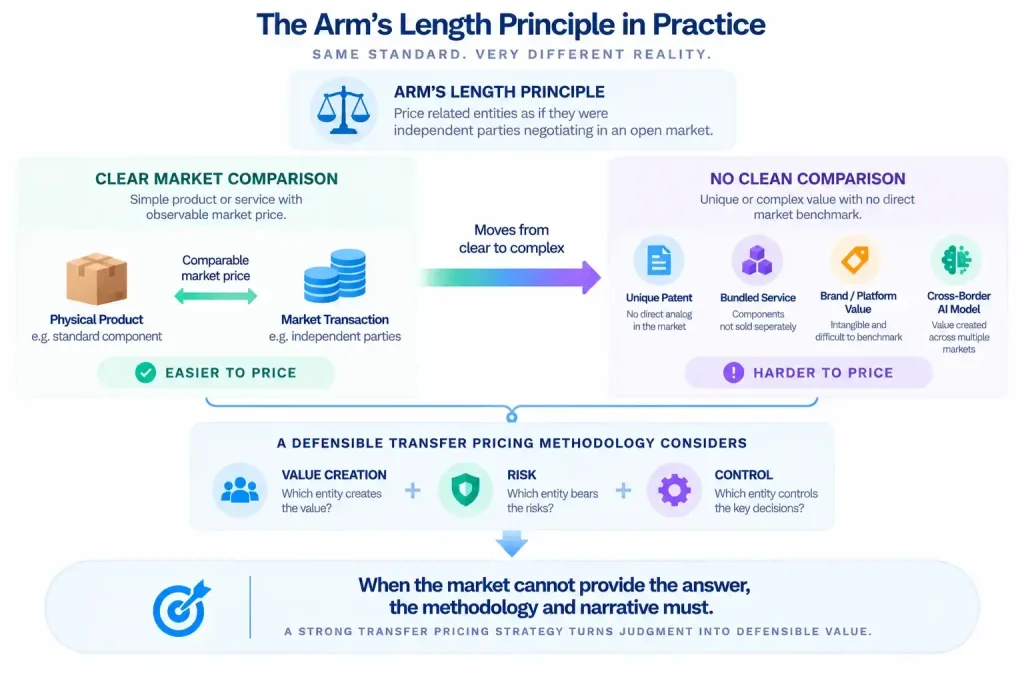
A market has no clean answer for several common cases.
- A patent with no direct analog anywhere else in the industry
- A bundled service whose provider never sells the components separately
- Brand equity, platform access, or specialized managerial expertise
- An AI model trained on data pulled from customers across a dozen markets at once
Each of these forces a company to build a defensible narrative instead of pointing to a market price. Who owns the intellectual property? Where does the risk sit? And who controls the underlying decisions? A transfer pricing strategy has to answer all three before an auditor asks.
Building a Transfer Pricing Strategy Before the First Audit
Most companies delay this work. Revenue starts appearing in a second country. A team forms in a third, and a contractor becomes a legal entity somewhere else. The transfer pricing policy, if one exists at all, becomes a patchwork of assumptions made under time pressure.
Case: Pricing Cross-Border Services From Day One
A marketplace SaaS platform was preparing for a $20M Series B. It built its finance function around a consolidated US and Polish reporting structure from the outset. The team documented intercompany service pricing between the two entities from the start, rather than bolting it on after an audit request. That discipline gave investors a clean picture of margin by entity during diligence. Finance did not have to reconstruct the numbers under pressure.
A high-growth cybersecurity and identity access management company followed a similar path. Its finance and revenue operations ran across US and offshore delivery centers as a single function from early on. That meant cross-charges between entities followed a documented method, rather than an informal split negotiated after the fact.
The Cost of Ignoring Transfer Pricing Strategy
Treating transfer pricing as a problem to solve retroactively carries a real bill.
- Reallocated income and double taxation: A government can require justification for an intercompany arrangement. An unconvincing answer can mean the same income gets taxed twice.
- Penalties and litigation: Weak documentation turns a routine inquiry into a prolonged, expensive dispute.
- Internal misalignment: A subsidiary that feels it subsidizes another tends to stop collaborating. Managers start optimizing for their own entity’s numbers instead of enterprise value.
- Reputational exposure: A public dispute over tax practice can damage trust with investors and employees well beyond the dollar amount at stake.
Case: Coherence Across Five Countries
A Euronext Paris-listed gaming and digital entertainment company operated across five countries. It rolled out a single consolidated finance system, built on one unified revenue and cost definition. That structure compressed statutory reporting cycles under both IFRS and US GAAP ahead of an IPO-readiness process. The same coherence that satisfied auditors also gave the company confidence during more than $100M in cross-border acquisitions that followed. Intercompany pricing did not need to be rebuilt for every new entity added to the group.
Transfer Pricing Strategy in the Age of AI and BEPS Pillar Two
Three forces are reshaping how a transfer pricing strategy gets built.
- Technology: A model trained in one country and deployed in a dozen others complicates the idea of a single transaction. Traditional methods, cost-based pricing, resale minus, and the transactional net margin method, start to strain under this pressure. Value is now co-created across time zones in real time.
- Regulation: The OECD’s BEPS framework, Pillar Two, and country-by-country reporting are narrowing the room for arbitrage. Tax authorities are also building their own detection tools. That means anomalies get flagged by algorithms, not just by auditors reading a filing.
- Strategy: Where a company locates intellectual property has become a signal. So does who takes on risk in each entity. Together, they tell investors, regulators, and employees how the company explains itself.
A $127M global consumer products company with a supply chain spanning two continents felt this shift directly. Isolating and documenting the transfer price between its manufacturing and distribution entities did more than satisfy compliance. It exposed a working capital problem that a generic cost-of-goods line had been hiding. Fixing it changed how leadership thought about growth.
Three Key Takeaways
- A transfer pricing strategy is not a tax footnote. It documents who creates value, who bears risk, and who controls decisions across a company’s legal entities. That documentation is what an auditor will ask for first.
- The arm’s length principle works well for a widget sold across a border. It strains against a patent, a bundled service, or an AI model with no clean market comparison. That is where a defensible narrative matters most.
- Building transfer pricing into the finance function from the first cross-border transaction costs far less than reconstructing it later. Companies that documented pricing early carried that discipline into diligence, IPO readiness, and acquisitions without missing a step.
Disclaimer: This article is intended for informational purposes only and does not constitute legal, tax, or accounting advice. You should consult your own tax advisor or counsel for advice tailored to your specific situation.
Hindol Datta is a four-time CFO and senior finance executive with over 25 years of leadership experience across cybersecurity, SaaS, gaming, logistics, digital marketing, medical devices, consumer products, and nonprofit organizations. He has led more than $120M in fundraising and over $150M in M&A transactions while building the financial and operational systems that let complex businesses scale with confidence. He is the author of seven books in the Systems CFO Series and holds active CPA, CMA, and CIA credentials.
AI-assisted insights, supplemented by 25 years of finance leadership experience.