Executive Summary
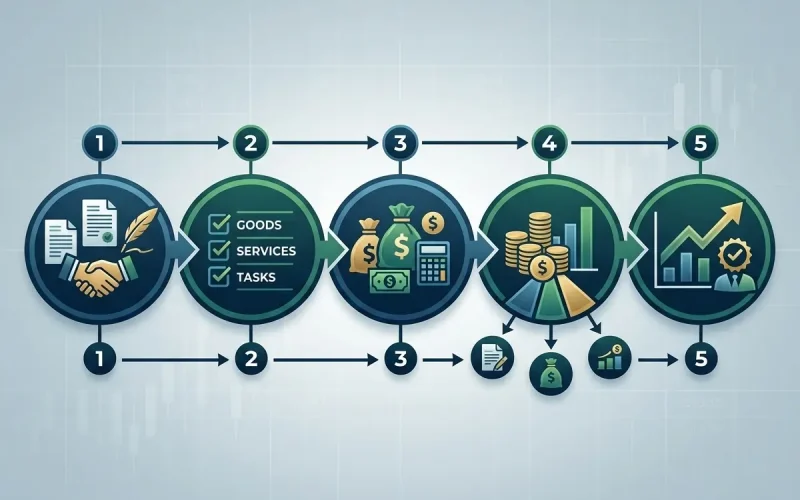
Every finance leader eventually faces the same boardroom question, Is our top line built on solid ground? The answer lives inside a disciplined, five-step framework that governs how companies recognize revenue under GAAP. This article walks through that framework in plain language, drawing on more than two decades of hands-on experience across SaaS, cybersecurity, logistics, gaming, digital marketing, and medical devices. Rather than treating the standard as a compliance checkbox, this piece frames it as an operating discipline that shapes deal structuring, forecasting, and investor trust. Readers will find a practical walkthrough of each step, real operating lessons from Series B through Series D companies, and a clear view of where finance teams most often stumble. For CFOs, controllers, and finance leaders preparing for their next audit or capital raise, this is a grounded reference for building revenue policy that holds up under scrutiny.
Why Revenue Recognition Is a Board-Level Discipline
Every founder remembers a first board conversation about revenue. The question sounds simple, yet the answer, as any experienced finance executive will admit, rarely is. Getting this right requires understanding the revenue recognition principle in its full form, not the loose version many teams start with. It is no longer sufficient to book revenue when it feels earned. It requires aligning contractual obligations, customer intent, and delivery mechanics into a rigorous five-step model. For finance leaders, this is not merely a technical exercise. It is a matter of narrative integrity with the board, the auditors, and the investors who read the numbers as a proxy for operational discipline.
Over more than twenty-five years leading finance organizations across cybersecurity, SaaS, gaming, logistics, digital marketing, and medical devices, I have watched this framework unfold in company after company, from early Series B rounds through Series D scale-ups. Without clear policies, companies overstate top line, understate liabilities, or misclassify contract assets. Worse, they erode the trust that boards and investors place in the finance function. This article walks through the five-step model under GAAP, framed not as theory but as an operating playbook that any finance leader can put into practice.
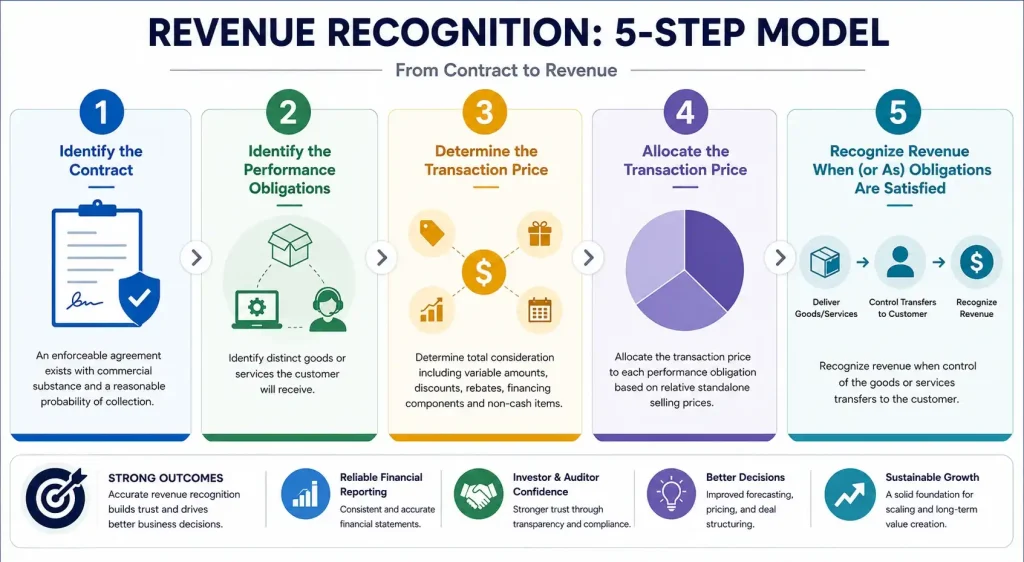
Step 1: Identify the Contract with a Customer
The word contract conjures formal documents and signatures. Under the current standard, however, a contract exists whenever there is an enforceable agreement, commercial substance, and a reasonable probability of collection. That means even a simple online purchase or a usage triggered subscription can qualify as a contract for accounting purposes.
In SaaS environments, this often includes rolling monthly commitments, click through agreements, or a combination of a master service agreement and a statement of work. In manufacturing and logistics settings, it may involve blanket purchase orders or shipment driven terms. The key task for finance is to identify precisely where performance begins and when enforceability takes hold.
Founders often ask whether a signed sales booking should immediately translate into revenue. This is the first reality check most finance teams deliver. Until a contract is enforceable and payment is probable, no recognition should occur, and auditors will expect documentation showing that these thresholds have been met.
Step 2: Identify the Performance Obligations
This step has tripped up more companies than any other I have encountered. The relevant question is not what was sold. It is what the customer actually receives, and whether those deliverables are distinct from one another.
Consider a SaaS company that sells platform access, onboarding support, and future upgrades together. Are these three separate obligations or a single bundled service? The answer depends on whether each element can be used independently and whether delivering one enhances the value of another.
A Lesson from the Field
In one engagement, a company had bundled its analytics module with its core license and initially treated both as a single deliverable. On closer review, the analytics module could operate on a standalone basis. That finding required separate revenue timing and a historical adjustment to prior periods.
Manufacturers face a parallel challenge. A hardware vendor shipping equipment alongside installation support must determine whether delivery and setup are genuinely distinct. If the installation customizes the product in a way that is integral to its function, the bundle remains whole. If not, separate obligations arise. This analysis shapes revenue timing, margin forecasting, and even how deals are structured at the term sheet stage, and it must be revisited whenever an offering evolves.
Step 3: Determine the Transaction Price
Price seems straightforward until the details arrive. The transaction price includes fixed fees, variable consideration, financing elements, and non-cash compensation. This is where finance leaders must lean heavily on modeling judgment rather than simple arithmetic.
Discounts, rebates, usage based fees, and performance bonuses all affect the transaction price. They must be estimated up front and constrained where uncertainty exists. A useful rule of thumb is to recognize only the portion of consideration that is unlikely to reverse.
I have seen a growth stage logistics platform offer volume based rebates and initially book revenue at list price. Auditors later flagged that the rebates were both probable and estimable, which required the company to rework its estimates, apply appropriate constraints, and adjust recognized revenue accordingly. For SaaS companies offering free trials or money back guarantees, an expected refund liability must also be carved out and held as a liability until certainty resolves. Boards often overlook these nuances, but investors rarely do. Getting this right is strategic, not merely technical.
Step 4: Allocate the Transaction Price to Performance Obligations
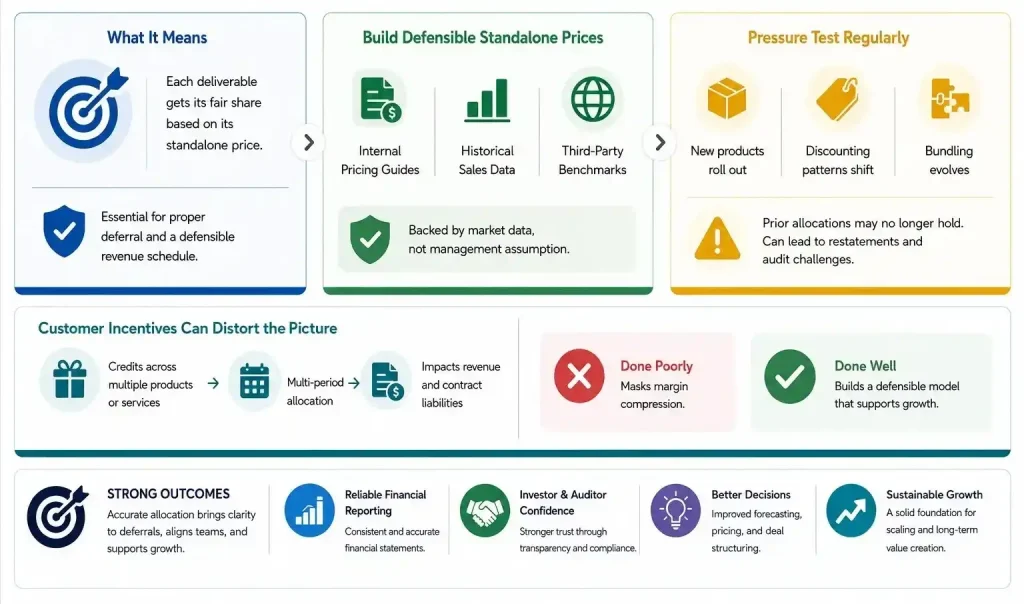
Once obligations are identified and the price determined, the next task is allocation. Each deliverable receives its fair share based on its relative standalone selling price. This may sound academic, but it is fundamental to proper deferral and to a defensible revenue schedule.
If a company sells software bundled with one year of support, and support is priced separately elsewhere in the business, the standalone selling price must be backed by market data rather than management assumption. Internal pricing guides, historical sales data, and third party benchmarks all help build that defensibility.
Finance leaders should pressure test their standalone selling price frameworks on a regular cadence. As new products roll out, discounting patterns shift, or bundling evolves, prior allocations may no longer hold. I have seen a SaaS platform forced to restate three quarters of revenue after auditors challenged its allocation between a core license and what had been treated internally as a free add on.
This step is also where customer incentives can distort the picture. If credits apply across multiple products or future services, allocation becomes a multi period exercise that affects both revenue and contract liabilities. Done poorly, it masks margin compression. Done well, it builds a defensible model that supports growth.
Step 5: Recognize Revenue When or As Performance Obligations Are Satisfied
The final step moves theory into timing. Revenue is recognized when control of the good or service transfers to the customer. That can happen at a single point in time, such as hardware delivery, or over time, such as monthly platform access or ongoing professional services.
For time based revenue, finance teams must choose between input or output measures. SaaS companies often use a straight line pattern when service is delivered evenly across the term. Others rely on usage metrics, milestones, or resource consumption to better match the economics of delivery.
When Timing Errors Compound
One Series C enterprise client used time based revenue for its licenses but overlooked variable usage charges embedded within those same contracts. When the audit began, those usage fees were reclassified onto an output basis, which required rebooking roughly $1.2 million in prior quarter revenue. The ripple effects touched EBITDA forecasts, board updates, and ultimately investor confidence in the numbers.
Professional services firms face a related decision between cost based inputs, such as hours incurred, and milestone based recognition. Construction style contracts may use a percentage of completion approach tied to resources consumed or deliverables achieved. Regardless of method, consistency and documentation remain essential to withstand audit scrutiny.
Where Most Startups Stumble
The most common mistake is treating this standard as a one time accounting project rather than a living framework. It touches the deal desk, sales compensation design, CRM configuration, and contract language. If the finance team operates in a silo, key updates get missed. If the ERP system is not properly aligned, revenue will misfire in ways that are expensive to unwind later. And if founders do not understand the downstream implications, deal strategy can quietly work against the company’s own revenue policy.
A second frequent failure is ignoring the customer’s perspective entirely. The standard centers on control, meaning what the customer actually receives and when they receive it. That view often differs from what a sales team intends or promises informally. Finance leaders must act as translators between operational language and accounting outcomes, a role I have played repeatedly across cybersecurity, gaming, and digital marketing organizations where sales velocity and accounting rigor can pull in different directions.
Using Revenue Policy as a Strategic Asset
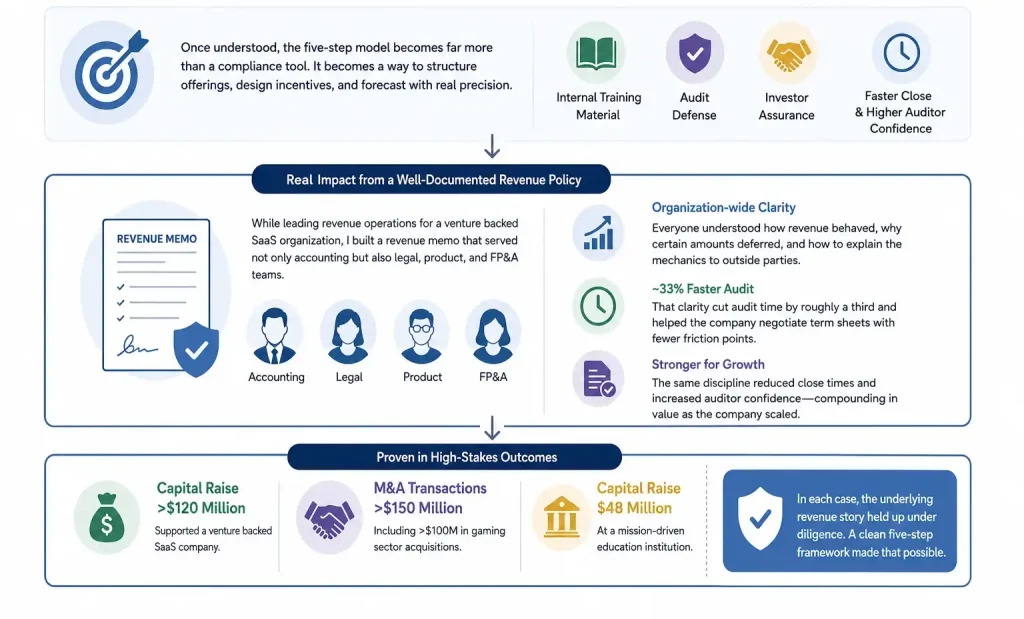
Once understood, the five-step model becomes far more than a compliance tool. It becomes a way to structure offerings, design incentives, and forecast with real precision. Well documented revenue policies serve as internal training material, audit defense, and investor assurance all at once. They also tend to reduce close times and increase auditor confidence, which compounds in value as a company scales toward larger raises or a strategic transaction.
While leading revenue operations for a venture backed SaaS organization, I built a revenue memo that served not only accounting but also legal, product, and FP&A teams. Everyone in the organization understood how revenue behaved, why certain amounts deferred, and how to explain the mechanics to outside parties. That clarity cut audit time by roughly a third and helped the company negotiate term sheets with fewer friction points. The same discipline supported a capital raise exceeding $120 million and M&A transactions exceeding $150 million across my career, including more than $100 million in gaming sector acquisitions and a $48 million capital raise at a mission driven education institution. In each case, the underlying revenue story had to hold up under diligence, and a clean five-step framework made that possible.
Conclusion
This standard rewards clarity, not creativity. It asks finance leaders to think carefully about contracts, obligations, pricing, allocation, and timing, and to document that thinking well enough to survive an audit or a due diligence process. Companies that embrace the five-step model early gain real operational alignment and stronger investor trust. They structure smarter deals, close audits faster, and forecast with greater precision, whether they operate in SaaS, manufacturing, logistics, or a hybrid product and service model. Across sectors as varied as cybersecurity, gaming, digital marketing, and medical devices, the same underlying discipline applies: revenue should reflect what the customer actually received, not simply what was booked. For finance leaders operating in venture backed or growth stage environments, this framework is not just a rule to satisfy auditors. It is a discipline that, properly built, becomes a lasting lever of strategic advantage.
Disclaimer: This blog is intended for informational purposes only and does not constitute legal, tax, or accounting advice. You should consult your own tax advisor or counsel for advice tailored to your specific situation.
Hindol Datta is a seasoned finance executive with over 25 years of leadership experience across SaaS, cybersecurity, logistics, and digital marketing industries. He has served as CFO and VP of Finance in both public and private companies, leading $120M+ in fundraising and $150M+ in M&A transactions while driving predictive analytics and ERP transformations. Known for blending strategic foresight with operational discipline, he builds high-performing global finance organizations that enable scalable growth and data-driven decision-making.
AI-assisted insights, supplemented by 25 years of finance leadership experience.