
Executive Summary
Term sheet red flags rarely announce themselves, because a short document that looks like a preliminary outline can carry provisions that quietly erode founder value, shift control to investors, and limit strategic options for years after the round closes.
This article examines 20 common term sheet red flags, split between economic traps that affect how proceeds are divided and governance traps that affect who makes decisions. For each one, it explains the risk and what founders, CFOs, and early stakeholders should negotiate instead, so that every one of the term sheet key terms supports the company’s long-term path.
Why Term Sheet Red Flags Hide in Plain Sight
Brevity masks complexity in a term sheet, and a clean deal or a high valuation can distract founders from structural asymmetries buried in a few lines of text, and the most dangerous provisions are often those that do not look like traps at first glance. Reviewing the term sheet key terms with care is therefore a matter of strategic survival rather than simple negotiation.
Economic Term Sheet Red Flags
The first group of term sheet red flags concerns money: how valuation is calculated, who gets paid first, and how much is left for founders and employees at exit.
Pre-Money Valuation Illusions and Option Pool Misdirection
A high pre-money valuation can prove a hollow victory when investors require the option pool expansion to sit inside the pre-money figure. The headline number looks generous, but the pool comes out of the founders’ stake before the new capital is counted. Founders should confirm whether the pool sits pre-money or post-money and model the fully diluted cap table both ways to see the true cost.
Participating Preferred and Stacked Liquidation Preferences
A 1x participating preferred returns the investor’s capital and then adds a pro-rata share of what remains, which can severely impair founder outcomes in mid-sized exits. In a $50M exit, an investor holding 25% with a 1x participating preference on $10M collects $10M first and then 25% of the remaining $40M, for a total of $20M. Founders should push for non-participating preferred or cap participation at 2x or a fixed amount.
The risk compounds when later investors demand senior preferences over earlier rounds. Each layer stacks on the last, and $40M of invested capital can carry $60M or more in preferences.
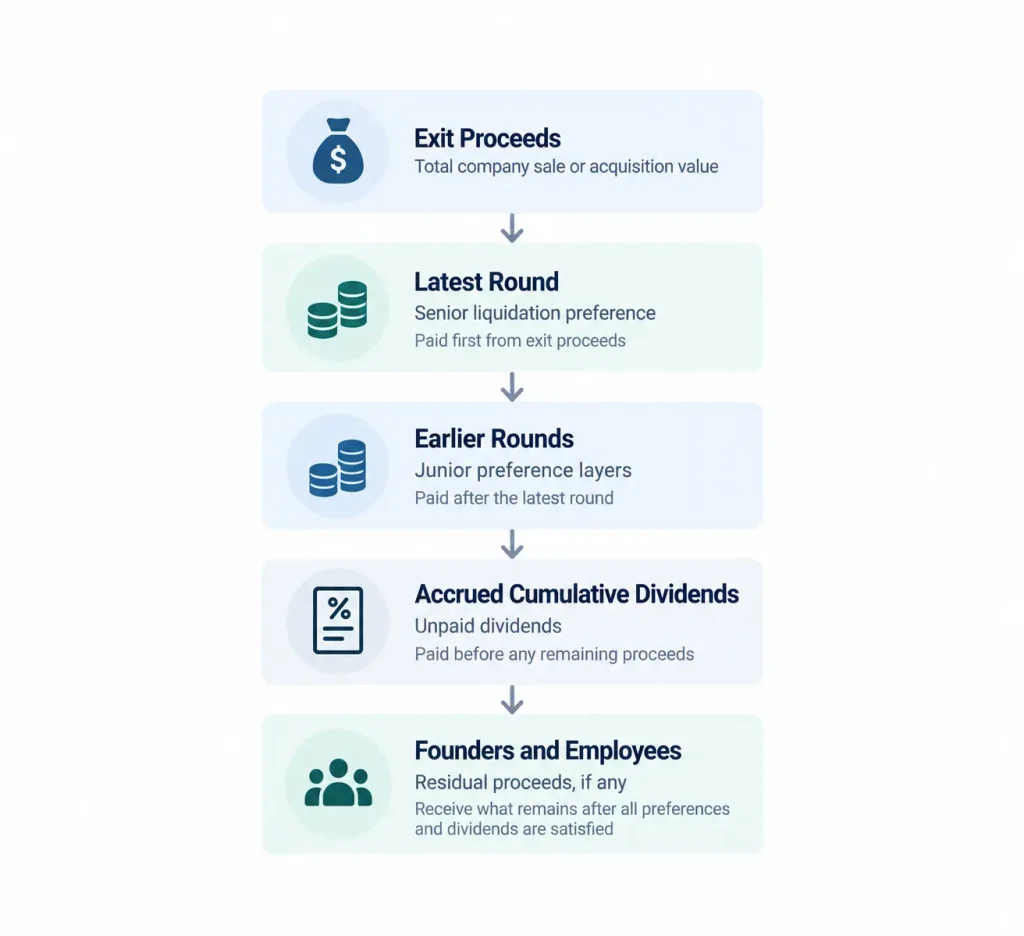
Pari passu treatment, which puts investors on equal footing, or a cap on cumulative preferences keeps the stack manageable. Raising $36.5M across Series A through C at a venture-backed digital marketing company showed how quickly preference terms negotiated in one round set the template for the next.
Cumulative Dividends and Full Ratchet Anti-Dilution
Cumulative dividends, often 6% to 8% a year, accrue quietly and must be paid before common shareholders receive anything. Compounded at 8% over seven years, a $5M investment grows to roughly $8.6M owed ahead of common. Founders should push for non-cumulative dividends, or negotiate caps and triggers if cumulative terms are unavoidable.
Full ratchet anti-dilution resets an earlier investor’s conversion price to the new, lower price regardless of how much the down round raises. If the next round prices at half the earlier level, that investor roughly doubles its share count with no new capital. Broad-based weighted average protection, which accounts for the size of the down round, offers a far more equitable alternative.
Other Economic Term Sheet Red Flags
| Red Flag | The Trap | What to Negotiate |
| Vague conversion language | Undefined SAFE or note conversion terms favor early holders or distort ownership | Define how every instrument converts, at what discount or cap, and its post-money impact |
| Oversized option pool | A 15% to 20% pool with no usage plan, with ungranted options counted as dilution | Size the pool to real hiring plans and confirm unused options revert |
| Escrow and earnout treatment | Preferred paid on gross value while common bears the contingencies | Apply preferences only to amounts actually received |
| Redemption rights | Forced buybacks after 5 to 7 years can trigger a liquidity crisis or premature sale | Remove them or make them board-discretionary with company protections |
| Tax and accounting exposure | Early exercise, 409A valuations, and RSUs create surprise tax bills or audit risk | Involve tax counsel and model real-world vesting and dilution |
Governance Term Sheet Red Flags
The second group of term sheet red flags is subtler, because power rarely declares itself. It often sits in board composition, voting thresholds, and protective provisions that gradually shift decisions away from founders.
Board Composition and CEO Replacement Rights
Founders often underestimate how quickly board control can shift. A five-person board with two investor seats, one founder seat, and two independents chosen by investors becomes investor-controlled in practice. When that structure combines with a clause allowing the board to replace the CEO, the founder’s role becomes vulnerable soon after financing. An odd-numbered board with balanced representation, jointly approved independents, and clear performance review criteria protects founder input on leadership changes. Managing board relationships and audit committee engagement during a $37M raise at a mission-driven education institution showed how much independent director selection shapes the tone of every later decision.
Supermajority Thresholds and Protective Provision Creep
Supermajority requirements for decisions such as selling the company, raising new rounds, or issuing options can hand an effective veto to a small investor block. Thresholds of 66% or 75% need calibrating so that no single investor can paralyze the company. Protective provisions also tend to expand with each round, with later investors seeking vetoes over ordinary matters such as key hires or modest debt. Founders should limit vetoes to structural decisions like a sale of the company or new preferred issuance.
Other Governance Term Sheet Red Flags
| Red Flag | The Trap | What to Negotiate |
| Founder re-vesting | Most founder shares become subject to clawback, leaving founders effectively at-will | Back-weighted vesting, acceleration, and protection against termination without cause |
| Expanded information rights | Broad inspection and audit rights drift into operational interference | Limit rights to quarterly and annual reporting |
| Future financing consent | Even small bridges or SAFEs need a full investor vote | Set thresholds, such as no vote for bridges under $1M |
| ROFR and transfer restrictions | Investors delay or block secondary sales and founder liquidity | Define timelines, pricing floors, and response periods |
| Unused option pool | The pool dilutes founders but is never granted or refreshed | Tie pool size to hiring plans and refresh only as needed |
| Drag-along without safeguards | Investors force a quick exit against founder preference for growth | Limit drag-along to bona fide, arm’s length deals at market value, with fairness opinions |
Among governance term sheet red flags, financing restrictions deserve particular scrutiny in early-stage companies. During a turnaround at an early-stage digital marketing SaaS company that cut monthly burn from $800K to $200K, speed of decision-making mattered as much as capital, and consent requirements on small financings can strip away that agility.
Reviewing Term Sheet Key Terms with a Double Lens
Every clause in a term sheet encodes a power dynamic, whether it divides wealth or allocates decisions. A high valuation paired with a stacked preference can produce hollow equity, a balanced-looking board can tilt toward investors, and a modest protective clause can become a strategic veto. Founders should review the term sheet key terms with one eye on the immediate financing and the other on the long-term path, using a short checklist:
- Model the fully diluted cap table under realistic exit values
- Test liquidation waterfalls at low, mid, and high outcomes
- Map every veto, consent right, and voting threshold
- Confirm how board seats and independents will evolve over future rounds
- Involve legal and tax counsel before signing
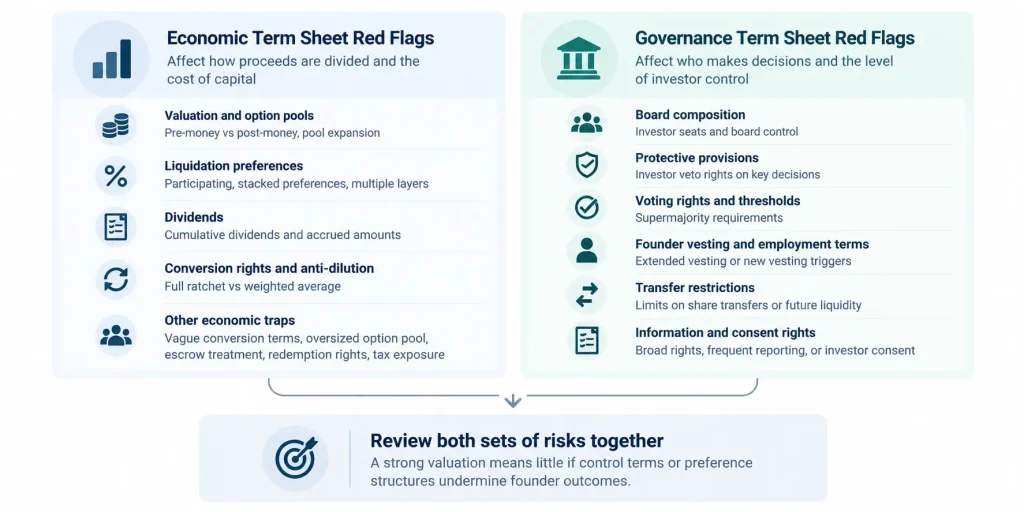
Negotiation is less about optimizing every clause and more about aligning each one with the company’s values and objectives. A founder who understands the full implications of every provision negotiates from strength rather than instinct.
Three Key Takeaways
- The most costly term sheet red flags are economic structures such as participating preferred, stacked preferences, and pre-money option pools, which can erase the benefit of a high headline valuation.
- Governance provisions, including board composition, supermajority thresholds, and expanding vetoes, shift control gradually, so founders should negotiate them as carefully as price.
- Modeling exit waterfalls and mapping every consent right before signing turns the term sheet key terms into a deliberate strategic choice rather than a surprise discovered at exit.
Disclaimer: This article is intended for informational purposes only and does not constitute legal, tax, or accounting advice. You should consult your own tax advisor or counsel for advice tailored to your specific situation.
Hindol Datta is a four-time CFO and senior finance executive with over 25 years of leadership experience across cybersecurity, SaaS, gaming, logistics, digital marketing, medical devices, consumer products, and nonprofit organizations. He has led more than $120M in fundraising and over $150M in M&A transactions while building the financial and operational systems that let complex businesses scale with confidence. He is the author of seven books in the Systems CFO Series and holds active CPA, CMA, and CIA credentials.
AI-assisted insights, supplemented by 25 years of finance leadership experience.