
Executive Summary
Behind every successful transaction sits a tax model. When it is built well, it becomes a decision-making compass. When it is built poorly, it erodes expected returns and misleads investors before the ink is even dry. Tax modeling in M&A is not simply a compliance exercise handed off after the term sheet is signed. It is an anticipatory framework connecting the target’s current tax posture to the future structure of the combined entity. It determines whether deferred tax assets and deferred tax liabilities are understood upfront or discovered too late.
This article walks through four layers that make tax modeling in M&A work in practice. These are the pre-closing tax attributes a buyer actually inherits, the post-closing structure that sets the tax future, the deferred tax reconciliation between GAAP and tax, and the scenario modeling that stress-tests every assumption before the board signs off. Each layer draws on direct advisory experience across global, multi-entity technology and public-company transactions. The goal is to ground the framework in what actually happens once a deal team starts pulling the tax file apart.
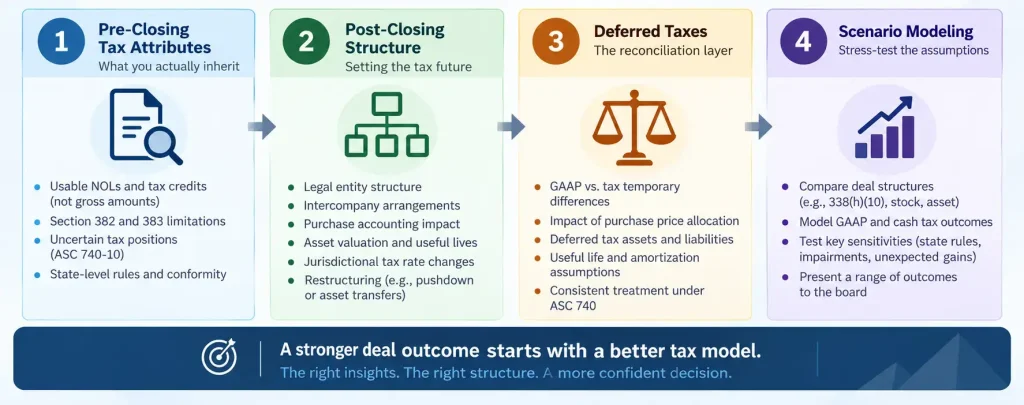
Pre-Closing Tax Attributes: What You Actually Inherit
The pre-deal tax posture of a target sets the tax base for everything that follows. This includes net operating losses, valuation allowances, and credit carryforwards such as R&D and foreign tax credits. Uncertain tax positions still sitting on the books belong on that list as well.
Headline numbers rarely survive contact with substantiation. In a diligence engagement supporting a high-growth, multi-entity technology company operating across five countries, the tax attributes on paper looked far stronger than what proved usable. Section 382 limitations and documentation gaps closed that gap quickly. A target can present tens of millions in tax assets. A buyer who takes that figure at face value can build an effective tax rate model on a foundation that will not hold.
Deal tax models must incorporate:
- The usable portion of tax attributes, not the gross figure
- Applicable limitations, including Sections 382 and 383
- Risk factors tied to uncertain tax positions under ASC 740-10
- State-level differences in conformity and utilization rules
Post-Closing Structure: Setting the Tax Future
Post-close tax planning is where value is either crystallized or quietly given away. Legal entity structure, intercompany arrangements, and financing methods all shape what comes next. Together they determine the tax base, the compliance cost, and the audit risk the combined entity will carry going forward.
Cross-border M&A execution on a Euronext Paris-listed gaming and digital entertainment company made this concrete. Operations spanned the United States, France, the United Kingdom, Singapore, and South Korea. Restructuring legal entities post-close and aligning intercompany arrangements took real modeling work. So did projecting deferred tax changes from purchase price allocation ahead of time, work that can surface meaningful net present value savings before the first post-close balance sheet closes. That kind of upfront modeling turns integration from a scramble into a plan.
Key inputs in post-close modeling include:
- The impact of purchase accounting on book and tax differences
- Valuation of stepped-up assets
- Useful life assumptions and amortization methods
- Jurisdictional effective tax rate changes
- Integration-related restructuring, including pushdown accounting or asset transfers
Deferred Taxes: The Reconciliation Layer
Deferred tax assets and liabilities exist to reconcile GAAP and tax. They translate temporary differences in income recognition into future tax consequences. That translation is sensitive to purchase price allocation outcomes and useful life assumptions, often in ways that are easy to underestimate.
Valuation modeling on an IT services acquisition made the mechanics visible. Intangible assets carrying long useful lives, valued as part of purchase price allocation, can create a deferred tax liability. That liability does not always match the pace at which the underlying revenue is actually generated. The mismatch forces a second look at amortization assumptions. ASC 740 requires consistent treatment across purchase accounting, provision-to-return true-ups, and financial disclosures. Misalignment here does not stay quiet. It invites auditor challenges and distorts pro forma earnings until it is corrected.
Scenario Modeling and Sensitivities
A tax model that only reflects one path is not a model. It is a guess dressed up in a spreadsheet. Deal tax models must flex under pressure. They should show how valuation, financing, and structuring decisions move both GAAP and cash taxes across a range of outcomes.
Multi-year financial modeling under variable funding scenarios, developed for a mission-driven education and research institution’s board and audit committee, reinforced a simple lesson. Sensitivity analysis belongs at the center of tax modeling, not at the margins. The same discipline applies to a 338(h)(10) election, a stock deal, or a partial asset acquisition. Deferred tax impacts can vary by tens of millions of dollars depending on which structure is chosen. Presenting that range to a board, rather than a single number, turns a generic debate into an informed decision.
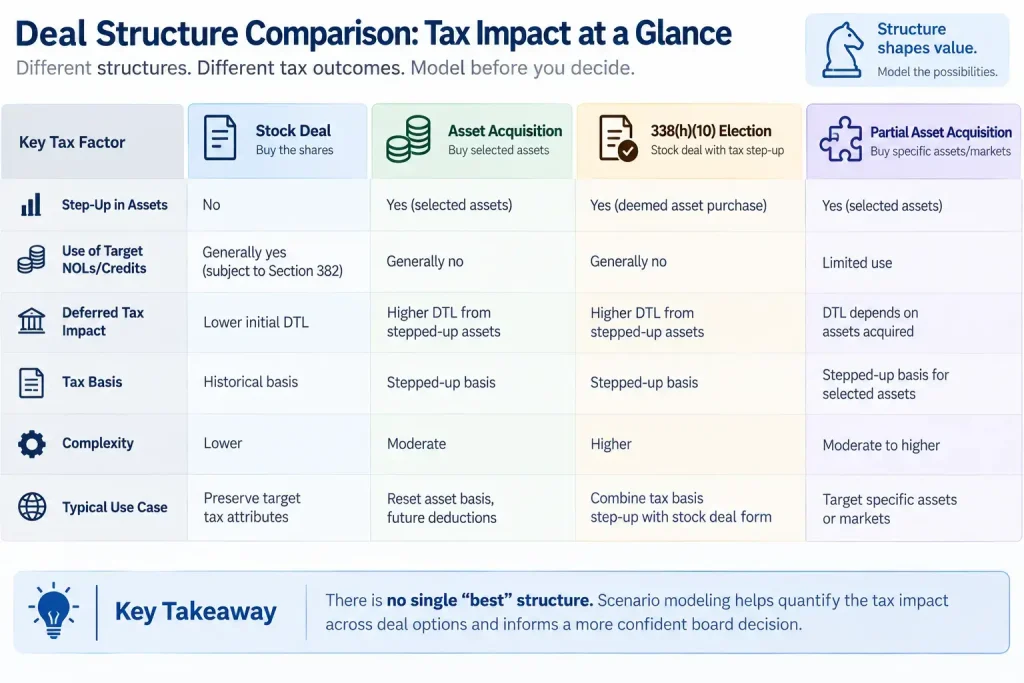
Tax models should be stress-tested against questions such as:
- What happens if state apportionment rules change
- What happens if a deferred tax liability becomes impaired
- What happens if a restructuring step triggers an unexpected taxable gain
Three Key Takeaways
1. Pre-closing tax attributes are only worth what survives substantiation. A CFO who models the gross NOL or credit balance instead of the usable portion is pricing risk incorrectly before the deal even closes.
2. Post-close structure decisions, from legal entity design to intercompany arrangements, create or destroy value long after signing. The modeling work belongs in the diligence phase, not the integration phase.
3. A tax model without scenario analysis is a static guess. Presenting a board with a range of outcomes across different deal structures produces sharper decisions than presenting a single confident number ever will.
Disclaimer: This article is for informational purposes only and does not constitute legal, tax, or financial advice. Please consult qualified advisors before finalizing deal tax structures.
Hindol Datta is a four-time CFO and senior finance executive with over 25 years of leadership experience across cybersecurity, SaaS, gaming, logistics, digital marketing, medical devices, consumer products, and nonprofit organizations. He has led more than $120M in fundraising and over $150M in M&A transactions while building the financial and operational systems that let complex businesses scale with confidence. He is the author of seven books in the Systems CFO Series and holds active CPA, CMA, and CIA credentials.
AI-assisted insights, supplemented by 25 years of finance leadership experience.