
Executive Summary
A well-built talent management strategy does not begin in the human resources department. It begins in finance. Every dollar spent on people carries the same opportunity cost, compounding potential, and risk as any other capital allocation decision. This article argues that human capital management (HCM) belongs alongside working capital, inventory, and fixed assets on the CFO’s dashboard. People are not productivity units. They are the single most powerful lever an organization has over its own future.
What follows examines a finance function that stops treating talent as an expense line. It starts treating talent as a portfolio in its own right. What follows offers a working framework for measuring trust as a leading indicator. It also lays out three concrete changes to budgeting, compensation, and forecasting. It closes with an honest look at where the model still falls short.
When a Clean Forecast Hides a Broken Talent Management Strategy
There is a particular kind of failure that a spreadsheet cannot catch. Finance leaders who have sat through a benefits redesign or a reorganization tend to recognize it the moment it starts. The numbers reconcile, the ratios hold, and the variance checks out, yet something in the building has shifted. Conversations grow more careful. Managers second-guess decisions they once made without hesitation. Nobody has technically lost a job, but the organization has severed something all the same. No accrual entry can restore it.
That gap between a clean forecast and a fraying culture is usually the first sign of drift. A talent management strategy has slipped into pure cost containment. Finance prices the labor line, HR manages the people. The two functions rarely speak the same language about what the organization is actually protecting or destroying. One high-growth cybersecurity and identity access management company had roughly $30M in annual recurring revenue. It employed more than 230 people spread across five countries. That gap showed up first in its forecasting model. The finance team tracked attrition and bench utilization as workforce ratios. Nobody connected them to the trust holding delivery teams together across time zones, not at first. The numbers stopped reporting on the past once that connection clicked into place. They started functioning as an early warning system instead.
Why Cost-Centric Human Capital Management Fails Growing Companies
Most finance leaders learn to view talent through the lens of containment: salary bands, overtime risk, benefit escalators, workforce ratios. The instinct is defensible. Payroll is usually the largest controllable expense on the income statement. A finance function that cannot forecast it within a reasonable band has bigger problems than culture. The trouble is that an organization can become very good at controlling the cost of talent while remaining almost blind to the value it is destroying in the process.
Reorganizations get celebrated for streamlining SG&A while the emotional toll of constant redefinition goes unmeasured. Payroll forecasts land within pennies of plan while institutional memory quietly walks out the door with every departure that nobody modeled. Culture gets filed under “soft,” even though it functions as one of the more durable economic moats available to a business, since a company with a magnetic culture and modest raw talent will often outperform a roster of strong resumes operating inside a toxic internal politics.
The Difference Between Controlling Headcount and Building a Talent Management Strategy
Controlling headcount is a budgeting exercise. Building a genuine talent management strategy is closer to running a capital allocation process, and the distinction shows up most clearly in how a finance team answers three questions:
- Is this dollar of workforce investment generating a compounding return, or simply covering a fixed cost?
- What is the payback period on a training, benefits, or leadership investment, and how would that be modeled if it were a piece of equipment instead of a person?
- Where are the systemic bottlenecks, such as a misaligned manager or a stalled promotion path, that are slowing the return on people the organization has already hired?
A finance chief who cannot answer those questions with the same confidence applied to a capital expenditure request is, in effect, managing human capital management (HCM) by instinct rather than by design.
Modeling Talent Like Capital: A Framework for Human Capital Management (HCM)
The shift from cost containment to capital thinking tends to start with a single uncomfortable question, often posed by someone outside finance entirely: what if workforce investment were modeled the way capital efficiency is modeled, with the same rigor applied to payback period and bottleneck analysis? That question does not reduce people to numbers. It uses numbers to surface a truth that a quarterly report rarely reveals, such as why the strongest engineers are leaving or why two departments behave like rival nations.
The Trust Ledger: Five Signals Worth Tracking
One practical response is a “trust ledger,” a set of proxies for workforce belief that can sit alongside traditional financial KPIs such as productivity per FTE, margin contribution by team, and retention cost. Five dimensions tend to do most of the work:
- Transparency Delta – how closely internal narratives at town halls and all-hands meetings align with observable outcomes such as reorganizations, layoffs, or M&A activity.
- Career Liquidity – whether internal mobility rates suggest people believe they can grow inside the organization, since declines here correlate closely with passive attrition.
- Manager Signal Strength – the time lag between a strategic direction being announced and being adopted on the ground, which reveals whether managers amplify or distort clarity.
- Recognition Flow – the density of peer-driven recognition across functions, distinct from top-down bonuses, which tends to be denser in high-performing cultures.
- Exit Sentiment Residual – a reverse net promoter score built from structured exit interviews and post-departure referral behavior.
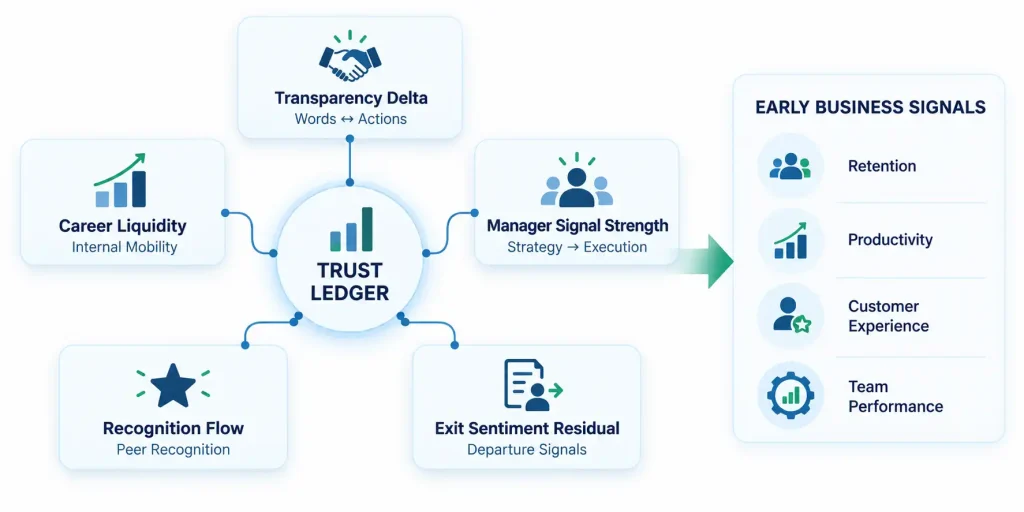
When these five signals were overlaid against financial performance in one customer service unit, a team that looked efficient on paper, with low absenteeism and strong SLA performance, showed collapsing recognition flow for several quarters before customer satisfaction dipped and call resolution time rose by 27%. A separate product team with rising trust metrics accelerated feature cycles by 40% quarter on quarter with headcount held flat, delivering a return on talent investment that ran at roughly 2.6 times the baseline once scope and budget were normalized.
Where the Financial Operating Model Meets a Talent Management Strategy
Once trust data earns a place next to financial data, three parts of the operating model tend to change.
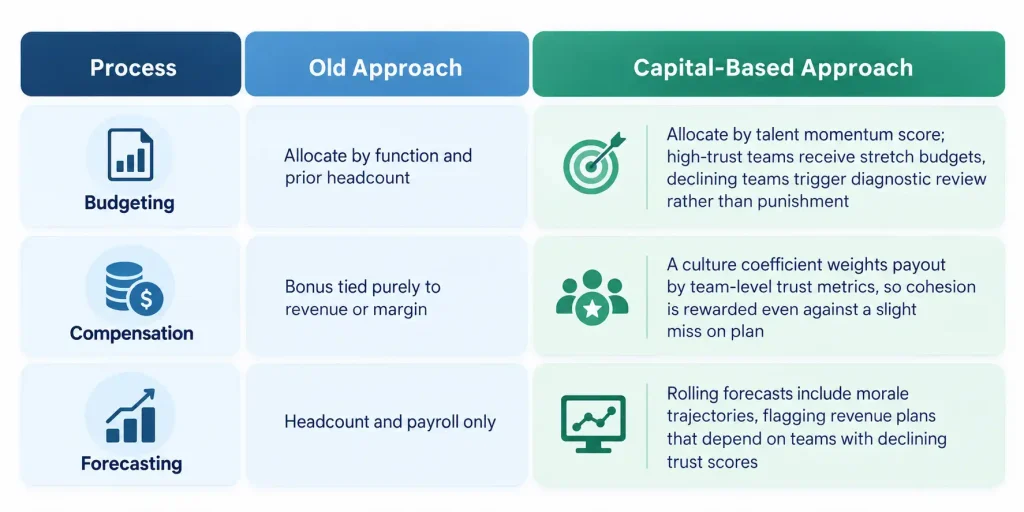
The forecasting shift tends to matter most in fast-scaling environments. In a venture-backed digital marketing organization that grew from $9M to $180M in revenue over twenty-four months, the finance function expanded from a single person to a team of twelve during that stretch, and the forecasts that held up best were the ones that treated the finance team’s own capacity and morale as a modeled constraint rather than an afterthought.
The Limits of Measuring What Cannot Fully Be Measured
None of this works perfectly, and any finance leader who claims otherwise has not run the model long enough. A trust index can look strong right up until a scandal surface that no survey captured. A team penalized for weak manager scores can rebound sharply after a single leadership change that nobody priced into the model. Sentiment sometimes lies, and silence sometimes masks strength rather than weakness.
The goal of this kind of human capital management (HCM) framework was never to define people through data. It is to see problems earlier and support teams faster, using the one language that boards and shareholders reliably understand: numbers with consequences attached to them. A finance function that treats trust metrics as infallible is making the same mistake as one that ignores them entirely.
Finance’s Role in a Modern Human Capital Management (HCM) Strategy
There is a version of finance that behaves like a gatekeeper, pruning budgets and defending variance. There is another version that behaves more like a gardener, removing friction and creating the conditions under which people either flourish or leave. The first version protects the current quarter. The second protects the compounding value of the organization’s most expensive and most reversible asset.
A finance chief who has run Finance, HR, IT, Legal, and Facilities simultaneously inside a lean mission-driven institution learns quickly that the boundary between “finance” and “talent” was always somewhat artificial, since the same capital discipline that raised $37M for that institution also had to answer for whether the people it funded felt any ownership over the mission. That is the deeper case for a talent management strategy built on capital logic: it does not ask finance to become HR. It asks finance to tell the truth about what makes an organization worth building, using the tools finance already has.
Three Key Takeaways
- A talent management strategy that treats people purely as a cost to be controlled will always miss the moment when culture starts to fray, because attrition benchmarks and time-to-fill metrics are lagging indicators dressed up as good news.
- Human capital management (HCM) becomes a genuine capital discipline only when trust proxies, such as internal mobility, manager signal strength, and recognition flow, sit next to financial KPIs like margin contribution and retention cost, rather than living in a separate HR dashboard nobody in finance reads.
- The payoff shows up in the operating model itself: budgets built around talent momentum, compensation weighted by a culture coefficient, and forecasts that treat morale as a modeled risk factor tend to catch revenue misses and retention wins months before a standard headcount report would.
Disclaimer: This article is intended for informational purposes only and does not constitute legal, tax, or accounting advice. You should consult your own tax advisor or counsel for advice tailored to your specific situation.
Hindol Datta is a four-time CFO and senior finance executive with over 25 years of leadership experience across cybersecurity, SaaS, gaming, logistics, digital marketing, medical devices, consumer products, and nonprofit organizations. He has led more than $120M in fundraising and over $150M in M&A transactions while building the financial and operational systems that let complex businesses scale with confidence. He is the author of seven books in the Systems CFO Series and holds active CPA, CMA, and CIA credentials.
AI-assisted insights, supplemented by 25 years of finance leadership experience.