
Executive Summary
Sustainability reporting has moved from a back-page gesture to a signal that investors, lenders, and customers now weigh alongside financial results. Emissions, water use, and supply chain exposure increasingly shape views on risk, resilience, and the cost of capital. That shift places the CFO, not only the sustainability team, at the center of how a company reports.
The sections ahead trace the evolution of sustainability reporting and show how to build financial-grade ESG data. They also explain how credible disclosure supports valuation and why the CFO serves as the steward of a company’s long-term story.
How Sustainability Reporting Became Financial Infrastructure
Not long ago, sustainability lived on the margins of the annual report, written in the language of goodwill instead of governance. A few pages described trees planted, donations made, or recycled inputs used. The intent was good, but the rigor of earnings reports was missing.
From Story to Signal
Capital markets, regulators, and customers changed that picture. Asset managers began to weigh emissions intensity in risk assessments, and banks linked loan terms to sustainability targets. Consumers started rewarding or rejecting brands based on how they operate. What had once been a story became a signal, and the numbers began to follow.
The regulatory landscape remains active, though increasingly fragmented by jurisdiction. The EU narrowed the scope of its Corporate Sustainability Reporting Directive through its Omnibus reforms, focusing on the largest companies. California’s climate disclosure laws continue to advance, while the SEC has proposed rescinding its 2024 climate disclosure rules. For finance leaders, the lesson is that expectations keep evolving even as specific rules shift.
When ESG Is Priced, Finance Must Own It
When markets price sustainability, finance must take ownership of it. No CFO needs to become a climate scientist to lead this work. The job is to translate emissions, water withdrawals, and labor exposure into the logic of enterprise value. The goal is not to prove the company is good; it is to prove the company is strategically credible.
Credibility in sustainability reporting comes from alignment between plans and resources. A decarbonization path should be realistic, financed, and sequenced. Finance should map climate risk with the same rigor it applies to currency or interest rate exposure. The shift from gesture to governance is complete when the sustainability report and the annual financial filing begin to tell the same story.
Building Financial-Grade Sustainability Reporting
The first wave of sustainability reporting was expressive, and the next must be decisive. It must translate carbon into cost curves and environmental risk into quantified exposure. Finance does not need to own every ESG program, but it alone knows how to make the data reliable and decision-ready.
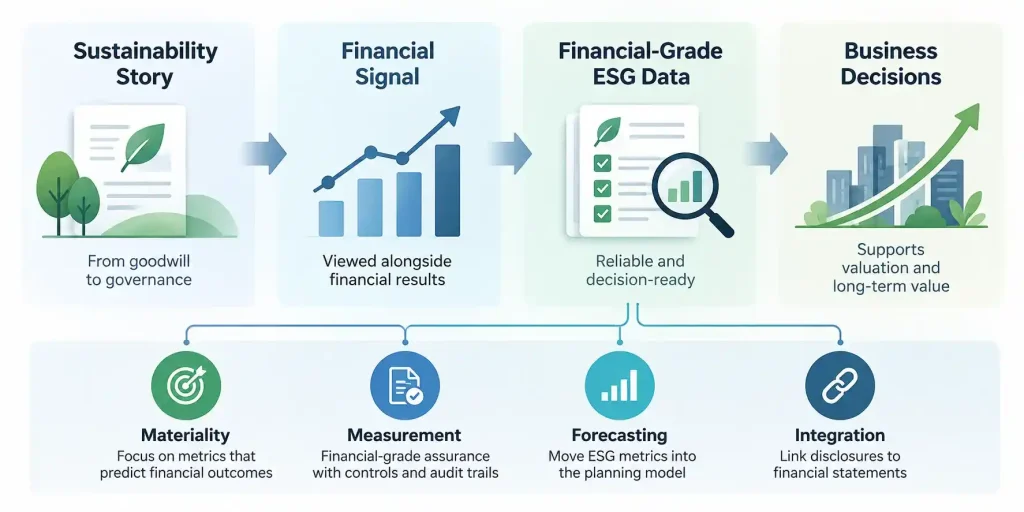
Four Disciplines for ESG Data
Finance teams should treat sustainability data as a class of economic variables, each with its own volatility, measurement error, and trajectory. Four disciplines turn that data into a decision tool:
- Materiality: focus on the metrics that predict financial outcomes for the specific business model
- Measurement: bring ESG data up to financial-grade assurance with controls, audit trails, and clear calculation logic
- Forecasting: move ESG metrics into the planning model by geography, business unit, or product line
- Integration: link disclosures to the financial statements, such as emissions cuts that tie to operating savings
Material Sustainability Metrics by Business Model
| Business Model | Likely Material Metrics | Financial Link |
| Manufacturing | Scope 1 and Scope 2 emissions intensity | Energy cost, carbon pricing, and capex needs |
| Digital services | Data center energy mix and e-waste policy | Operating cost and customer procurement demands |
| Logistics | Fleet electrification timing and regulatory corridor risk | Fuel cost, asset replacement, and route access |
| Consumer products | Supplier practices and sourcing footprint | Supply continuity, brand risk, and retailer requirements |
Measurement is where many companies fall short in their sustainability reporting. Many teams model emissions instead of measuring them, and supply chain labor data can be patchy. Controls that resemble those used for financial reporting, with sourcing, timestamps, and verification, close that gap.
A $170M global medical device manufacturer with plants in Copenhagen, Cork, and Taiwan shows why audit-grade discipline matters. Standard costing, inventory controls, and cost accounting there had to withstand line-by-line scrutiny in a heavily regulated industry. The same rigor applied to sustainability data makes disclosures far more credible.
Running Sustainability Scenarios
With this infrastructure in place, finance can model sustainability scenarios as it would any other risk. Leaders can ask what happens if carbon prices rise 30% over five years or how early emission reductions affect access to green financing. These questions belong at the core of capital allocation, not in a separate sustainability office.
Sustainability Reporting as a Valuation Lever
A common belief holds that ESG exists only to limit downside, acting as a hedge or reputational insurance. That view of sustainability reporting is far too narrow. When sustainability sits inside the financial logic of the business, it can support valuation instead of discounting it.
Clarity Investors Can Model
Investors tend to reward clarity more than they reward virtue. A company that explains its emissions trajectory alongside its gross margin strategy looks credible, and one that has costed its carbon exposure looks foreseeable. In markets that price uncertainty quickly, foreseeability becomes a premium asset.
Research from groups such as the NYU Stern Center for Sustainable Business has linked stronger sustainability performance with better financial resilience in many studies. Investors respond to how efficiently a company appears to use capital under pressure, and reporting shapes that view. Scattered, aspirational disclosures read as noise, while bounded, sequenced metrics tied to financial models make a company look like a coherent system.
A $127M global consumer products company with a supply chain spanning China and Vietnam illustrates the financial weight of supply exposure. Owning the logistics P&L across ocean freight, trucking, last-mile delivery, and warehousing meant that sourcing and transport choices flowed straight into margin. Sustainability metrics tied to those same flows give investors a clearer view of future cash stability.
Questions Investors Will Ask
Sustainability disclosures should live inside the investor narrative, referenced on earnings calls and in valuation models. If a company targets carbon neutrality by a certain year, investors will ask how much of the plan depends on capex or policy. They will also ask how it affects return on invested capital, which makes these valuation fundamentals instead of side questions.
The CFO as Steward of Long-Term Value
Every company eventually faces a deeper question about whether it is building something that will still matter in ten years. The answer does not appear in a single income statement. It lives in the continuity of purpose and in how well the business explains why it should endure.
Consistency Builds Trust
The CFO is well placed to tell this story, because capital seeks duration and investors bet on staying power. Sustainability reporting is an act of memory, showing what the company promised, what it delivered, and what it knows about the road ahead. Trust grows from consistent, rigorous disclosure more than from perfect metrics.
A Euronext Paris-listed gaming company reporting under both IFRS and US GAAP shows the value of consistent multi-framework reporting. A single, unified definition of revenue across subsidiaries in five countries made results comparable and defensible. Sustainability metrics benefit from the same discipline when standards differ across jurisdictions.
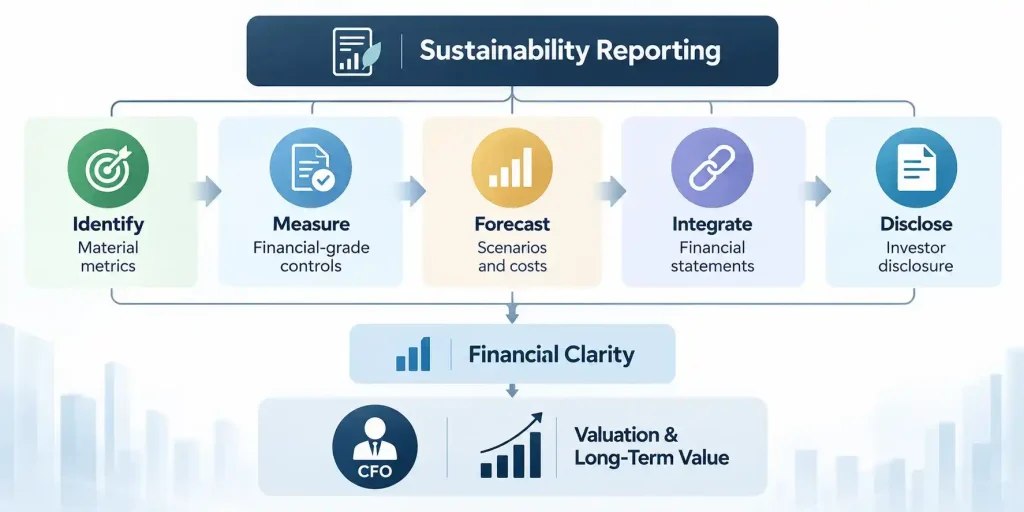
The Sustainability Reporting Cycle
| Identify | Measure | Forecast | Integrate | Disclose |
| Select material metrics | Apply financial-grade controls | Model scenarios and costs | Link to financial statements | Report consistently to investors |
When investors see sustainability modeled, funded, and governed with the same seriousness as working capital, they begin to value resilience as well as earnings. The CFO becomes the anchor of continuity, keeping the company faithful to a long-term logic as politics and regulations shift.
Three Key Takeaways
- Sustainability reporting has become a capital signal, not a branding exercise. Finance must translate ESG data into the logic of enterprise value.
- Financial-grade sustainability reporting depends on materiality, measurement controls, forecasting, and integration with the financial statements.
- Clear, consistent disclosure supports valuation by making future cash flows easier to model, and the CFO is best placed to steward that long-term story.
Disclaimer: This article is intended for informational purposes only and does not constitute legal, tax, or accounting advice. You should consult your own tax advisor or counsel for advice tailored to your specific situation.
Hindol Datta is a four-time CFO and senior finance executive with over 25 years of leadership experience across cybersecurity, SaaS, gaming, logistics, digital marketing, medical devices, consumer products, and nonprofit organizations. He has led more than $120M in fundraising and over $150M in M&A transactions while building the financial and operational systems that let complex businesses scale with confidence. He is the author of seven books in the Systems CFO Series and holds active CPA, CMA, and CIA credentials.
AI-assisted insights, supplemented by 25 years of finance leadership experience.