
Executive Summary
The succession planning meaning most people carry is an HR exercise. It involves naming a replacement for a senior role and revisiting the plan at the annual talent review. In finance, the definition carries far more weight than that. Succession planning preserves judgment, relationships, and decision rights when the people who hold them leave. A gap in any of those behaves like a liquidity event that offers no warning.
This article defines the concept in financial terms and maps critical roles by consequence. It then sets out the design and rehearsal practices that turn a plan into readiness.
Succession Planning Meaning in a Financial Context
Standard definitions describe succession planning as identifying and developing internal talent for key leadership positions. The need arises when incumbents retire, resign, or become unavailable. In finance, the purpose reaches beyond filling a chair. The chair carries reporting integrity, lender confidence, and capital allocation discipline that no spreadsheet can store.
Financial risk is usually framed around markets, liquidity, credit, and currency. The unplanned exit of a key financial leader rarely reaches the risk register. Yet it can destabilize the same system in a single afternoon. When a CFO leaves without warning, years of informal vendor agreements, unreconciled projections, and trust built with lenders leave too. When a treasurer retires, the successor inherits the accounts but not the decades of banking relationships behind them.
Why Succession Planning Belongs in Financial Risk Management
Leadership gaps behave like liquidity crises, since they arrive all at once. The abrupt departure of a finance chief can trigger a lender covenant review within 30 days. The financials have not changed, but the relationships have, and credit rests on confidence.
Most risk frameworks do not assign probability to retirement or simulate the loss of signature authority during a crisis. Key person continuity is therefore a component of financial solvency. The succession plan belongs inside the business continuity framework instead of a human capital appendix.
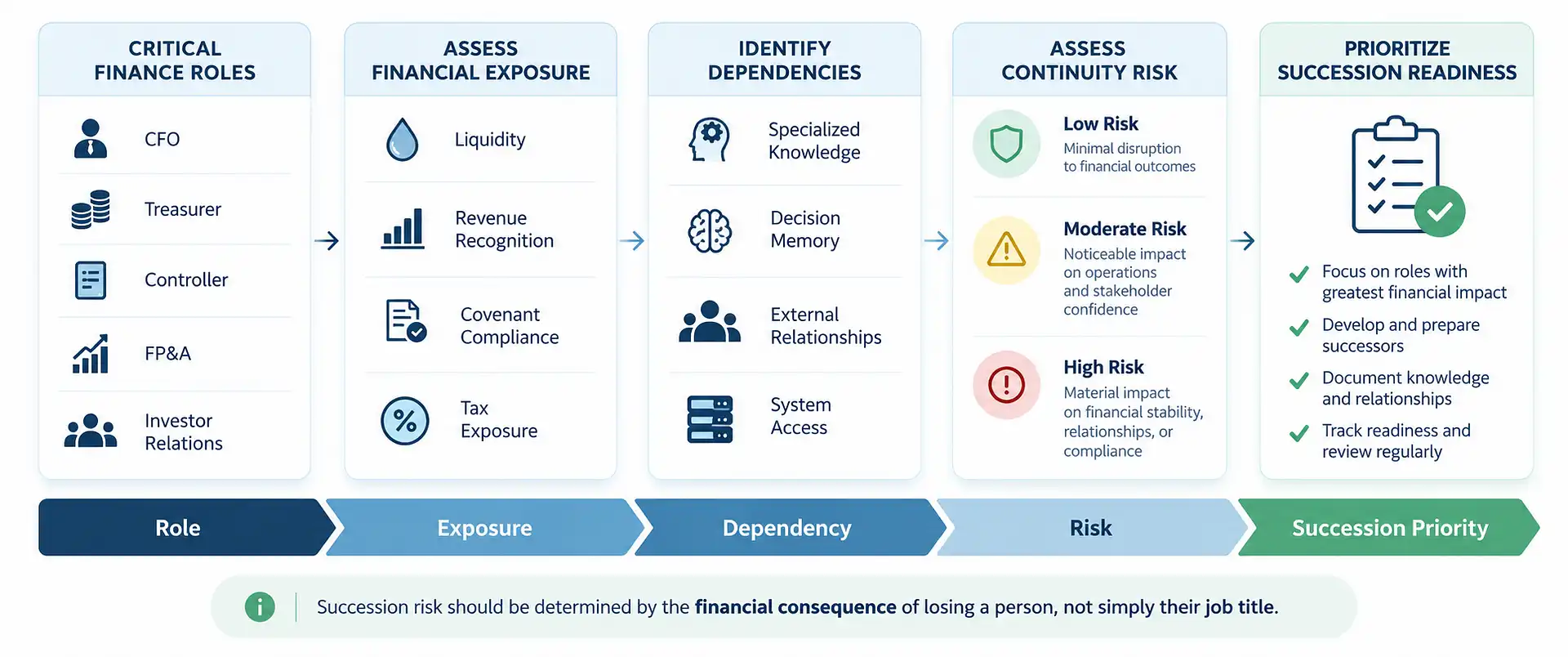
Mapping Financial-Critical Roles by Consequence, Not Title
Titles do not map to risk; exposure does. The riskiest roles are often the most central and not the most senior: the treasurer with deep knowledge of debt facilities, the controller who understands month-end close, and the finance partner who translates numbers into decisions for product and sales leaders. A controller who closes the books in five days despite legacy systems that would slow anyone else by two weeks illustrates the point, because without documentation the close can slip by nine days after that person leaves, and auditors flag new items.
Questions That Reveal Key Person Risk
Effective succession planning begins with four diagnostic questions for every critical role:
- If this person left tomorrow, what would stall?
- What would become less reliable?
- Which external stakeholders would lose confidence?
- Which internal decisions would be delayed or distorted?
Applying those questions across four functions surfaces the names that matter:
- Financial close: who owns the process and reviews consolidations.
- Treasury: who manages debt schedules, bank draws and rollovers, and liquidity lines.
- FP&A: who turns model outputs into board narratives and owns the three-year plan assumptions.
- Investor relations: who speaks the language of analysts and holds the confidence of equity holders.
The exercise reveals fragility that looks small from a distance, such as a single person with access to a debt compliance model that no one else understands, or a retiring senior manager who holds personal relationships with two rating agency contacts, a departure that can create a 90-day visibility gap and invite scrutiny.
Risk Adjacency, Bandwidth, and Decision Memory
Each mapped role is then assessed for adjacency to liquidity, revenue recognition, covenant compliance, and tax exposure, and the closer the link, the more urgent succession readiness becomes. Bandwidth matters as well: whether deputies hold partial knowledge, whether processes are documented, and whether relationships are institutional or personal, all of which determine recovery time.
A subtler dimension is decision memory, since capital allocations, lease structures, and amortization policies rest on cumulative reasoning that often lives in one head, and when that person leaves the decisions remain while the rationale fades. Documenting both what was decided and why, including the tradeoffs, creates leadership memory instead of another policy manual. In a high-growth cybersecurity SaaS company with roughly 230 employees across five countries, a documented, system-driven process compressed the monthly close from 18 days to 10, and that same documentation makes a finance role transferable instead of personal.
Succession Planning Meaning in Practice: Designing a Plan That Withstands Shock
Effective succession planning answers one question: if this person left tomorrow, would the business manage the moment or scramble to survive it? The four stages below form a cycle that repeats each quarter. Inventory, Readiness, and Rotational Exposure
- A living inventory: financially critical roles listed for risk mitigation, covering anyone whose absence would threaten reporting, liquidity, access to capital, or stakeholder confidence.
- Readiness of systems: whether the incumbent can be shadowed, decisions are documented, and access rights are shared securely.
- Rotational exposure: rising leaders own key deliverables, join external meetings, and brief stakeholders under controlled pressure, which separates inheriting a title from inhabiting a responsibility.
Internal promotion alone rarely solves the problem, since successors often know the reports but not the relationships. In a venture-backed manufacturing company where the finance function begins with a single hire, key person risk is total by definition, and building the chart of accounts, controls, and forecasting model from a blank page is the first act of succession planning, because every system created reduces dependence on one mind.
Documentation, Drills, and Psychological Readiness
Undocumented reasoning is a liability, so every forecast assumption and major judgment belongs in a decision trail written as a note to a successor. Annual continuity drills then ask what breaks, who steps in, and what gets delayed if a person is lost tomorrow, and the answers expose forgotten dependencies.
Transitions also fail when predecessors are unready to let go, since the quiet ego that prefers to be indispensable damages continuity more than any structural gap. Direct reports should be asked early who their shadow is and what that person must learn without them in the room.
Board Alignment and Quarterly Review
Boards must know who is next in practice and not only on paper. Monthly board reporting and audit committee engagement, as in a mission-driven education and research institution, show that confidence comes from seeing the bench in action, with successors presenting and depth made visible. The plan must also stay dynamic, and like financial scenario models it degrades without use.
Rehearsing the Handoff: The Final Test of a Succession Plan
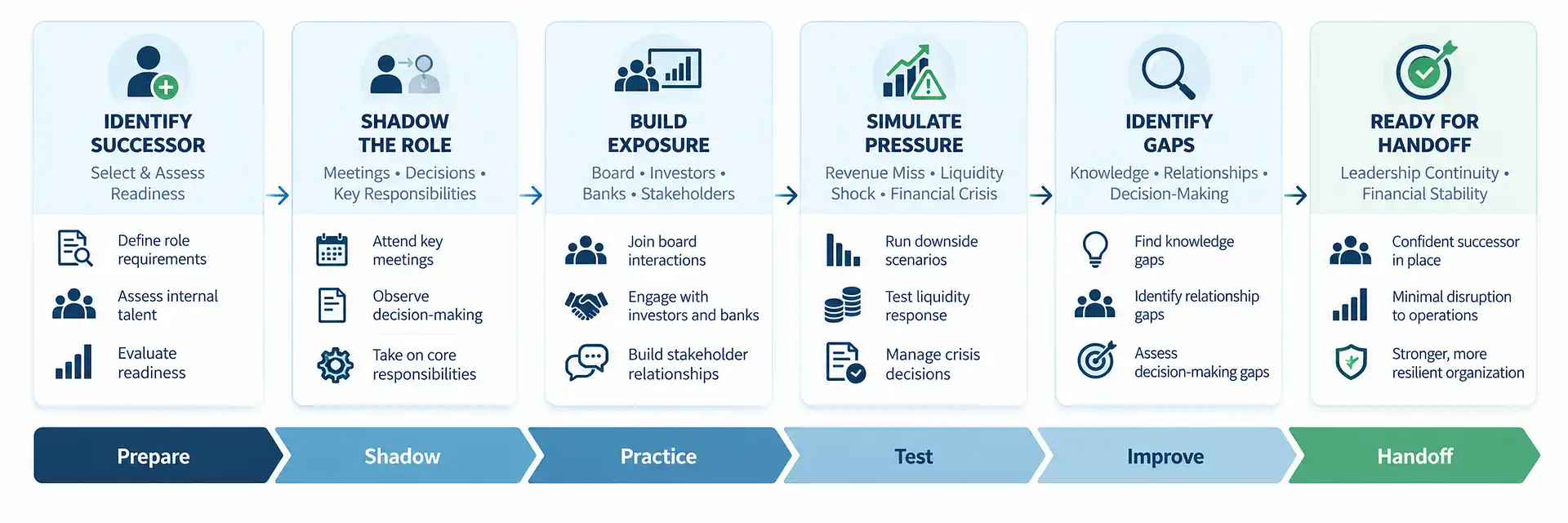
Practice reveals friction before it matters, and a six-week shadow period, in which a successor joins key meetings, drafts communications, and runs the forecast review while the incumbent CFO stays present but silent, tends to surface unchallenged assumptions, outdated review habits, and missing relationships. When the real transition arrives, it becomes a step and not an event.
Four Rehearsal Methods
- Shadow model: the successor temporarily assumes key responsibilities under the guidance of the incumbent.
- Diagnostic assignments: delivering the quarterly board update twice a year, or leading the annual budget defense while the CFO defers.
- Scenario delegation: briefing a contingency such as a 10% revenue miss in Q2 or a supply chain liquidity shock as if to the board.
- Non-technical rehearsal: fluency with investors, the trust of the executive team, and the ability to communicate uncertainty with transparency and calm.
Rehearsal forces better documentation and stronger delegation protocols, and it shows whether the current leader has prepared the bench or built a system that relies on individual knowledge. A team that practices its transitions also treats change as part of continuity, so stakeholders feel relief instead of surprise.
Three Key Takeaways
- The succession planning meaning that matters in finance is the protection of judgment, relationships, and decision rights, so key person continuity belongs in the risk framework alongside liquidity and credit.
- Map critical roles by consequence and not title, document the reasoning behind decisions, and review the inventory of financially critical roles every quarter.
- Rehearse the handoff through shadow periods, board presentations, and scenario delegation, because a succession plan that has never been tested is a document and not readiness.
Disclaimer: This article is intended for informational purposes only and does not constitute legal, tax, or accounting advice. You should consult your own tax advisor or counsel for advice tailored to your specific situation.
Hindol Datta is a four-time CFO and senior finance executive with over 25 years of leadership experience across cybersecurity, SaaS, gaming, logistics, digital marketing, medical devices, consumer products, and nonprofit organizations. He has led more than $120M in fundraising and over $150M in M&A transactions while building the financial and operational systems that let complex businesses scale with confidence. He is the author of seven books in the Systems CFO Series and holds active CPA, CMA, and CIA credentials.
AI-assisted insights, supplemented by 25 years of finance leadership experience.