
Executive Summary
Success metrics decide whether capital moves toward a company or away from it. That capital may come from investors, lenders, or grant makers. In a funding context, success metrics demand far more than a dashboard of flattering ratios. They give a CFO the evidence that leadership understands its levers and its unit economics. They also reveal the distance between what has already happened and what is likely to come next.
This article covers the metrics that carry weight in funding conversations and the narrative that explains them. It also examines the gap between trailing data and forward promises. The closing sections address the habits that build readiness and the ethics that keep numbers believable. The same logic applies to grant management, where funders now expect outcome evidence in place of activity counts.
What Is Success Metrics in Funding Decisions
In the early life of an enterprise, capital rests on belief in the product, team, and market. As the company matures and its capital becomes institutional, investors need a way to measure that belief. Strategic metrics give them that measure. Success metrics are the indicators a business defines once and applies consistently over time. They show whether a company, or a funded program, is achieving what it set out to achieve. These metrics also speak in two directions at once. Internal metrics shape hiring, resource allocation, and product bets across the operating team. External metrics justify those choices to stakeholders whose time horizons and risk appetites differ from management’s. Reconciling the two takes a rigor that borders on editorial.
Why Relevance to the Future Matters
A metric must be accurate, yet accuracy alone does not persuade, because capital is an act of anticipation. Churn rate works as a proxy for product-market fit in most funding reviews. Sales efficiency tests whether growth is repeatable or merely purchased. Cohort profitability reveals whether growth deepens value or quietly dilutes it. Too many finance teams deploy metrics as ornaments, chosen for favorable definitions and presented to deflect hard questions. Sophisticated funders look for command instead, starting with a grasp of unit economics at the segment level. They expect leadership to explain why CAC payback sits where it does. They also want a credible account of how that payback period will improve.
Core Success Metrics That Move Capital
Investors rarely ask what a number is on its own terms. They ask what it means for the future they would be buying into. With that question in mind, the following indicators carry the most weight.
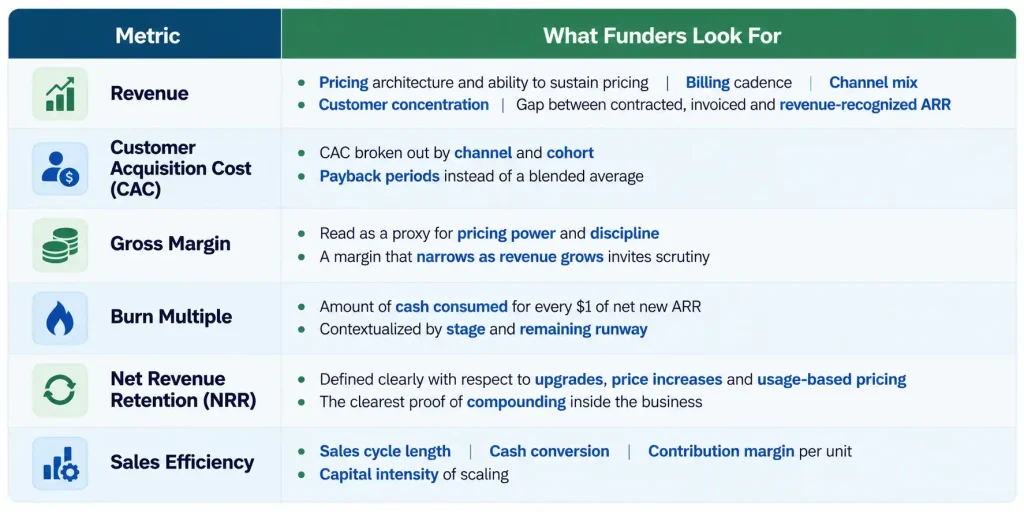
Practitioner Evidence on Unit Economics
A venture-backed digital marketing company grew from $9M to $180M in 24 months and raised $36.5M across three rounds. Its CAC, LTV, and contribution margin framework sustained investor confidence more than the growth rate itself. Finance could trace every dollar of spend to its payback. A marketplace SaaS platform raising a $20M Series B saw a similar result in diligence. Its cohort and unit economics models held up once definitions matched across the US and Polish entities.
Building a Financial Narrative Around Success Metrics
A dashboard may impress, yet the narrative behind it raises capital. Funders place trust in leadership as much as they allocate money. The CFO acts as a translator who turns figures into cause and effect. The strongest funding stories bring clarity through sequence and answer one central question. Why does this company deserve more capital now, and at this valuation?
Context Turns a Troubling Number into a Chapter
A weak CAC today becomes acceptable when the CFO can show how channel mix is shifting, how customer personas are evolving, and how automation will shorten time to value. A flattering number, by contrast, becomes suspect when its durability cannot be explained. When net revenue retention falls because low-margin accounts were pruned on purpose, and the remaining customers expand faster at higher gross margin dollars, the metric reads as a chapter and not a headline.
Clarity Over Novelty
Companies often invent bespoke measures such as adjusted GMV in the hope of standing apart, yet investors benchmark by instinct and a private lexicon tends to confuse the audience it was meant to convince. Clarity does not require simplicity, and the best narratives manage complexity, acknowledge what remains unsettled, and treat each metric as a mirror and never as a mask.
Reconciling Trailing Metrics with Forward Promises
Every metric presented in a boardroom is a lagging record of choices already made, while the ask in a funding round points forward. The investor knows that trailing twelve-month data cannot predict how a new product will land, so the request is for credibility and not certainty, meaning evidence that history has been understood well enough to serve as a base for judgment.
Growth, CAC, and Retention Under Scrutiny
A 40% two-year CAGR invites questions about repeatability, since a one-time enterprise deal tells a different story from product-led virality compounding quietly. Historical CAC summarizes what it took to win customers under past conditions, whereas funding decisions depend on marginal CAC, meaning what the next tranche of spend will cost in new segments. A 130% NRR loses predictive power if it leans on legacy customers on promotional pricing or on one module nearing saturation. Direction matters more than level, so the velocity and volatility of success metrics deserve more attention than any single figure.
Sequencing the Story
When a pricing overhaul launches in the first quarter, honest sequencing explains that churn may rise in the second, bookings may soften in the third, and cleaner LTV should emerge afterward. In a high-growth cybersecurity and identity company with roughly $30M in ARR, a driver-based forecasting engine held actuals within 5% of forecast for 8 consecutive quarters, and that record made forward projections believable. Capital fears opacity far more than it fears ordinary volatility in results.
Grant Management and the Same Evidence Standard
Grant makers apply a version of this logic. In a mission-driven education and research institution in Silicon Valley that raised $37M in equity and venture debt, multi-year models built under variable philanthropic and earned-revenue scenarios gave both donors and lenders a shared view of sustainability. Effective grant management follows the same pattern, with success metrics defined at the outset for outcomes, cost per outcome, restricted versus unrestricted use of funds, and reporting cadence, so a funder sees progress against commitments and not only spending.
Building Metric Readiness Before the Ask
Readiness without drama begins well before a raise, when success metrics become part of the internal language of the company and are discussed in channel strategy sessions, pricing reviews, and planning cycles instead of being reported after the fact.
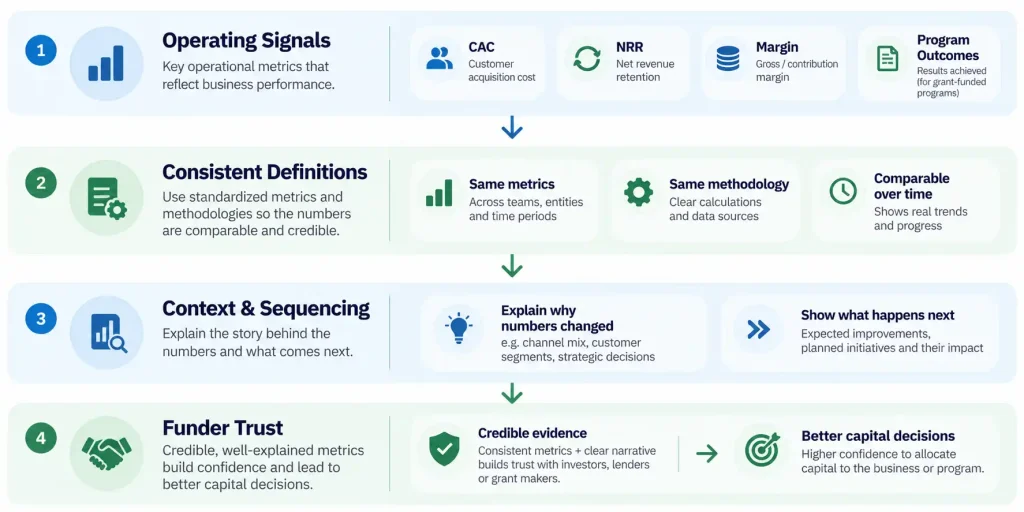
Embedding Metrics into Planning and Board Communication
Planning improves when the process opens with what the numbers say about strength and fragility, so that plans become responses and not assertions. Boards want signal and not a parade of highlights, which means bringing a metric thesis, such as why gross margin expansion reflects product modularity. Over time this builds boardroom memory, and when a raise begins the metrics in the deck are familiar because they have been lived.
The Ethics of Precision in Success Metrics
The greatest power of a metric lies in its ability to shape belief, and belief becomes an unspoken contract between a company and its capital. Drift begins innocently, with a pipeline assumption set slightly high, a churn figure cited without segmentation, or a blended CAC presented because the enterprise cohort lags. Investors tolerate imperfection but not illusion, which delays correction and, at its worst, deceives the company itself.
The CFO therefore anchors the story and does not merely sell it, asking whether the assumptions behind each number have been earned. Credibility comes from standardizing definitions across time and disclosing where leverage has yet to emerge. Capital is loyal to pattern, and pattern shows in how a company behaves when its numbers are challenged.
Three Key Takeaways
- Define success metrics once, apply them consistently across time, and tie each to a forward-looking decision, because funders reward relevance to the future far more than historical polish.
- Explain every number with context, sequencing, and cause and effect, since a difficult metric accompanied by a lucid explanation builds more trust than a strong metric left unexplained, whether the audience is an investor or a grant maker.
- Live inside the metrics daily through planning, board reporting, and grant management cycles, and hold to honest definitions, because the long-term believability of the company is worth more than any single round.
Disclaimer: This article is intended for informational purposes only and does not constitute legal, tax, or accounting advice. You should consult your own tax advisor or counsel for advice tailored to your specific situation.
Hindol Datta is a four-time CFO and senior finance executive with over 25 years of leadership experience across cybersecurity, SaaS, gaming, logistics, digital marketing, medical devices, consumer products, and nonprofit organizations. He has led more than $120M in fundraising and over $150M in M&A transactions while building the financial and operational systems that let complex businesses scale with confidence. He is the author of seven books in the Systems CFO Series and holds active CPA, CMA, and CIA credentials.
AI-assisted insights, supplemented by 25 years of finance leadership experience.



