
Executive Summary
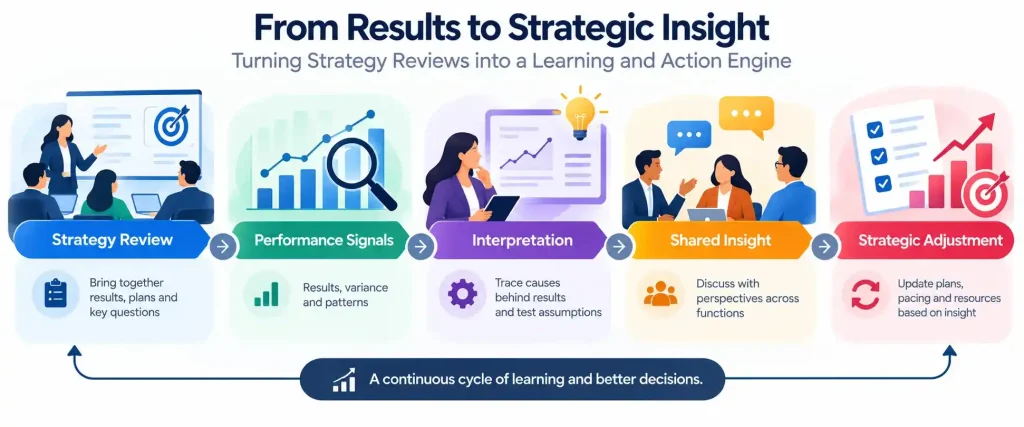
A strategy review should help leadership learn, yet many turn into polished performances that report results without explaining them. Teams present what they achieved, rationalize what slipped, and preview what comes next. When finance leads with insight instead of verification, the review becomes a forum for truth and course correction.
The sections ahead explain why so many strategy reviews feel hollow and introduce a strategic feedback loop led by finance. They also cover how the CFO can guide the conversation and build the contextual thinking that keeps strategy alive over time.
Why a Strategy Review Often Misses the Point
Some reviews tell leadership everything and teach it nothing. The decks are tight, the metrics beat targets, and headcount has scaled on plan. Yet when the final slide fades, one question hangs in the air: what did the company learn?
Performance Without Insight
Too often, a strategy review becomes a display of competence instead of an exploration of intelligence. Teams arrive to defend progress, leaders blame misses on outside headwinds, and finance only validates numbers. Behind every polished deck sit unasked questions about whether growth is repeatable, what changed in cohort behavior, and which signals the team ignored.
These questions go well beyond accounting and routine variance analysis. They require a financial presence driven by curiosity, not just accuracy, and most review formats leave no room for that kind of inquiry.
Three Long-Term Risks of a Hollow Review
When companies review strategy only to report outcomes, the damage builds slowly. Three long-term risks tend to emerge:
- Pattern blindness: early signals, such as a retention dip tied to one feature, disappear inside quarterly noise
- Planning fatigue: teams plan to survive the cycle instead of planning to learn from it
- Intellectual stagnation: leadership reviews the strategy but no longer renews it, so the business moves without adapting
The CFO becomes the counterweight by asking the second question beneath each metric. Instead of asking whether the team hit the number, the CFO asks what conditions produced the result and whether they are strengthening or decaying.
The Strategic Feedback Loop in a Finance-Led Strategy Review
The most dangerous question in any strategy review is the one nobody asks. It usually concerns what the results mean for what the company must do next. A finance leader who wants to lead strategically invites that question into the room.
From Outputs to Causes
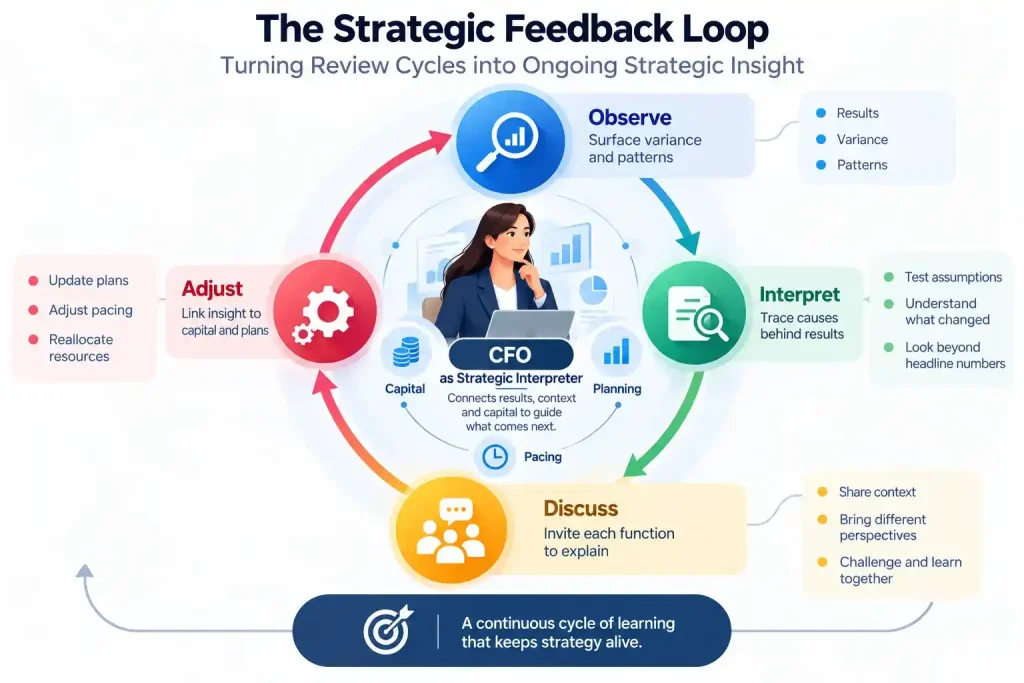
The strategic feedback loop shifts attention from what happened to what changed. Finance is well placed to lead this shift, since the CFO sees past actuals, present constraints, and future capital needs in one view. Using that vision means moving beyond observation toward disciplined questions asked in context.
Consider a quarter where revenue rises, CAC flattens, and product velocity improves. Most conventional reviews simply celebrate the beat and move on. Finance, however, may notice that two heavily discounted enterprise deals in contracting sectors drove the spike. The better question is whether that result is repeatable or masks softness in mid-market acquisition.
A professional services firm with five business units offers a useful reference point. Engagement-level profitability and utilization analytics, built from scratch, gave leadership its first clear view of where the business created margin and where it leaked. That kind of visibility turns headline results into questions worth discussing.
The Three Movements of the Strategic Feedback Loop
| Movement | What Changes | Example Question |
| Performance as signal | Variance becomes a starting point for investigation | Which assumption in the model no longer matches reality? |
| Insight as shared language | Each function helps interpret results | What shifted in buyer behavior or product usage? |
| Adjustment as habit | Insights feed directly into plans and pacing | How should hiring, pricing, or investment change next quarter? |
Over time, teams begin to anticipate this rhythm and arrive with their own hypotheses. The strategy review stops being a meeting and becomes a mirror that reflects where the company stands and what it misread.
Leading the Strategy Review as Interpreter, Not Enforcer
When the CFO enters a review as an enforcer, the room tightens and finance becomes the final stop in a compliance journey. When the CFO acts as an interpreter of variance and pattern, the room opens. Teams stop bracing for judgment and lean into understanding.
Four Disciplines for Finance Leaders
Guiding this kind of conversation requires balance between truth-telling and trust-building. Four disciplines help the CFO strike that balance:
- Pacing: curate the most revealing intersections, such as growth that collided with margin, instead of flooding the room with data
- Probing without destabilizing: treat tension between forecast and result as information, and receive honest admissions without penalty
- Linking insight to resources: turn each finding into a planning consequence, such as staging capital when hiring outpaces productivity
- Consistency: ask the same core questions each quarter so teams learn to prepare with the same lens
A mission-driven education and research institution shows how consistent review rhythms build trust. Staffing the finance and audit committees and delivering monthly and annual board reporting created a steady cadence of honest discussion. The same role included a $37M capital raise across equity and venture debt, where board confidence mattered.
Thinking in Context to Strengthen Every Strategy Review
The most powerful questions come from how a leader has listened long before the meeting. Context lets a revenue dip read as the lagging effect of a product bottleneck from six months earlier. It also lets a CAC spike read as a deliberate move into a higher-value segment instead of mismanagement.
Memory, Trust, and Emotional Calibration
A financial steward tallies results, while a strategic interpreter remembers the assumptions behind them. That memory holds the company accountable for learning speed as well as outcomes. Carving out mental space for this work is hard amid board prep, dashboards, and liquidity planning, yet it separates insightful reviews from routine ones.
A cybersecurity SaaS company with roughly $30M in ARR shows the value of this long memory. A driver-based forecasting engine held actuals within plus or minus five percent of forecast for 8 consecutive quarters. That consistency let leadership compare results against assumptions with confidence during each strategy review.
Insight in a strategy review also depends on relationships and trust. A sharp question without trust feels like critique, while the same question within trust feels like an invitation. The CFO must pace inquiry to the emotional readiness of the room, without diluting the truth.
The Strategy Review Cycle
| Observe | Interpret | Discuss | Adjust | Remember |
| Surface variance and patterns | Trace causes behind results | Invite each function to explain | Link insight to capital and plans | Carry assumptions into the next cycle |
Over time, the review cycle feels less like a checkpoint and more like a tuning session. The CFO keeps the business tuned to its strategy, not perfectly but persistently.
Three Key Takeaways
- A strategy review built only to report results creates pattern blindness, planning fatigue, and stagnation. Finance should shift the focus from outputs to the conditions that produced them.
- The strategic feedback loop treats performance as a signal and interpretation as a shared task. Each insight should feed directly into plans, pacing, and capital decisions.
- The CFO leads best as an interpreter, using pacing, consistent questions, and contextual memory to help the company review strategy honestly and adapt.
Disclaimer: This article is intended for informational purposes only and does not constitute legal, tax, or accounting advice. You should consult your own tax advisor or counsel for advice tailored to your specific situation.
Hindol Datta is a four-time CFO and senior finance executive with over 25 years of leadership experience across cybersecurity, SaaS, gaming, logistics, digital marketing, medical devices, consumer products, and nonprofit organizations. He has led more than $120M in fundraising and over $150M in M&A transactions while building the financial and operational systems that let complex businesses scale with confidence. He is the author of seven books in the Systems CFO Series and holds active CPA, CMA, and CIA credentials.
AI-assisted insights, supplemented by 25 years of finance leadership experience.