
Executive Summary
Annual planning in many companies has become a ritual of incremental adjustment. Teams extend last year’s numbers, smooth the variances, and trim bold ideas until they fit the margin. What emerges is a plan that is numerically precise yet strategically timid. In a market shaped by disruption, the annual plan must do more than balance a budget; it must extend the horizon.
This article shows how the CFO can turn annual planning from a compliance exercise into a strategic instrument. It covers time compression, the bridge from strategy to budget, process design, and the CFO as steward of long-term commitments. It also offers a three horizons framework, a staged funding model, and five design principles.
Why Annual Planning Compresses Long-Term Strategy
Every annual planning season ends with a sense of order, as targets settle and headcount maps to growth. That order, however, masks a steady compression of time. Strategic initiatives slip into next year, investments move into later phases, and ambitious ideas shrink to fit the margin. The annual plan becomes a record of constraint instead of a statement of conviction.
This compression is a design flaw, not a law of nature, and its causes are structural enough to name:
- Proximity bias: the current quarter is tangible while next year remains abstract, so plans favor what finance can measure now.
- Institutional habit: organizations become skilled at incremental delivery and cautious about bets that take years to pay off.
- Annual funding gates: long-horizon initiatives must justify themselves in short-horizon terms, and what cannot prove itself within the cycle often goes unfunded.
Making Compression Visible in the Annual Plan
The first remedy is a change of lens that places the year inside a three- to five-year arc. Which capabilities must the enterprise build, which markets must it enter, and which models must it test? Seen this way, the annual plan becomes one chapter of a longer story.
Within that arc, an underfunded product line, a market expansion stuck as a footnote, and pilots that never graduate all signal temporal distortion. The CFO should name each one and ask what the delay costs in relevance and talent, not only in dollars.
Capital Corridors and Staged Funding
Not every initiative needs full funding upfront, but every strategic initiative needs a path. A capital corridor provides one through sequenced funding gates tied to learning milestones, not financial KPIs alone. This structure keeps momentum alive without surrendering rigor.
How a Capital Corridor Releases Funding
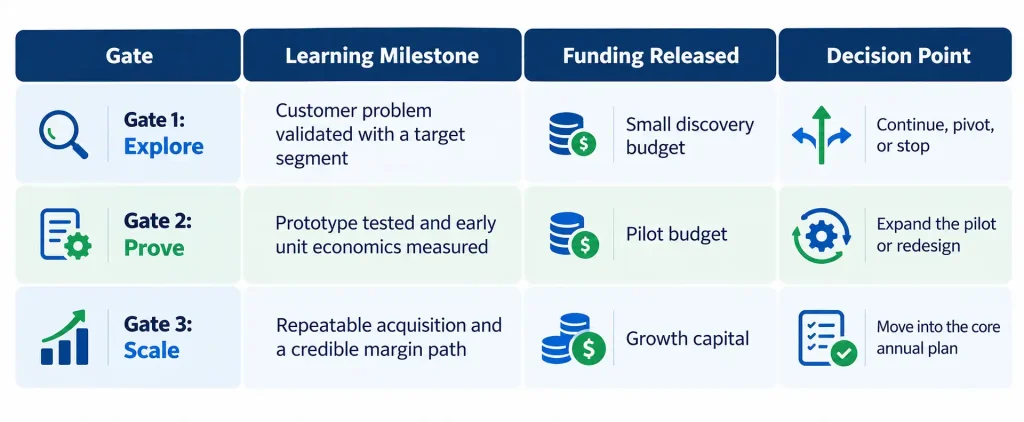
The same logic challenges the tyranny of single-year payback. A cost center today may become the margin engine three years from now, provided it survives long enough to mature. Telling incubation apart from inefficiency is a core finance judgment, and making that call well is leadership, not leniency.
Linking the Annual Plan to Strategic Horizons
Strategy is a set of intentions stretched across time, while the annual plan is a set of commitments grounded in the present. Too often, strategy arrives as a slide deck and fades once line items take over. What survives into the budget is a scattering of token initiatives.
To prevent this, the CFO must build a deliberate bridge from long-horizon objectives to near-horizon decisions. For each multi-year goal, finance should define this year’s intermediate outcomes as milestones, capability builds, or decision gates.
From Multi-Year Goals to This Year’s Milestones
| Multi-Year Goal | Outcomes Required This Year | How the Annual Plan Funds It |
| Launch a new business model within three years | Prototype the technology, explore regulatory risk, validate segments | Gated R&D and customer research budget |
| Enter three new markets | Capability mapping, regulatory diligence, and local customer research | Market-entry corridor with quarterly gate reviews |
| Reduce dependence on a legacy product line | Adjacent innovation that begins before erosion sets in | Protected allocation for adjacent growth |
At a $127M global consumer products company, finance owned both the annual operating plan and the multi-year long-range plan. Inventory turns rose from 3x to 7x through demand planning and SKU rationalization, releasing trapped working capital. Work of that kind unfolds across cycles and needs a plan that sees beyond the fiscal year.
Balancing the Three Horizons in Annual Planning
The CFO should help segment annual planning into three temporal domains, each with a distinct profile of uncertainty and return.
The Three Horizons Framework
| Horizon | Focus | Uncertainty | Return Profile | Planning Approach |
| Horizon 1: Core execution | Existing products and customers | Low | Near-term and predictable | Optimize with precision |
| Horizon 2: Adjacent growth | New segments or geographies | Medium | Medium-term | Fund with flexibility |
| Horizon 3: Transformative bets | New business models | High | Long-term and uncertain | Stage with rigor through capital corridors |
All three horizons must appear in the plan, though not with equal funding or detail. When one horizon dominates, the company becomes efficient but brittle, or ambitious but incoherent. Held in balance, the annual plan becomes a portfolio of intent.
Narrative as Part of the Bridge
Numbers alone are not sufficient, so the CFO must also explain how this year moves the company toward its future. That story anchors trade-offs and aligns teams around the reasons behind each decision. A mission-driven education and research institution faced variable philanthropic and earned revenue. There, multi-year funding scenarios let the board judge each annual budget against long-term sustainability.
Designing an Annual Planning Process for Precision and Possibility
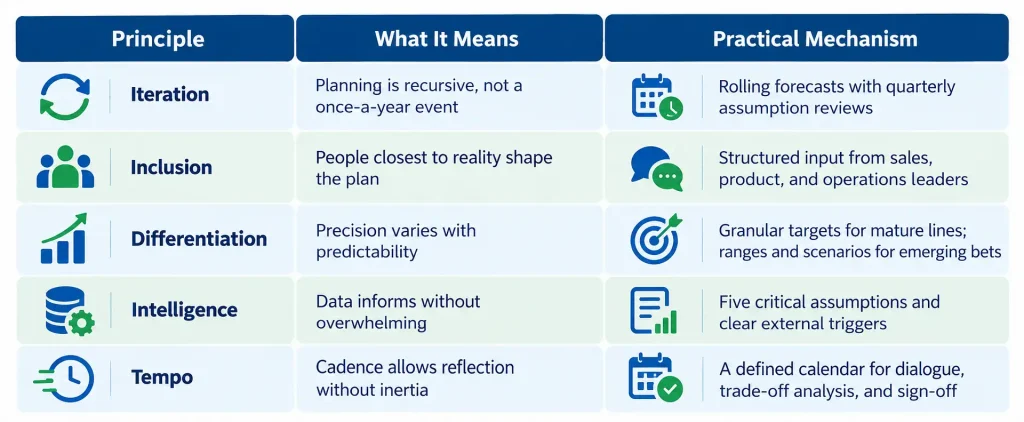
Effective annual planning must serve two forces at once: precision in forecasts and budgets, and ambition that no spreadsheet can fully capture. A plan built only for detail limits exploration, while a plan built only for aspiration loses operational grip. Either way, trust erodes, so the CFO must design the process as carefully as the content, guided by five principles.
Five Design Principles for the Planning Process
Iteration and Differentiation in Practice
Iteration strengthens accountability, because new information can update action instead of lagging behind it. A cybersecurity and identity SaaS company with roughly $30M in ARR offers an example. Its driver-based forecasting engine held actuals within plus or minus five percent of forecast for 8 consecutive quarters. Such accuracy depends on a cadence that keeps assumptions current, not frozen in January.
Differentiation matters just as much, since mature product lines can carry granular targets while emerging initiatives need ranges and scenario logic. Uniform precision imposed for the sake of control produces false confidence where uncertainty runs highest. Done well, the process becomes a strategic capability that builds trust in the numbers and the choices behind them.
The CFO as Steward of Time in Annual Planning
Time is often the most mispriced asset in corporate planning. Every financial decision is also a decision about when the future may arrive. Underinvestment in capability today becomes fragility tomorrow, and cutting R&D may protect the quarter while eroding the decade. In every cycle, the CFO should ask what must be true this year to keep the chosen future within reach.
Defending Unfashionable Investments
Some of the most important investments in any annual plan rarely make headlines or deliver immediate returns:
- Platform and systems modernization
- Data architecture and reporting infrastructure
- Sustainability and compliance infrastructure
These investments form the scaffolding for growth, and the CFO must shield them from quarterly impatience. A publicly listed gaming company operating across five countries shows the payoff. Its firmwide financial systems rollout created one definition of revenue across every subsidiary. It also shortened statutory reporting cycles under IFRS and US GAAP, a benefit that compounds over years.
Strategic Patience and Organizational Memory
Strategic progress compounds instead of arriving in step functions, and finance can often see when momentum is building or stalling. The hardest task is defending strategic patience during volatility. Retrenchment has its place, yet downturns are often when the future is cheapest to buy, as competitors pause and talent becomes available.
Through planning cycles, board updates, and internal narratives, the CFO also shapes organizational memory. A company that loses sight of its strategic intent turns reactive, while one that keeps it in view builds resilience. Every annual plan, in that sense, declares what the company will do and when it will reach its intended position.
Three Key Takeaways
- Treat annual planning as one chapter in a three- to five-year strategy, and use capital corridors to fund long-horizon initiatives through learning milestones instead of single-year payback.
- Make all three horizons visible in the annual plan, funding core execution with precision, adjacent growth with flexibility, and transformative bets with staged rigor.
- Design an annual planning process that is iterative, inclusive, and differentiated by maturity, so the annual plan earns trust as both a forecast and a commitment to the future.
Disclaimer: This article is intended for informational purposes only and does not constitute legal, tax, or accounting advice. You should consult your own tax advisor or counsel for advice tailored to your specific situation.
Hindol Datta is a four-time CFO and senior finance executive with over 25 years of leadership experience across cybersecurity, SaaS, gaming, logistics, digital marketing, medical devices, consumer products, and nonprofit organizations. He has led more than $120M in fundraising and over $150M in M&A transactions while building the financial and operational systems that let complex businesses scale with confidence. He is the author of seven books in the Systems CFO Series and holds active CPA, CMA, and CIA credentials.
AI-assisted insights, supplemented by 25 years of finance leadership experience.