
Executive Summary
Financial transparency is one of the most powerful and least used levers for building a strong corporate culture. Many companies hide burn, margins, and trade-offs to protect morale, yet that silence often breeds rumor and cynicism. When finance shares the truth with care, people begin to understand how their work fits into a larger system of consequence.
The sections ahead explore why companies fear transparency and how designed disclosure builds shared understanding. They also show how a CFO can create a lasting transparency model and why the practice depends on personal courage.
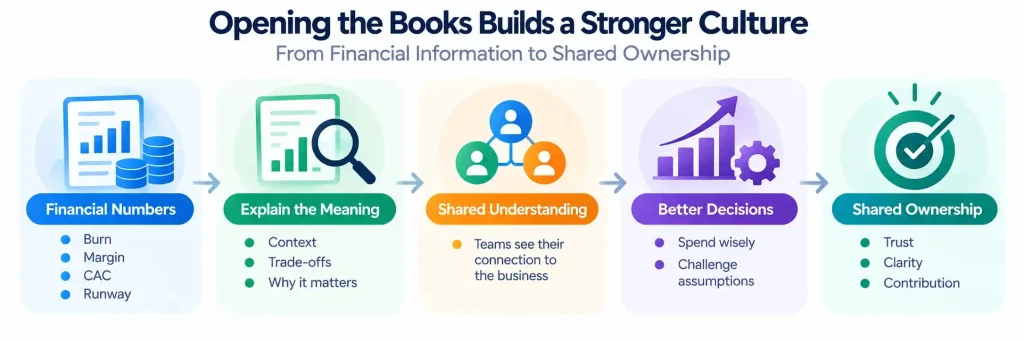
Why Companies Fear Financial Transparency
The first time a team sees the burn rate, the room changes. Some people feel a spike of anxiety, while others feel a quiet sense of pride. Nearly everyone realizes the company is a living system shaped by constraints. Many leaders avoid that moment because they fear what the truth might do to belief.
What Fills the Vacuum
Leaders who withhold numbers often hide burn under optimism and describe volatility as a growth phase. They mean to protect morale, yet they end up protecting people from understanding instead of fear. This reflects a common fallacy in corporate culture today, namely the belief that employees cannot handle the truth.
The larger damage comes from what replaces the facts. Without financial transparency, people invent explanations for slower hiring, uneven funding, or sudden strategy shifts. A new office lease suggests spending is out of control, marketing cuts suggest collapsing revenue, and a funding round suggests endless runway.
Transparency Is Education, Not Exposure
People already interpret the numbers; they simply do so with fragments and folklore. The CFO therefore needs to act as the composer of interpretation instead of the guardian of information. Done well, financial transparency reframes trust and signals that leadership believes its people can engage with reality.
An early-stage email marketing SaaS company offers a relevant example. An operational turnaround there reduced monthly burn from $800K to $200K. Changes of that scale depend on teams understanding why constraints exist, not simply being told to accept them.
Designing Financial Transparency for Shared Understanding
Effective financial transparency never happens by accident inside a company. It is not a spreadsheet dropped into a chat channel or a single candid all-hands meeting. Finance must design it for comprehension, because the value lies in the meaning people receive, not the volume of data shared.
Building Organizational Coherence
When finance teaches the numbers as a language, coherence begins to form across the company. Engineers see how runway moves with fixed cost, so a tighter hiring plan makes sense. Marketing understands what is at stake when CAC efficiency lags, and customer experience teams take pride when net revenue retention improves.
Pacing matters just as much as content in any disclosure plan. Each team should start with the truths closest to its own levers. Product might begin with cost to build, while go-to-market teams start with CAC and sales cycle friction. Disclosure that overwhelms tends to erode trust, so the CFO should curate, interpret, and leave space for questions.
Those questions become a signal in their own right. They show that people care about the business beyond their own lane. Over time, corporate culture gains less whispering and more dialogue, and that shared truth holds through pivots, downturns, and rapid scale.
Building a Financial Transparency Model That Lasts
Transparency that appears once is a revelation, while transparency that appears consistently becomes a system. The strongest companies build recurring structures of clarity instead of relying on annual reveals. The CFO designs this model to be intentional, layered, and responsive to each audience.
Four Pillars of the Model
A durable financial transparency model does not depend on one person or one meeting. It rests on four consistent pillars:
- Tiered clarity: each level of the organization sees the metrics tied to its own decisions
- Cadence: monthly updates, quarterly sessions, and function reviews keep the truth current
- Interpretation: finance explains why each number matters instead of simply pushing dashboards
- Cultural reinforcement: sharing the numbers signals respect, which people return through better decisions
Tiered Clarity Across the Organization
| Audience | What They Should See | Why It Matters |
| Executives | Cash flow, runway, margin sensitivity, and scenarios | Supports capital and strategy decisions |
| Managers | Budget adherence, ROI profiles, CAC, and payback | Connects daily choices to financial outcomes |
| Individual contributors | How their work links to value creation | Builds pride and a shared sense of contribution |
A frontline engineer does not need to parse balance sheet detail, but should understand how release velocity affects gross margin. Marketing coordinators may never see treasury operations, yet should feel the link between campaign efficiency and cash preservation. A simple monthly snapshot of burn, CAC, runway, and core metrics can spark company-wide conversation about cost per release, demand generation, and pipeline accuracy.
A cybersecurity and identity SaaS company with roughly $30M in ARR shows how steady reporting supports this model. Board-grade reporting and a reliable forecasting cadence held actuals within plus or minus five percent of forecast for 8 consecutive quarters. Predictable numbers make regular sharing far easier, because leaders are not bracing for surprises.
The Courage Behind Financial Transparency
No spreadsheet can teach the vulnerability that open books require. Even with a sound model and a clear runway, sharing the numbers can feel like exposure. Showing burn admits limits, showing margins reveals fragility, and showing variances proves that strategy rarely unfolds in a straight line.
Trusting People with the Truth
This kind of truth-telling is an executive strength, not a soft skill. It shows the company how to hold complexity calmly and invites everyone, from interns to vice presidents, into a more honest form of belonging. That belonging rests on earned confidence instead of manufactured optimism.
A mission-driven education and research institution in Silicon Valley offers a useful parallel. The CFO role there spanned Finance, HR, IT, Legal, and Facilities, which placed financial truth and people practices in the same set of hands. That combination made it natural to connect budget decisions with the experience of employees.
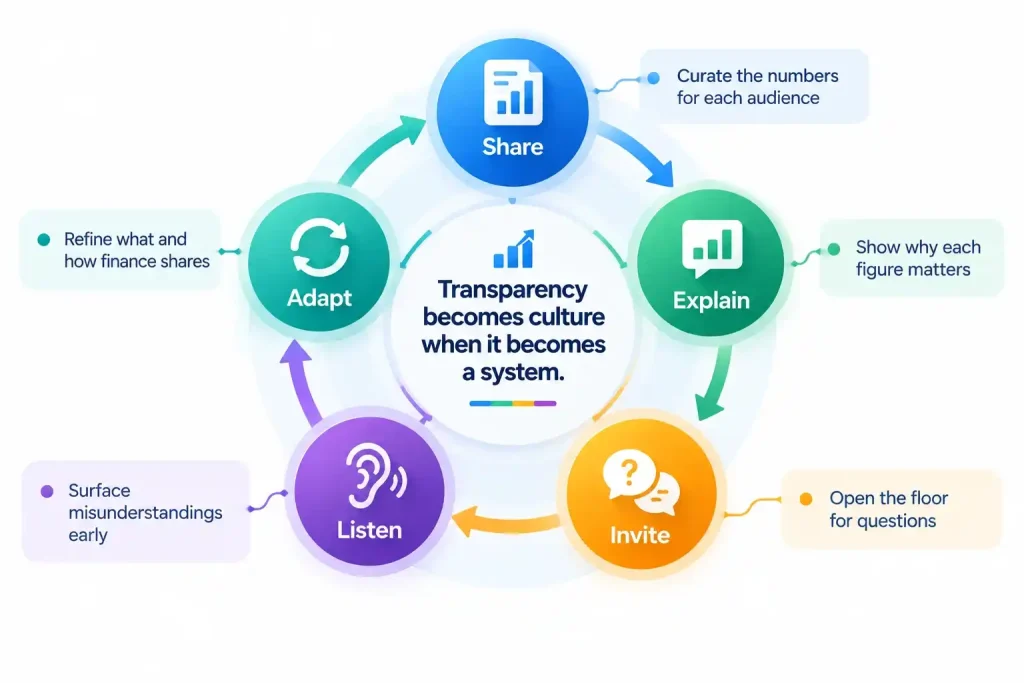
The Financial Transparency Cycle
| Share | Explain | Invite | Listen | Adapt |
| Curate the numbers for each audience | Show why each figure matters | Open the floor for questions | Surface misunderstandings early | Refine what and how finance shares |
When people see the numbers in context, they spend more wisely and challenge assumptions thoughtfully. They also treat the health of the company as a shared responsibility. The CFO must trust people with the truth before they feel ready, since that trust is often what helps them rise. Corporate culture then changes in the everyday tone of decisions, as politics fade and clarity takes their place.
Three Key Takeaways
- Withholding financial information does not protect corporate culture. It invites rumor and cynicism, while designed disclosure builds understanding and trust.
- Financial transparency works best as a recurring system built on tiered clarity, steady cadence, and clear interpretation, not as a one-time reveal.
- Opening the books requires personal courage from the CFO, and trusting people with the truth is what turns shared numbers into shared ownership.
Disclaimer: This article is intended for informational purposes only and does not constitute legal, tax, or accounting advice. You should consult your own tax advisor or counsel for advice tailored to your specific situation.
Hindol Datta is a four-time CFO and senior finance executive with over 25 years of leadership experience across cybersecurity, SaaS, gaming, logistics, digital marketing, medical devices, consumer products, and nonprofit organizations. He has led more than $120M in fundraising and over $150M in M&A transactions while building the financial and operational systems that let complex businesses scale with confidence. He is the author of seven books in the Systems CFO Series and holds active CPA, CMA, and CIA credentials.
AI-assisted insights, supplemented by 25 years of finance leadership experience.