
Executive Summary
Financial leadership means placing analytics at the center of strategy instead of using them to defend decisions already made. Most leadership teams have more dashboards than ever, yet their plans still run mainly on instinct, precedent, and narrative. The gap lies in how finance frames information, not in the numbers themselves.
The sections ahead explain why visibility alone rarely changes leadership behavior and how analytics can serve as narrative instruments. They also show how the CFO equips every executive to think in financial terms, and what temperament sustains that influence over time.
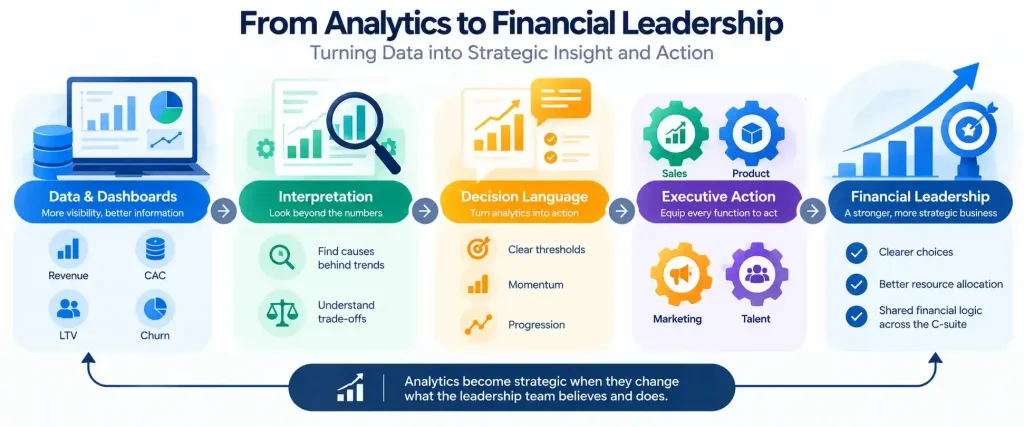
Why Visibility Alone Does Not Create Financial Leadership
Many companies assume that data abundance produces strategic clarity. Revenue funnels, churn curves, expense velocity, and hiring ratios all sit on screens in every executive meeting. Still, leaders glance at net retention, skim CAC against LTV, and leave with the same plan they brought into the room.
The Illusion of Visibility
This happens because leaders observe the numbers without integrating them. Finance builds more sophisticated systems, forecasts become dynamic, and scenario tools improve. Yet the data begins to feel like background music, present and complex but easy to ignore, while strategy keeps running on story and habit.
Four Reasons Analytics Fail to Shape Decisions
Good data often fails to change leadership behavior, and several patterns tend to repeat across companies:
- Most analytics are diagnostic instead of prescriptive, so they describe the past without pointing toward action
- Metrics often lack clear owners, leaving them detached from the levers leaders control
- Reports use financial language built for accuracy, not decision language built for interpretation
- Dashboards ignore how leaders think, which is in trade-offs, momentum, and progression instead of snapshots
Strong financial leadership therefore focuses on designing interpretation, not delivering more data. Numbers become strategic only when they change what a leadership team believes about itself.
Analytics as Narrative Instruments for Financial Leadership
Every strategy is a story, but that story needs structured proof that the vision is both credible and in motion. Most organizations separate the two, with the story living in the boardroom and the model living in finance. Financial leadership closes that gap by turning analytics into the instruments that give strategy its shape.
Building Progression Logic into Strategy
Consider a SaaS company planning to move from mid-market into enterprise sales. The market size justifies the move and the board supports it, yet strategy without proof lacks weight. Finance can frame a progression, such as enterprise CAC efficiency within 20% of the blended rate, shorter sales cycles, and margin lift from account expansion.
Each threshold then becomes a chapter in the strategic story instead of a hurdle. Once CAC converges, the company unlocks its next motion. Strategy begins to feel sequenced and earned, and analytics shift from post-mortems to chapters of confirmation.
Speaking in Decision Language
Analytics in financial leadership must also respect timing and context. A 10% revenue spike can mean different things depending on product cost maturity or quota timing. Above all, the numbers must travel in language that each leader can act on.
Translating Financial Language into Decision Language
| Financial Language | Decision Language |
| Gross margin declined 1.8% | Margin has dipped below the threshold needed to scale sales hiring safely |
| Blended CAC is up | New customers now cost more than their expected lifetime value supports |
| Unit economics drill-down for product | The threshold that unlocks the next wave of product hiring |
| Confidence intervals on pipeline | The point at which pipeline growth justifies new resources |
Over time, leaders begin to narrate their own progress in these terms. Phrases like “retention cohorts are ahead of plan” become part of the company vocabulary. The organization starts to believe its story because it is well proven, not merely well told.
How the CFO Spreads Financial Leadership Across the C-Suite
A quiet shift occurs when function heads begin to think in financial terms. A sales leader starts speaking about gross-margin contribution, a product lead references payback on roadmap choices, and a marketing head asks about CAC trends by segment. That change rarely comes from a single presentation; it comes from a CFO who teaches interpretation to every leader.
Matching Insight to Each Function’s Tempo
Influence depends on arriving at the moment when a decision is still taking shape. Sales runs on short cycles, product on long build timelines, and marketing on delayed signals. Financial insight must reach the CRO before quotas reset and the CPO while roadmap trade-offs are under debate. The CMO needs multi-quarter payback views tied to segment strategy.
A professional services firm with five business units shows the value of this tailoring. Engagement-level profitability, utilization tracking, and pipeline reporting, built from scratch across all five units, gave leaders their first clear view of margin creation and leakage. Each unit head could then act on insight tied to their own levers.
A venture-backed digital marketing company that scaled from $9M to $180M in 24 months offers a second example. Its CAC, LTV, and contribution margin framework gave commercial leaders a shared vocabulary for growth decisions. The finance team that supported this work grew from one person to twelve.
From Data Provider to Shaper of Thinking
When executives share dimensions of constraint, return, and risk, strategy becomes internally consistent without central command. Functions begin to approach finance to test assumptions, stage bets, and explore downside, because finance helps them tell the story more truthfully. The CFO teaches the mindset behind the metric, not just the metric itself.
The Temperament Behind Lasting Financial Leadership
The CFO who influences deeply often speaks sparingly. Precision matters, yet influence scales through presence, meaning the steady reliability of someone who holds complexity without panic. This temperament combines curiosity about causes with the courage to name where ambition exceeds resources.
Questions Instead of Verdicts
Strong financial leadership avoids using numbers as verdicts. Instead of saying a plan will not work, the CFO asks what must be true for it to succeed. The follow-up question is whether the team believes it can get there. Sometimes the most useful contribution is a single question, such as whether to wait for one more signal before committing spend.
A pre-Series A AI governance and assurance platform shows how modern tools support this posture. Rebuilding the finance workflow around AI tooling for modeling, reporting, and diligence compressed the time from question to decision. Faster answers gave leadership more room for thoughtful questions instead of rushed conclusions.
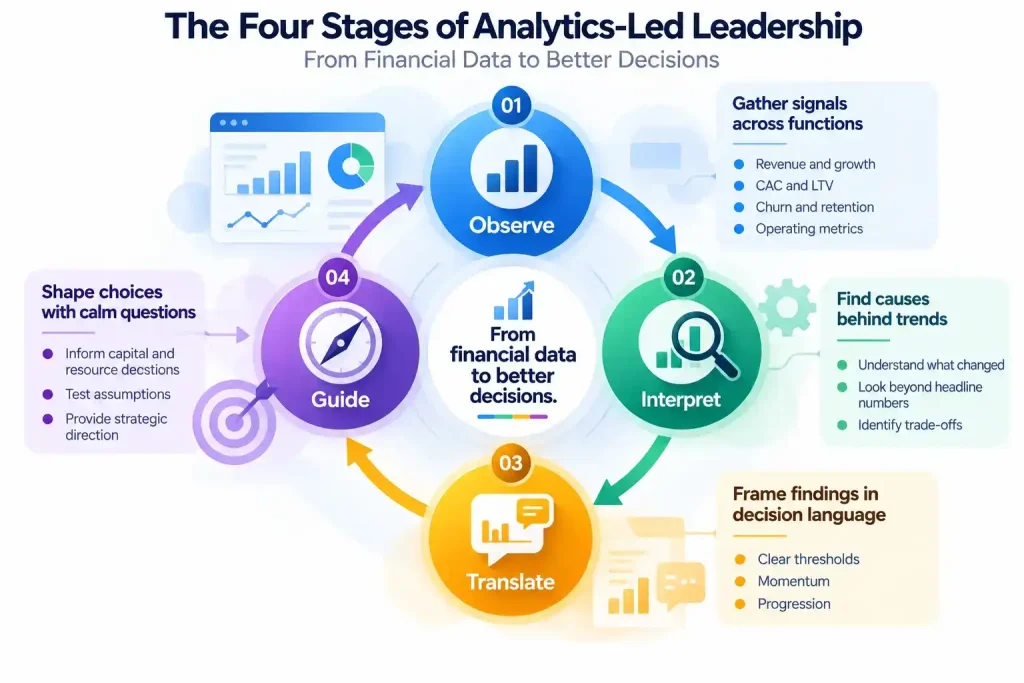
Four Stages of Analytics-Led Leadership
| Observe | Interpret | Translate | Guide |
| Gather signals across functions | Find causes behind the trends | Frame findings in decision language | Shape choices with calm, clear questions |
Trust in financial leadership grows from steady judgment, not from always being right. When that trust compounds, strategy feels steady because the company understands its risks within a shared financial logic. Carried with gravity instead of dominance, financial leadership shapes companies from the center through clarity sustained over time.
Three Key Takeaways
- Data abundance alone does not guarantee better leadership decisions. Financial leadership means designing how leaders interpret analytics, not simply delivering more dashboards.
- Analytics work best as narrative instruments that sequence strategy through clear thresholds, expressed in decision language that each function can act on.
- Lasting influence comes from timing insight to each function’s tempo and leading with questions, calm presence, and consistent judgment.
Disclaimer: This article is intended for informational purposes only and does not constitute legal, tax, or accounting advice. You should consult your own tax advisor or counsel for advice tailored to your specific situation.
Hindol Datta is a four-time CFO and senior finance executive with over 25 years of leadership experience across cybersecurity, SaaS, gaming, logistics, digital marketing, medical devices, consumer products, and nonprofit organizations. He has led more than $120M in fundraising and over $150M in M&A transactions while building the financial and operational systems that let complex businesses scale with confidence. He is the author of seven books in the Systems CFO Series and holds active CPA, CMA, and CIA credentials.
AI-assisted insights, supplemented by 25 years of finance leadership experience.