
Executive Summary
Financial milestones give a strategic roadmap the structure it needs to move from ambition to execution. Without them, deadlines drift, spending runs ahead of evidence, and the plan slowly loses credibility. When each strategic step carries a clear economic threshold, the company moves with speed, clarity, and self-awareness.
The sections ahead explain why roadmaps drift and introduce a milestone lattice that links strategy to capital. They also show how financial milestones work across product, sales, talent, and marketing, and what this approach asks of the CFO.
Why Roadmaps Drift Without Financial Milestones
Drift rarely announces itself; it accumulates quietly across the organization. A feature slips a quarter, and a hiring plan lags a month. Then a bold market launch quietly moves to the second half of the year. None of these moments alarms anyone alone, yet together they signal a roadmap pulling away from reality.
How Finance Spots the Problem First
The CFO usually feels drift in the numbers before anyone names it in a strategy meeting. Burn rises faster than ARR, headcount grows ahead of demand, and variance reports fill with reasonable explanations that never recover lost ground. The plan that once rallied the company becomes a story fewer people believe.
This is a failure of architecture, not ambition. Product plans in features, sales in pipeline, marketing in campaigns, and people teams in ratios. Each function may work with precision, but no shared financial tempo ties them together.
The Two Costs of Drift
Drift carries two costs that compound over time. First, time becomes expensive, since a launch that slips a quarter loses revenue and also the signal needed for the next funding round. Second, trust erodes as teams begin to doubt forecasts and finance becomes the department of “no.”
The fix is not more control but better choreography. A roadmap item that simply says “release in Q3” leaves too much unsaid. Stronger phrasing reads “release by Q3 with less than $2.4M spent on build and $800K on adoption.” Hiring 30 new sales reps becomes conditional on conversion above 14% and CAC under $8K.
Building a Milestone Lattice with Financial Milestones
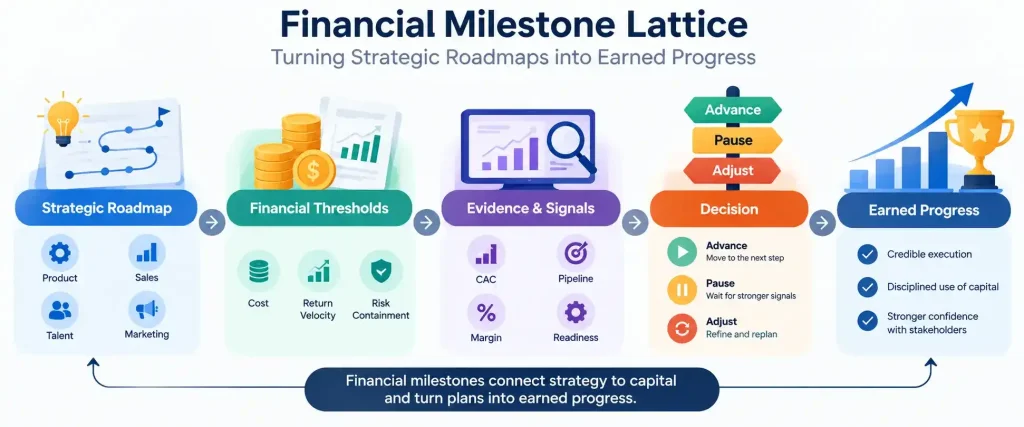
A milestone lattice turns a roadmap from a timeline into a sequence of earned thresholds. Finance and business leaders build it together, so it becomes a shared agreement instead of a top-down rule. The company advances because it has met the next economic truth, not simply because the calendar turned.
Three Things a Milestone Lattice Does
A well-designed lattice built on financial milestones changes how the whole company plans and advances. Three distinct jobs set it apart from a simple timeline:
- Converting strategy from a list of goals into a path of thresholds
- Attaching economic meaning to each threshold, including cash outlay, return velocity, and risk containment
- Building conditionality into execution so progress depends on proof, not dates
Consider a Series B company planning a European launch in Q4. Under a lattice model, the roadmap asks what must be true before launch. The answer might require $3M in weighted pipeline and a localization readiness score above 90%. It might also cap initial marketing spend at $400K and keep Net Promoter Score above 50.
Timeline Roadmap Versus Milestone Lattice
| Dimension | Traditional Timeline | Milestone Lattice |
| Trigger to advance | The calendar date arrives | Financial and operational thresholds are met |
| Handling delays | Slips accumulate without clear cost | Each delay is priced in capital and signal |
| Role of finance | Reviews variance after the fact | Designs thresholds with business leaders |
| Board conversation | Are the deliverables on schedule? | Has the company earned the next step? |
Questions That Shape Each Milestone
The CFO becomes the composer of progression instead of the enforcer of budget. Useful questions ask how much learning a milestone requires and what signal shows it is wise to proceed. Leaders should also weigh the downstream effects of a late milestone. Sometimes a milestone slips by two weeks while still meeting its economic threshold, and progress continues. In other cases a deadline arrives with CAC doubled, and the company pauses.
A pre-Series A AI governance and assurance platform shows how this thinking supports fundraising. Building the operating model, multi-year scenario analyses, and capital strategy from nothing gave the founder a clear link between milestones and the investor narrative. Each scenario tied a financial threshold to a strategic step.
How Financial Milestones Power Execution Across Functions
When a roadmap carries financial milestones at every step, each function begins to see the future as a series of earned crossings. The CFO does not turn product into accounting; the role is to help every operator think in progressions.
Product and Go-to-Market
A core feature release might require engineering capacity plus a gross margin readiness threshold, a minimum beta conversion rate, and a service readiness score. The conversation moves from whether the team can ship to whether shipping now makes economic sense. Sales milestones take the form of costed pipeline by region, ramp speed by rep cohort, and payback periods tied to headcount plans.
A venture-backed digital marketing company that scaled from $9M to $180M in 24 months illustrates the value of this discipline. Its CAC, LTV, and contribution margin framework supported $36.5M raised across three funding rounds. Clear economic checkpoints helped each round rest on proof instead of promise.
Talent and Marketing
Hiring under financial milestones becomes gated by output, not by calendar aspiration. An R&D expansion might depend on a 20% reduction in build cost per feature. A customer success ramp might require evidence of automation savings first. Marketing campaigns become investments that must deliver lead quality above a modeled conversion threshold, with CAC held within 15% of plan.
A cybersecurity SaaS company with roughly $30M in ARR and more than 230 employees shows how gated hiring works in practice. A capacity model and an optimized mix of employees and subcontractors kept bench utilization under five to seven percent during rapid growth. Hiring followed demand signals instead of running ahead of them.
The CFO as Composer of Strategic Progress
Leading through financial milestones requires the CFO to carry the roadmap as an internal rhythm, not a document to police. The average CFO enters a roadmap meeting as a voice of feasibility, while the excellent CFO arrives as a co-author of progression.
Three Capabilities That Matter Most
Leading this way asks more of a CFO than technical skill. The approach rests on three capabilities that go beyond financial modeling:
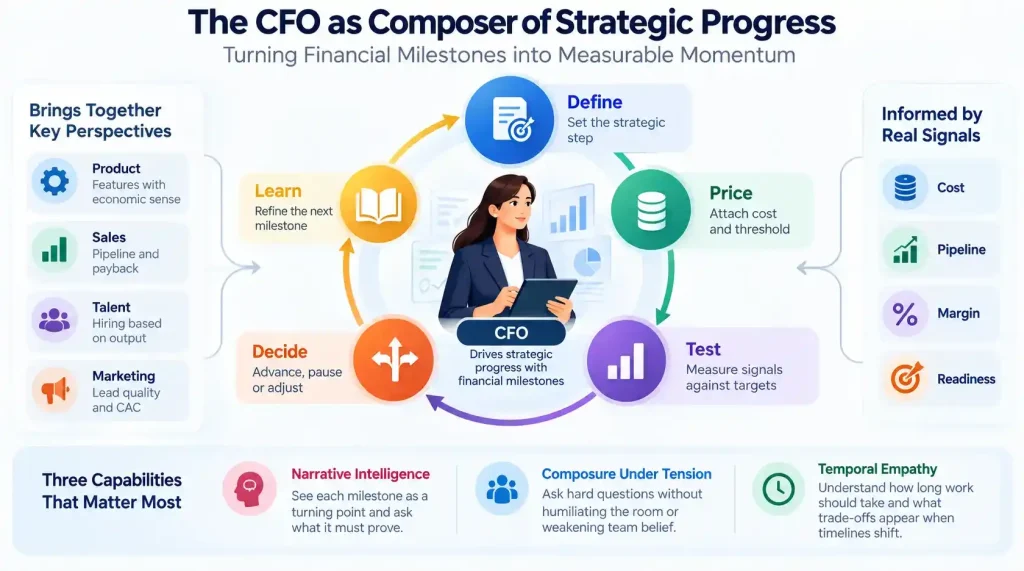
- Narrative intelligence: seeing each milestone as a turning point in the company story and asking what it must prove
- Composure under tension: asking hard questions without humiliating the room or weakening team belief
- Temporal empathy: understanding how long work should take and what trade-offs appear when timelines shift
When teams hear that a product is “90% ready,” a composed CFO hears technical debt, onboarding cost, and pressure on customer success. That insight turns into scenario ranges and runway implications, shared without fear or pride.
The Financial Milestones Cycle
| Define | Price | Test | Decide | Learn |
| Set the strategic step | Attach cost and threshold | Measure signals against targets | Advance, pause, or adjust | Refine the next milestone |
When the company sees that finance understands its progress in financial, temporal, and operational terms, resistance fades. Teams begin to rely on finance for framing as well as funding. A milestone then acts as a mirror, showing the company who it is becoming and whether it is ready for the next step.
Three Key Takeaways
- Roadmaps drift when functions plan in isolation without a shared financial tempo. Financial milestones connect every strategic step to cost, signal, and capital.
- A milestone lattice advances the company based on earned thresholds instead of calendar dates, letting execution flex without losing discipline.
- Financial milestones work best when every function uses them, and when the CFO leads with narrative intelligence, composure, and a clear sense of timing.
Disclaimer: This article is intended for informational purposes only and does not constitute legal, tax, or accounting advice. You should consult your own tax advisor or counsel for advice tailored to your specific situation.
Hindol Datta is a four-time CFO and senior finance executive with over 25 years of leadership experience across cybersecurity, SaaS, gaming, logistics, digital marketing, medical devices, consumer products, and nonprofit organizations. He has led more than $120M in fundraising and over $150M in M&A transactions while building the financial and operational systems that let complex businesses scale with confidence. He is the author of seven books in the Systems CFO Series and holds active CPA, CMA, and CIA credentials.
AI-assisted insights, supplemented by 25 years of finance leadership experience.