
Executive Summary
The CEO-CFO partnership shapes strategic execution more than any other relationship, yet many companies reduce it to handoffs. When the CEO sets the vision and finance simply models it afterward, strategy drifts away from what the business can fund.
Moving the CEO-CFO relationship from a transactional rhythm to a co-creative one depends on four shifts. These include rethinking the legacy model, adopting a new operating design, executing well under pressure, and honoring an emotional contract of trust.
Why the Traditional CEO-CFO Relationship Falls Short
The CEO-CFO partnership never appears as a line item, and no org chart fully captures it. It works more like a covenant, often wordless and sometimes strained, yet essential to everything the business attempts.
The Split Brain Between Strategy and Feasibility
A strategic CFO gives shape to the CEO’s ambition without letting it drift into delusion. A CEO sees what could be, and the CFO asks what must be true for it to happen. Execution begins in the tension between possibility and constraint.
Legacy structures rarely let that tension do useful work. Built for linear growth and scarce capital, the traditional model casts the CEO as visionary and the CFO as restraint. A vision arrives fully formed, and finance receives a request to model it. What follows is a split brain, with strategy divorced from feasibility and velocity misaligned with solvency.
Designing a Co-Creative CEO-CFO Partnership
In every durable company, the CEO-CFO partnership eventually shifts from opposition to orchestration and from gatekeeping to co-creation. The CFO stops waiting for an invitation into strategy, and the CEO stops assuming vision must precede finance.
From Sequence to Synchrony
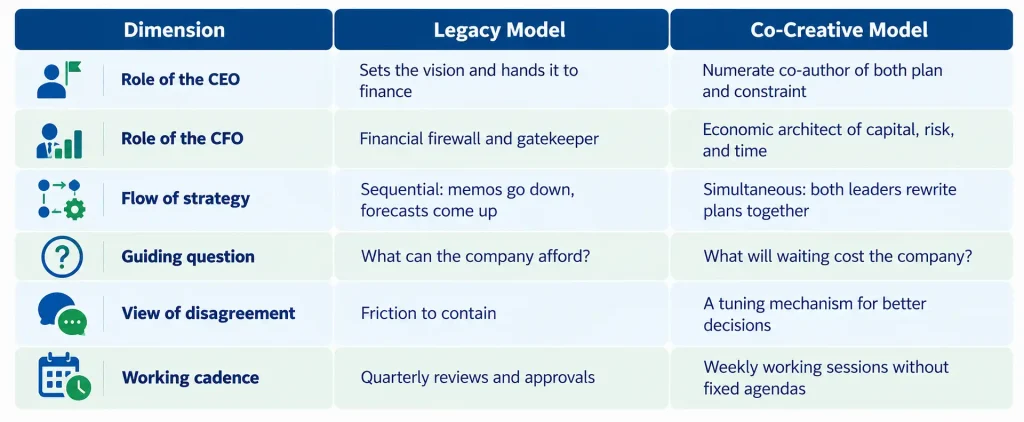
Under the old architecture, the CEO owns the what and the why, while the CFO enforces the how and the when. In a co-creative model, those distinctions blur because both roles deepen, not because discipline disappears.
A numerate CEO grows curious about the texture of financial metrics and sees finance as an ally of growth. A strategic CFO learns the narrative arc of the company’s ambition, not only its levers and limits. Instead of asking what the company can afford, this CFO asks what waiting will cost.
Legacy Model Versus Co-Creative CEO-CFO Partnership
When Conversation Replaces Process
A mid-stage technology company scaling into international markets is often led by a product-minded founder and a disciplined CFO. Strategy memos flow downstream to finance, and forecasts return upstream for approval. Growth eventually stalls, not for lack of opportunity but because capital fails to reach the places where strategy lives.
The fix is rarely a new process but a weekly conversation without a fixed agenda, where both leaders rewrite plans together. Those sessions work best when both leaders examine the same questions through different lenses:
- What does great look like for this initiative?
- How long can the company fund this bet without clarity?
- Which early signals matter most, both financial and behavioral?
Over time, both leaders stop translating and start improvising. Budgets arrive with context, and pivots come easier. At a cybersecurity and identity access management company spanning five countries, this predictability held actuals within 5% of forecast for 8 consecutive quarters.
For the CFO, this model means moving from financial firewall to economic architect, composing capital into narrative, risk, momentum, and time. For the CEO, it means accepting that strategy is made of numbers and that modeling disciplines the dream instead of diminishing it. In enduring companies, both leaders face the unknown and agree on why to build, how to fund, and when to stop.
How the CEO-CFO Partnership Drives Strategic Execution in Real Time
Sometimes the future arrives without warning, as a key customer churns or a funding round falls short. The strategic plan, so carefully modeled, turns upside down overnight. These moments, not the quarterly review, reveal the true strength of the CEO-CFO partnership. Strategy rarely fails in principle, since it fails in execution, and execution is a coordinated response instead of a department. A great CEO-CFO partnership does not agree more often than others, but it decides better under pressure.
Deciding Together When the Model No Longer Holds
A global SaaS company committed to a land-and-expand strategy in a new vertical faces a familiar test. Early signals look promising, yet the cash runway is tight and investors are circling. The CEO has seen traction in customer meetings and wants to keep going. Meanwhile, the CFO sees a burn rate running hot and a model that no longer holds.
In a legacy dynamic, one pushes and the other pulls, and the company contains risk but loses momentum. A practiced partnership sits down without slides or advisors and asks different questions:
- What if hiring slows while product resourcing stays intact?
- Which signals must the company validate before the next raise?
- Which metrics matter most now, not to prove success but to de-risk belief?
Reworking the capital plan in real time, the two leaders co-compose a response instead of settling for compromise. Budget can shift within a week, and the investor narrative can move toward learning velocity. Even if the bet fails, the CEO-CFO partnership holds because it has already proven itself through conduct. A similar discipline cut monthly burn from $800K to $200K at an early-stage email marketing technology company.
The CEO-CFO Partnership Across Core Business Decisions
Across every major decision domain, a strong CEO-CFO partnership changes the question leaders ask.
Where the Partnership Changes the Question
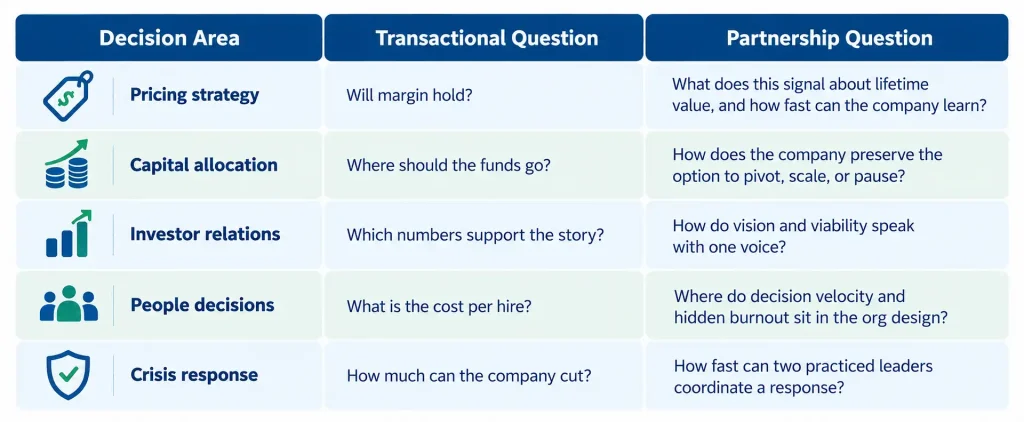
At a $127M global consumer products company, this approach to capital allocation showed up in working capital. Inventory turns more than doubled from 3x to 7x, releasing trapped cash through demand planning and SKU rationalization. At a publicly listed gaming company, one definition of revenue across every subsidiary gave investors a consistent story.
The Emotional Contract Behind a Strong CEO-CFO Partnership
There is a moment, usually unrecorded, when a CEO turns to the CFO for honesty instead of numbers. A launch is faltering or a thrilling bet now feels uncertain, and the room needs integrity more than intelligence.
This emotional contract appears in no governance charter and on no KPI dashboard. It is an unwritten agreement between both leaders to share the truth, face doubt, and disagree with care. Trust of this kind accumulates slowly, through returned calls, prepared meetings, and honest admissions of uncertainty.
The Hidden Cost of CFO Silence
Many CFOs hesitate to step fully into this side of the CEO-CFO partnership, not for lack of skill but for fear of the cost. The concerns they carry tend to sound familiar:
- Telling the CEO the full truth might damage the relationship.
- Open disagreement could earn the label of obstructionist.
- Raising a red flag may turn the CFO into the problem.
The true cost, in practice, lies in the silence those fears produce. Polite, analytical CFOs who stay out of the real rooms earn respect but never shape direction. The CEO then walks alone until the numbers betray an optimism nobody challenged.
Disagreement as Collaboration at Its Highest Fidelity
A CEO does not need a second voice that echoes the first, but one that sharpens it. That voice buys time when the plan is early and helps correct course when it is wrong. In return, the CFO needs a seat beside the company’s ambition, shaping the first draft and not only the edited release.
Disagreement without rupture or ego defines this contract, and trust turns it into the deepest form of collaboration. When the CEO-CFO partnership works at this level, strategy stops being a deck and becomes a drumbeat. The organization no longer hears two voices, because it moves to the rhythm of one mind where discipline makes vision real.
Three Key Takeaways
- Replace sequential handoffs with co-authorship, because a CEO-CFO partnership built on weekly working sessions keeps capital flowing to where strategy lives.
- Build decision muscle before a crisis, since leaders who practice shared judgment in quiet quarters can shift budgets within days.
- Treat honest disagreement as a core duty of the strategic CFO, because trust, truth, and courage turn a CEO’s ambition into disciplined execution.
Disclaimer: This article is intended for informational purposes only and does not constitute legal, tax, or accounting advice. You should consult your own tax advisor or counsel for advice tailored to your specific situation.
Hindol Datta is a four-time CFO and senior finance executive with over 25 years of leadership experience across cybersecurity, SaaS, gaming, logistics, digital marketing, medical devices, consumer products, and nonprofit organizations. He has led more than $120M in fundraising and over $150M in M&A transactions while building the financial and operational systems that let complex businesses scale with confidence. He is the author of seven books in the Systems CFO Series and holds active CPA, CMA, and CIA credentials.
AI-assisted insights, supplemented by 25 years of finance leadership experience.