
Executive Summary
In most organizations, the strategic roadmap is treated as a communication artifact. It gets built once, presented in a slide deck, and revisited only when a board meeting demands an update. That framing wastes the tool. A well designed roadmapping process is a command mechanism. It synchronizes capital, capability, and conviction, and it turns a directional ambition into an operating rhythm.
This article sets out how a roadmapping process should be built. It covers the five questions every roadmap must answer. It covers how to align the roadmap with capital structure and how to integrate it across functions. And it covers how to govern the roadmap so feedback actually changes the plan. It also covers performance metrics in accounting terms. A roadmap without a metric attached to each milestone is simply a story.
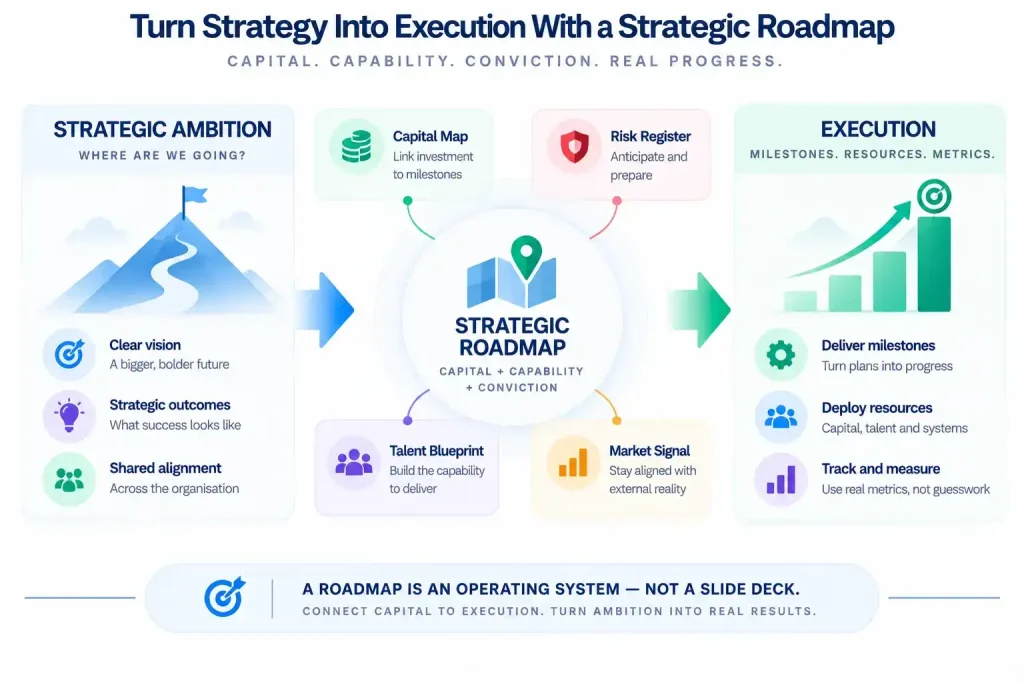
The Roadmap as an Operating System, Not a Slide Deck
A roadmap fails for a predictable reason. It gets built as a static timeline, misaligned with cash and disconnected from capacity. The vision inside it is rarely wrong. The roadmapping process around it is.
Treated correctly, a roadmap becomes an enterprise narrative. It works as a capital map, a risk register, a talent blueprint, and a market signal, all in one document. That shift, from artifact to system, makes the difference. It separates a roadmap that gets revised quarterly from one that gathers dust after the kickoff meeting.
Designing a Roadmapping Process Around Five Questions
A durable roadmapping process answers five questions with no ambiguity left in the room.
- Where are we going? This covers vision and outcomes.
- Why now? This covers context and urgency.
- How will we get there? This covers milestones and dependencies.
- What resources are required? This covers capital, talent, and systems.
- What will tell us we are on track? This covers metrics and signals.
When these five questions are answered together, the roadmap stops being a wish list. It becomes a plan that finance, product, and the board can all read the same way.
Aligning the Roadmapping Process with Capital Structure
Capital is not infinite, and strategy is not cheap. A roadmapping process that ignores debt covenants, investor expectations, and liquidity milestones will eventually collide with all three. The fix starts with mapping cash flow against milestone cost. It continues with scenario-planning for acceleration or delay, and timing any capital raise against real proof points, not calendar convenience.
Case in Point: Anchoring a Raise to Unit Economics
A marketplace SaaS platform raised a $20M Series B. It built its roadmap around a consolidated US and Polish reporting framework, paired with cohort and unit economics models. Those models anchored investor diligence and withstood scrutiny that a generic timeline never would have survived. The lesson travels well beyond that one raise. A roadmap that cannot show its unit economics is asking investors to take the milestones on faith.
A pre-Series A AI governance and assurance platform followed a similar logic on a smaller scale. Its roadmap tied a phased capital strategy to a multi-year scenario model. Every fundraising conversation had a specific resource ask attached to a specific outcome, rather than a general appeal for runway.
Integrating Functional Workstreams Into One Roadmap
Strategic roadmaps often fail because they live in silos. Product owns one version. Sales builds another. Finance budgets a third. The result is friction, missed signals, and a leadership team that argues about facts instead of trade-offs.
A high-growth cybersecurity and identity access management company avoided this problem. It ran finance and revenue operations as a single roadmap owner across its US and offshore delivery centers. Every function saw its role on the same page, and every function saw the cost of falling behind.
A durable roadmapping process integrates at least four workstreams:
- Product, covering feature delivery and technical debt
- Sales and go-to-market, covering launch sequencing and enablement
- Finance, covering cash cadence and cost inflection points
- People, covering hiring plans and leadership bandwidth
Building Roadmap Governance and Feedback Loops
A roadmap without governance drifts. It needs a cadence: quarterly recalibration against external signals, and clear cross-functional ownership. It also needs a forum where trade-offs get decided, rather than deferred.
Turning Signals Into Course Corrections
Signals only matter if they change the plan. Customer feedback should accelerate or halt a feature set. Sales traction should validate or delay a market entry. Cash burn trends should adjust hiring or vendor spend before the number becomes a crisis.
An early-stage digital marketing and community technology company demonstrated this under pressure. Its roadmap had to absorb a full operational turnaround, cutting monthly burn from $800K to $200K. The dashboards that fed that roadmap tracked burn against runway in real time. The roadmap itself became the mechanism for deciding what to cut and what to protect.
Embedding Optionality: Fast Path, Base Case, Defensive Path
Volatile environments punish a roadmap with only one path forward. A roadmapping process built for resilience carries three branches at once.
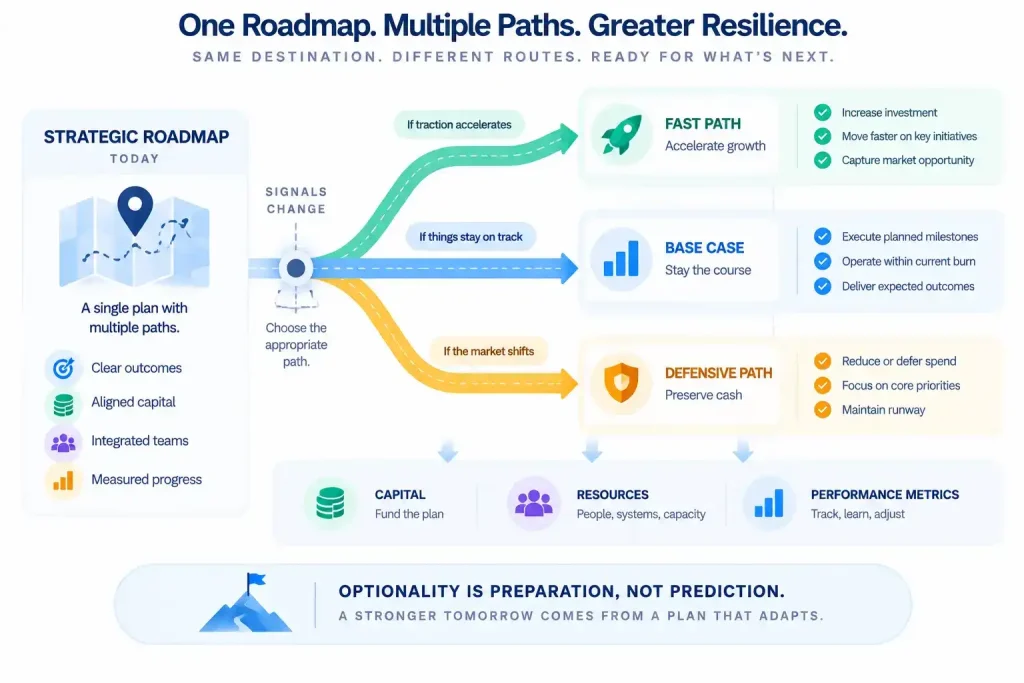
- A fast path, triggered if traction accelerates ahead of plan
- A base case, tied to current capacity and current burn
- A defensive path, built to preserve cash if the market shifts
Optionality here is not hedging. It is preparation. A mission-driven education institution raising $37M in equity and venture debt used this structure. It ran multi-year financial models under variable philanthropic and earned-revenue scenarios. That let the board see every path before committing to one.
Communicating the Roadmap and Measuring What Matters
Boards, investors, and employees care less about a timeline than about conviction. A roadmap narrative that works answers three questions. What is the bet, what are the signals, and what happens if the signal changes? That framing replaces false certainty with readiness. Readiness is the only honest posture a roadmap can take in a market that will not hold still.
Performance metrics in accounting terms give that narrative its spine. A forecast is not useful because it is detailed. It is useful because it is accurate enough to trust. One high-growth cybersecurity company built a driver-based forecasting engine. It held actuals within five percent of plan for eight consecutive quarters. That kind of accuracy turns a roadmap milestone from an aspiration into a number the board can act on.
Three Key Takeaways
- A roadmapping process only earns its place when it answers five questions together. It must show where the company is going, why now, and how it gets there. It must also show what resources it needs and what signal will show it is on track.
- Capital structure and roadmap design have to move together. A milestone that ignores cash runway or investor timing is a wish, not a plan.
- A fast path, a base case, and a defensive path let a company change direction without losing its footing. Performance metrics in accounting terms are what back each one.
Disclaimer: This article is intended for informational purposes only and does not constitute legal, tax, or accounting advice. You should consult your own tax advisor or counsel for advice tailored to your specific situation.
Hindol Datta is a four-time CFO and senior finance executive with over 25 years of leadership experience across cybersecurity, SaaS, gaming, logistics, digital marketing, medical devices, consumer products, and nonprofit organizations. He has led more than $120M in fundraising and over $150M in M&A transactions while building the financial and operational systems that let complex businesses scale with confidence. He is the author of seven books in the Systems CFO Series and holds active CPA, CMA, and CIA credentials.
AI-assisted insights, supplemented by 25 years of finance leadership experience.