
Executive Summary
Strategic resilience is the capacity to adapt quickly, absorb shocks, and seize opportunities that appear during disruption. A sound risk management strategy builds that capacity by moving risk out of the compliance corner and into planning, capital allocation, and culture. This article shows how CFOs can make that shift.
Risk is not only something to minimize but something to understand, price, and use in decisions. Readers will find a portfolio view of risk, methods for embedding it in planning, a way to calibrate appetite, and the cultural habits that make strategic resilience durable.
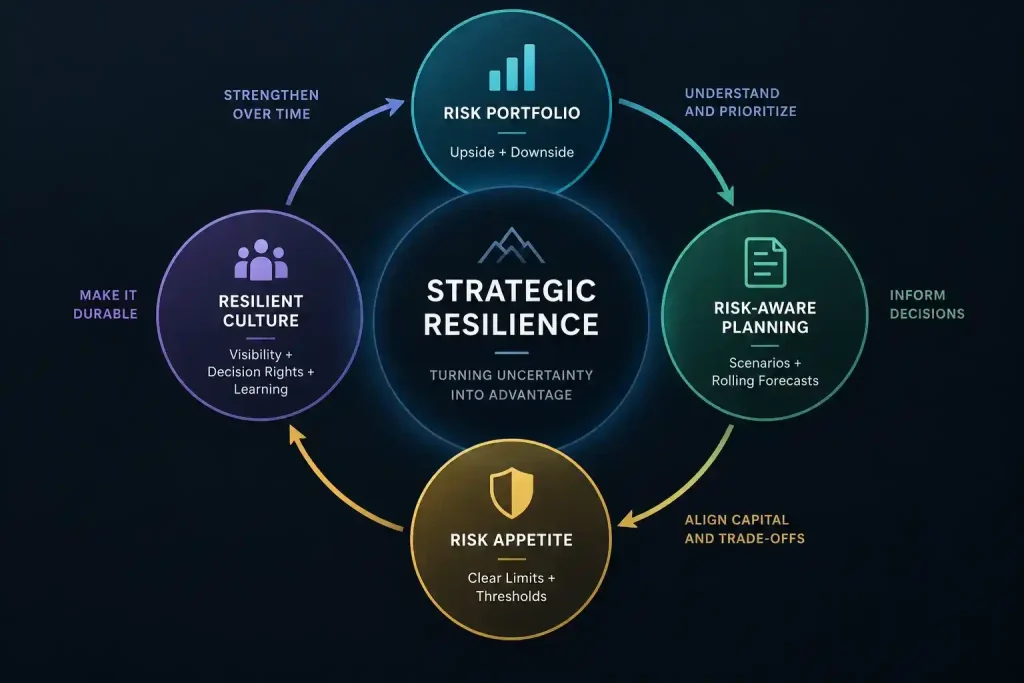
Reframing Risk as a Portfolio for Strategic Resilience
From Compliance to Strategic Exposure
Traditional risk management looks backward toward audits, loss prevention, and incident avoidance. Strategic risk behaves differently because it arrives as changing assumptions, such as shifts in customer behavior, regulation, geopolitics, or technology. These shifts may violate no policy and trigger no control, yet they can rewrite the economics of a business model.
An effective risk management strategy therefore begins with a portfolio view. Risks are categorized by their connection to value drivers and not only by likelihood and severity. Leaders ask which exposures affect revenue growth, gross margin, cash conversion, customer retention, or market access. A resilient enterprise concentrates on the exposures that determine the durability of its value proposition.
The portfolio approach turns risk into a design parameter. Consider a company weighing geographic expansion into a new region. A traditional framework lists regulatory complexity and currency volatility as reasons for caution, while a portfolio approach asks whether the move reduces dependence on a mature market.
The portfolio should include upside risks such as regulatory tailwinds and technology breakthroughs. Tracking them beside downside exposures lets CFOs accelerate investment when tailwinds arise. Controllable and non-controllable risks deserve separate treatment in the portfolio. Supply chain diversification, balance sheet flexibility, and modular product architecture cannot prevent economic shocks, but they reduce fragility.
At a $127M global consumer products company with a supply chain spanning China and Vietnam, that fragility was tangible. Demand planning, SKU rationalization, and logistics optimization lifted inventory turns from 3x to 7x, which released working capital and created room to absorb disruption.
Ownership, Sensing, and Board Engagement
Three practices make the risk portfolio a working part of strategic resilience:
- Cross-functional ownership: every business unit owns its risk profile, and risk indicators tie to financial KPIs, investment thresholds, and incentives. A sales team in emerging markets should be rewarded for growth delivered within credit and regulatory limits.
- Continuous sensing: static risk registers cannot keep pace with new threats, so real-time data and scenario libraries should detect pattern shifts early.
- Board engagement: directors should join scenario walkthroughs and ask which risks are priced into strategic bets. They should also test whether appetite matches capital posture.
Embedding Risk Management Strategy into Planning
Planning has long been treated as the domain of certainty, with linear forecasts and base-case budgets, and risk appears only as a footnote. Persistent volatility makes that separation unworkable in modern enterprises. Strategic resilience requires risk to become a core design principle of planning.
Assumptions, Models, and Optionality
The first step is making strategic assumptions explicit. Every forecast rests on assumptions about pricing power, customer growth, regulation, and competition, yet most organizations never state them. The CFO surfaces and stress-tests them by asking what happens if pricing slips two quarters or wage inflation exceeds budget by 300 basis points.
Risk-adjusted models then link those assumptions to earnings, cash flow, and capital ratios. In a multi-entity business, a currency shock may reduce revenue in one region while improving cost ratios in an importing division. Integrated planning captures these second-order effects to produce insight and not noise. Planning systems should support driver-based modeling and rapid reforecasting, and finance teams need strategic foresight alongside technical skill.
Scenario modeling is also about option value and not only downside protection. A risk-aware plan includes surge capacity, pre-approved vendor contracts, and contingent hiring. Capital can be released in tranches tied to market signals, a practice borrowed from venture capital that reduces regret costs.
Rolling forecasts strengthen the system because annual budgets are rigid and backward-looking. At a high-growth cybersecurity and identity access management company with $30M in ARR, a driver-based forecasting engine held actuals within plus or minus 5% of forecast for 8 consecutive quarters. At a mission-driven education institution, multi-year models under variable philanthropic and earned-revenue conditions brought confidence to long-term sustainability.
Credibility and Alignment
Boards and investors increasingly distrust single-path narratives, so scenario-based plans raise strategic resilience as well as credibility. A plan with high, base, and low cases, articulated triggers, and capital flex points signals maturity. Risk-aware planning also draws in operations, procurement, HR, compliance, and product teams. The organizational question shifts from how to hit the number to how to succeed under different futures.
Calibrating Risk Appetite and Tolerance for Strategic Resilience
A vague comfort with risk cannot guide the balance between ambition and caution. A risk management strategy needs a clear, operational definition of appetite and tolerance, and the CFO is well placed to lead it.
| Concept | Definition | Example metric |
| Risk appetite | How much risk the enterprise will take in pursuit of strategic objectives | Maximum acceptable earnings volatility |
| Risk tolerance | Operational boundaries within which risk is acceptable | Liquidity covenant headroom |
| Concentration limit | Cap on exposure to a single factor | Share of revenue from one customer |
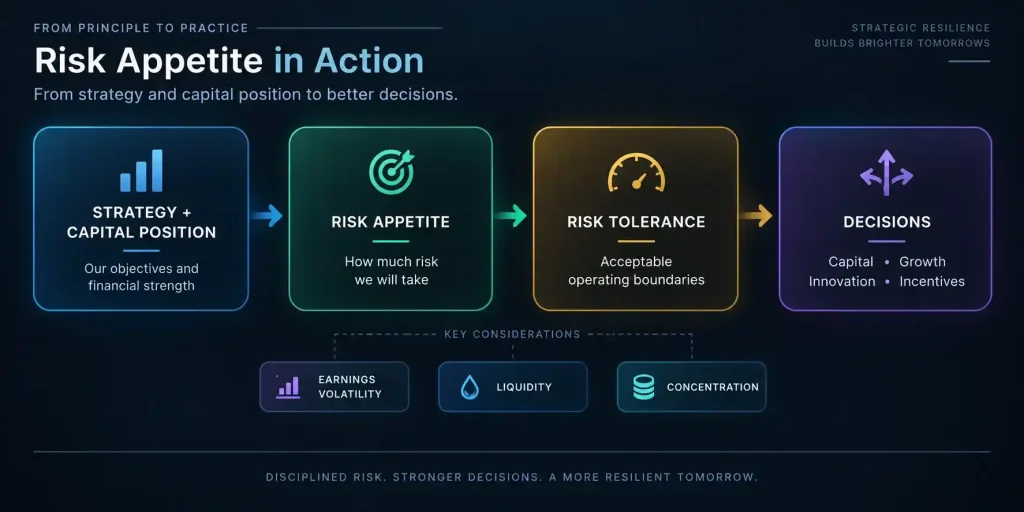
Appetite begins with the context of strategy and capital position. A highly leveraged company in a cyclical industry may accept little cash flow volatility, while a well-capitalized software firm may tolerate short-term losses. Appetite must then be quantified through earnings volatility, leverage ratios, customer concentration, and exposure by geography or currency.
Applying Appetite Across the Enterprise
- Governance: capital committees evaluate proposals on risk exposure as well as return, including correlation to a single economic factor.
- Trade-offs: a shared appetite framework speeds choices between higher-growth ventures and stable, lower-yielding ones.
- Innovation: appetite sets the acceptable failure rate, the size of experiments relative to enterprise capital, and the thresholds for commercialization or termination.
- Incentives: pay that rewards aggressive growth without downside volatility drifts from strategy, while overly conservative targets suppress intelligent risk-taking.
- Cascade: corporate sets overarching thresholds and business units localize them, so a high-growth emerging market unit may accept more regulatory complexity than a mature one.
- Communication: a clear framework tells boards, lenders, regulators, and investors that the enterprise is not overreaching.
Appetite also evolves as markets shift and performance changes, so regular review keeps strategic resilience aligned with strategy. It should be reviewed annually, or more often, within strategic planning and capital review cycles.
Building a Culture That Sustains Strategic Resilience
Frameworks, models, and thresholds are the skeleton of a risk management strategy, while culture is the muscle of strategic resilience. Without transparency and accountability, even elegant frameworks collapse under pressure.
Safety, Visibility, and Decision Rights
Psychological safety comes first in any resilient culture. Individuals at any rank must be able to raise concerns without fear of reprisal. When finance leaders answer bad news with inquiry instead of punishment, they set the tone that escalation is professionalism and not failure.
Risk must also be visible and relevant to daily management routines. Sales leaders should see customer credit exposure beside pipeline metrics, and supply chain teams should review concentration risk beside throughput. Narrative forecasting helps, since each forecast comes with its assumptions, dependencies, and risk factors.
Speed in a crisis depends on clear decision rights, which turn strategic resilience into fast action. Resilient enterprises document escalation paths, delegation thresholds, and pre-approved contingencies, then rehearse them. At an early-stage email marketing technology company, a turnaround reduced monthly burn from $800K to $200K.
Talent, Technology, and Learning Velocity
Strategic resilience resides in people, whose ability to sense and respond to risk no system can replace. High-performing organizations build risk judgment into hiring and promotion criteria and fund analytical training. They rotate talent across functions to build business acumen and scenario thinking. Technology should serve operational utility more than analytical elegance, delivering signals inside existing workflows.
Learning velocity separates a static enterprise from one with real strategic resilience. Resilient organizations run post-mortems after near misses and analyze failures without blame. Governance reinforces the habit as audit committees review learning mechanisms and compensation committees check that bonuses reward foresight and prudence. Strategic resilience extends outward to the wider ecosystem as well, because transparency about risk builds trust with suppliers, partners, customers, and regulators. That trust becomes an advantage in a crisis, when vendors prioritize reliable partners.
Three Key Takeaways
- Treat risk as a portfolio of strategic exposures tied to value drivers, and build strategic resilience by managing controllable risks and tracking upside as well as downside.
- Embed the risk management strategy into planning through explicit assumptions, scenario models, tranche-based capital, and rolling forecasts, and calibrate appetite with quantified limits.
- Sustain strategic resilience through psychological safety, visible risk signals, clear decision rights, and a disciplined habit of learning from surprises.
Disclaimer: This article is intended for informational purposes only and does not constitute legal, tax, or accounting advice. You should consult your own tax advisor or counsel for advice tailored to your specific situation.
Hindol Datta is a four-time CFO and senior finance executive with over 25 years of leadership experience across cybersecurity, SaaS, gaming, logistics, digital marketing, medical devices, consumer products, and nonprofit organizations. He has led more than $120M in fundraising and over $150M in M&A transactions while building the financial and operational systems that let complex businesses scale with confidence. He is the author of seven books in the Systems CFO Series and holds active CPA, CMA, and CIA credentials.
AI-assisted insights, supplemented by 25 years of finance leadership experience.