
Executive Summary
A strategic partnership can look strong on paper and still prove brittle in practice when currencies shift, supply chains break, or regulations change. In a volatile, uncertain, complex, and ambiguous world, contracts alone cannot hold an alliance together. Durable partnerships depend on shared resilience, transparent data, fair risk allocation, aligned incentives, and steady leadership.
The sections ahead set out a strategic partnership framework built on five pillars. They cover resilience by design, trust infrastructure, symmetry of exposure, harmony in complexity, and relational leadership. Together they show why the CFO is well placed to lead partnerships that endure when conditions turn against both sides.
Designing a Strategic Partnership for Resilience
The most enduring relationships are those that withstand stress, not those that shine in easy times. Old partnership models relied on crisp timelines, equilibrium assumptions, and elegant but rigid revenue-share clauses. Pandemics, tariffs, wars, and sudden shifts in demand have strained those designs, and such disruptions now form part of the normal story.
Building Flexibility into the Agreement
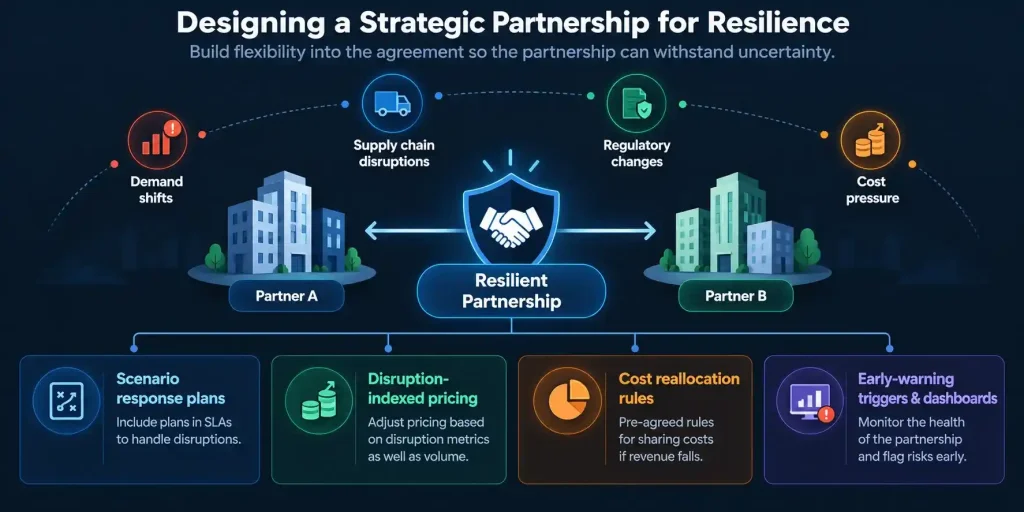
Resilience begins by treating volatility as a native condition instead of an edge case. A strategic partnership built for strain usually includes several design features:
- Scenario response plans attached to service level agreements
- Pricing indexed to disruption metrics as well as volume
- Pre-agreed rules for reallocating costs if revenue falls
- Early-warning triggers and dashboards that track the health of the relationship
A cost-reallocation clause does not need legal complexity to work. Its value comes from the conversation that produced it, held in calm conditions when both sides could imagine disagreement and plan for it. No model can capture every risk, but resilience preserves the integrity of the partnership when unexpected events arrive.
A pre-Series A AI governance and assurance platform shows how finance can shape partnerships from the start. Work there included go-to-market financial modeling and partnership economics alongside multi-year scenario planning. That pairing linked partnership economics directly to the capital strategy and investor narrative.
Trust Infrastructure as a Strategic Asset
Trust is the true currency of any partnership, ahead of equity, margin, or ambition. Once broken, it collapses everything built on it, and once strengthened, it makes even imperfect arrangements viable. In a VUCA world, transparency becomes a structural necessity instead of a courtesy.
From Sentiment to Shared Data
Useful trust in a strategic partnership is not blind optimism. It is clear visibility into what a partner can absorb, what liquidity it must preserve, and which regulatory constraints it faces. Friction often grows from misunderstanding instead of malice. An undisclosed margin squeeze or an assumption of speed that the other side cannot deliver can quietly erode goodwill.
The CFO can design systems that make opacity unlikely. Bilateral metrics, co-developed KPIs, and shared scenario models let both firms see how stress affects each side. Opening one’s own books, carefully but generously, signals that the company takes the partnership seriously enough to be known.
A Euronext Paris-listed gaming company that completed more than $100M in cross-border M&A shows why shared visibility matters. Due diligence and post-merger integration across several countries depended on consistent financial definitions and open data between teams. A shared model with transparent logic and assumptions often does more to ease tension than any formal reporting requirement.
Symmetry of Exposure in Partnership Risk
Contracts often present risk as evenly shared, yet the lived experience rarely matches. Risk tends to flow toward the partner with less capital, less visibility, or weaker negotiating power. The firm with stronger leverage often carries less operational exposure, while the other absorbs delays, errors, and neglect.
Asking Who Is Most Harmed
Asymmetry hides in assumptions, in whose projections form the baseline, and in which side controls data, channels, and the timing of escalation. A strong strategic partnership framework asks a simple question: if this fails, who is most harmed? The answer should cover operational fatigue, reputational strain, and strategic consequence, not just line items.
VUCA Conditions and Partnership Design Responses
| VUCA Condition | Partnership Risk | Design Response |
| Volatility | Sudden cost or demand shocks | Scenario plans and disruption-indexed pricing |
| Uncertainty | Unclear planning horizons | Shared forecasts and staged commitments |
| Complexity | Misaligned incentives across firms | Incentive mapping and joint governance |
| Ambiguity | Risk and opportunity hard to separate | Transparent assumptions and escalation protocols |
Symmetry in a strategic partnership does not require equal burden. It requires intentional sharing, such as a capital-rich partner carrying the other through a delayed receivable to protect a joint innovation. Finance can embed fairness through buffers, incentives that reward transparency, and escalation protocols that resolve disputes without damaging reputations.
A $127M global consumer products company with a supply chain spanning China and Vietnam offers a relevant example. Managing DTC, Amazon, and wholesale channels alongside ocean freight, trucking, and warehousing created many points where risk could shift between partners. Securing $12M in growth financing also required strong banking and lender relationships built on clear communication.
Harmony in Complexity
Every partnership begins with optimism, shared vision, and confident projections. Time then introduces friction, such as a delayed shipment, a change in tone, or a divergence in how each side measures success. Adversity reveals whether the alignment was structural or simply untested.
Mapping Incentives Before They Collide
Misaligned incentives appear in cost centers that clash with revenue models and in timelines that suit one reporting cycle but burden another. They also appear in service levels that please customers while punishing operations. A joint venture might see one firm’s marketing incentives drive sales that trigger fulfillment penalties for the other. Each side performs well on paper while quietly damaging the other.
The answer is harmonization within a clear strategic partnership framework, not oversimplification. Governance should include incentive diagnostics and regular conversations in which each side explains the pressures behind its behavior. Operational friction rarely resolves at the operational level, so executives must design alignment into the structure itself.
The CFO brings both cost logic and time logic to this work. An early win for one side can become a late loss for the other. Finance can model that friction before it turns into guarded efficiency. Partnerships rarely fail through dramatic rupture; more often, they fade as each side optimizes for itself.
The CFO as Relational Strategist
Leadership in uncertainty requires standing inside the turbulence, attentive to morale, trust, and fatigue as well as markets and models. Every strategic partnership is a relationship beneath its clauses and KPIs. In a world of half-finished plans and half-certain partners, the CFO’s greatest contribution is steady availability.
Choosing to Stay
That availability means listening before defensiveness sets in and modeling new versions of the partnership as acts of respect, not admissions of failure. It also means tolerating ambiguity without punishing the partner who raises it. When disruption hits both firms, the CFO can reopen the conversation by acknowledging that conditions have changed and that both sides will adapt together.
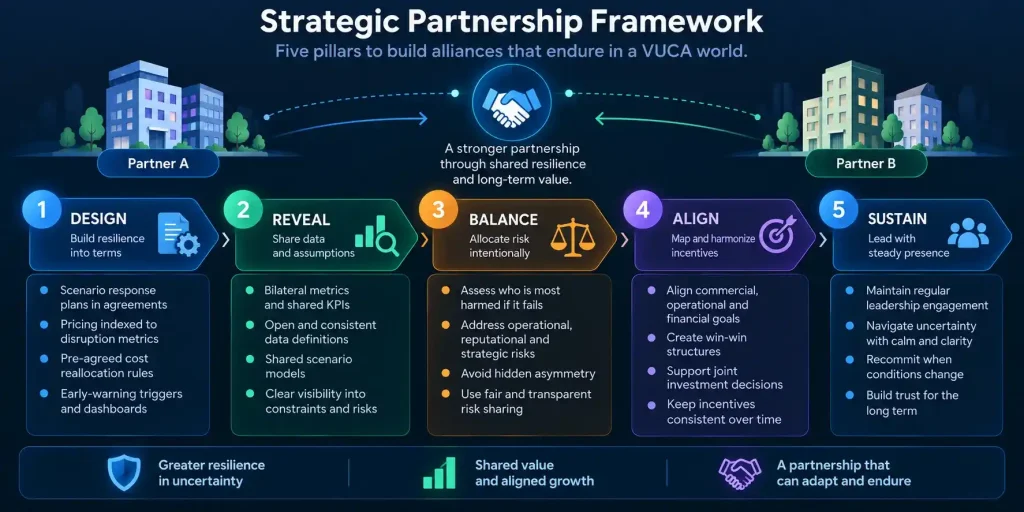
The Strategic Partnership Framework
| Design | Reveal | Balance | Align | Sustain |
| Build resilience into terms | Share data and assumptions | Allocate risk intentionally | Map and harmonize incentives | Lead with steady presence |
Trust capital accumulates through many small, decent decisions over years. Fear often tempts leaders to cut the partner loose or protect the quarter. Strong finance leaders resist that pressure, because in a VUCA world the partnerships that endure are those whose members choose to stay.
Three Key Takeaways
- Leaders must design a strategic partnership for strain before disruption arrives. Scenario plans, flexible pricing, and pre-agreed cost-sharing rules all belong in the agreement.
- A strategic partnership framework built on shared data, intentional risk symmetry, and incentive mapping prevents quiet erosion of trust.
- The CFO strengthens alliances by acting as a relational strategist, staying present and adaptive when conditions shift for both partners.
Disclaimer: This article is intended for informational purposes only and does not constitute legal, tax, or accounting advice. You should consult your own tax advisor or counsel for advice tailored to your specific situation.
Hindol Datta is a four-time CFO and senior finance executive with over 25 years of leadership experience across cybersecurity, SaaS, gaming, logistics, digital marketing, medical devices, consumer products, and nonprofit organizations. He has led more than $120M in fundraising and over $150M in M&A transactions while building the financial and operational systems that let complex businesses scale with confidence. He is the author of seven books in the Systems CFO Series and holds active CPA, CMA, and CIA credentials.
AI-assisted insights, supplemented by 25 years of finance leadership experience.



