
Executive Summary
Strategic alliances have long belonged to dealmakers, with finance approving funding and checking the accounting afterward. That reactive posture fails when growth must be non-linear and innovation lives outside the enterprise. The modern CFO must learn to design strategic alliances, not simply approve them.
This article explains how to embed a strategic alliance into the core of financial planning. It covers alliance economics, modeling discipline, governance, and how partnerships expand what a plan can achieve.
Why Strategic Alliances Belong Inside the Financial Plan
Most partnerships unfold in quiet boardrooms, built on aligned incentives rather than headlines. Strategic alliances of this kind are capital strategies in disguise, not simple business development maneuvers.
They create optionality, reshape capital intensity, and reallocate risk across the forward-looking model. Treating them as footnotes misreads their nature, since they are sometimes the only path to executing strategy at pace. Each alliance belongs in the model as a dynamic variable, not a static assumption pasted in late in the cycle.
Rethinking the Financial Logic of Strategic Alliances
The classical financial model is inward-facing, with revenue and costs tethered to owned resources. Yet in an economy shaped by speed, talent, and customer intimacy, few companies win without strategic alliances.
Finance often treats a strategic alliance as exogenous to the plan. A commercial leader declares that the partner will bring in $30M next year, and finance must reconcile that claim blind. The alliance becomes a black box, promised elsewhere, modeled here, and understood nowhere. This detachment breeds distorted forecasts, hidden risk, and overconfident capital commitments.
Standalone Plan Versus Alliance-Enabled Plan
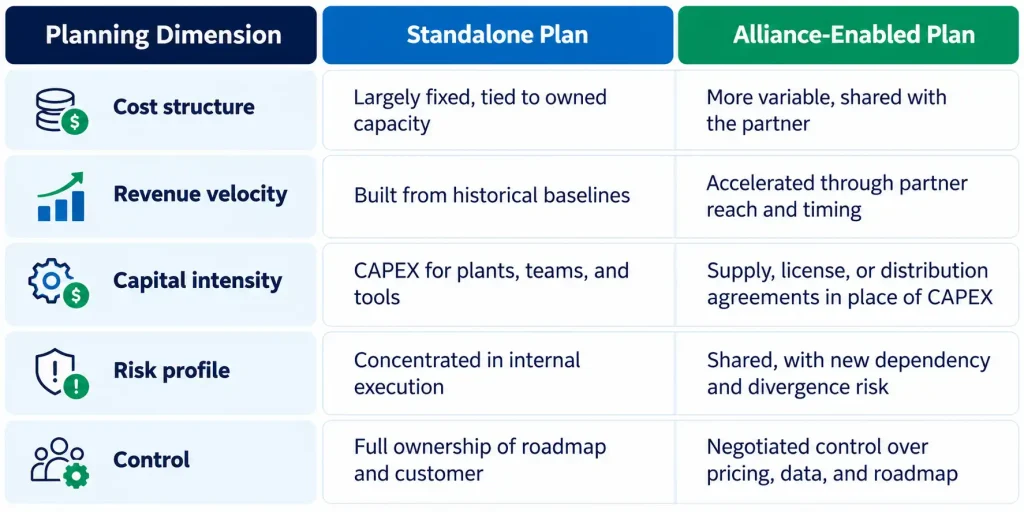
A strategic alliance behaves like a vector, not a line item, because it alters trajectory, shape, and exposure. The table below summarizes the shifts that finance should expect to model.
How Different Alliance Types Reshape the Model
Each type of alliance leaves a distinct fingerprint on the financial architecture:
- Pharmaceutical partnerships change R&D burn, revenue recognition, launch costs, and data governance through co-funded trials.
- Technology alliances, such as an embedded AI engine, add revenue share, integration costs, and margin dilution.
- Distribution partnerships extend reach without a new field force, turning fixed selling costs into variable ones.
- Manufacturing partnerships replace CAPEX with a supply agreement, preserving cash and changing capital formation logic.
Consider a consumer products company with suppliers spread across China and Vietnam. Treating logistics partners as core planning levers can lift inventory turns from 3x to 7x.
Strategic alliances deserve the same modeling rigor as internal operations, calibrated with financial prudence as well as commercial enthusiasm. When they work, they do more than help execute the plan; they change what kind of plan is possible.
Modeling Strategic Alliance Economics
Strategic alliances make planning harder, because their economics are rarely linear and their incentives diverge beneath a shared intent. The model must still turn those terms into numbers leadership can act on.
Translating Legal Terms into Cash Flow Logic
A sound alliance model begins with a breakdown of entitlements and obligations. Finance should answer four questions before building any forecast:
- What does the agreement grant: revenue share, margin tiers, IP access, or geographic exclusivity?
- Who owns the customer, and who controls pricing across the shared offering?
- Who carries the risk if adoption lags or the joint roadmap slips?
- How does cash move between the two organizations, and on what timing?
Modeling these mechanics is an act of translation from legal agreement to financial reality. For an early-stage AI platform, partnership economics should shape the operating model and investor narrative from the first draft.
Sample Alliance Scenario Tree
Strategic alliances are probabilistic by nature, so a single-case forecast offers false precision. Each branch of a scenario tree should reflect a plausible operational reality and a signal that confirms it early.
| Branch | Partner Performance | Financial Effect | Early Warning Signal |
| Upside | Partner exceeds volume commitments | Revenue arrives early and margin expands | Activation rates above target by quarter two |
| Base | Partner meets plan with modest delays | Revenue follows plan with a one-quarter lag | Integration milestones slip by under 30 days |
| Downside | Joint product misses product-market fit | Co-investment written down, revenue deferred | Pipeline conversion below half of plan |
| Exit | Partner changes strategy or ownership | Option clauses triggered, unwind costs incurred | Change-of-control or renewal notice received |
Many partnerships also front-load cost and back-load benefit, with co-investment in year one and limited returns until year three. EBIT-focused models can obscure this timing asymmetry, so capital allocation must reflect the cash reality.
Transfer Pricing, Embedded Options, and Integration Friction
Cross-border strategic alliances add tax, jurisdictional, and repatriation constraints, so top-line growth is not always free cash flow. A listed company reporting under both IFRS and US GAAP will see this gap in every cross-border revenue flow.
Embedded options to buy out, exit, convert, or expand carry real value, and finance should estimate their probability of exercise. A mature model also carries a line for integration friction, which grounds collaboration without discouraging it.
Governance and Performance Management of a Strategic Alliance
A strategic alliance is a living architecture of interdependence, not a single transaction. The initial deal opens a door, but governance decides whether the partnership walks through it or drifts into inertia.
Alliances operate across asymmetries of power, information, and urgency. Left unmanaged, these gaps become fault lines; managed well, they become sources of complementarity. Many strategic alliances fail because expectations diverge, long before the economics collapse.
Alliance KPIs Finance Should Track
Shared metrics must reflect the specific logic of each partnership, not generic scorecards. Finance should help keep them measurable, material, and monitored.
| KPI Category | Example Metrics | Why It Matters |
| Commercial | Volume commitments, revenue share benchmarks | Tests whether the partner delivers promised reach |
| Adoption | Activation rates, joint pipeline conversion | Signals product-market fit before revenue shows it |
| Operational | Integration velocity, milestone completion | Surfaces friction that erodes real returns |
| Marketing | Co-marketing impact, partner-sourced leads | Validates the shared go-to-market investment |
| Financial | Contribution margin, cash payback period | Connects alliance activity to capital allocation |
Fast-scaling digital marketing businesses depend on strict CAC, LTV, and contribution margin discipline to grow profitably. Partner-sourced revenue needs the same scrutiny, since it can look healthy while eroding margin underneath.
Cadence, Ownership, and External Reporting
Monthly or quarterly reviews should assess progress, explain deviations, and define next actions with finance in the room. The strongest strategic alliances appoint a general manager to coordinate across both organizations, supported by finance. For material alliances, governance also extends to guidance, segment reporting, earnings call KPIs, and risk disclosure.
Inflection Points and Alliance Culture
Option valuation and renewal modeling should prepare for exit clauses and change-of-control events well before urgency arrives. Governance also thrives on transparency, and finance, as a neutral arbiter, can set that tone with candor and empathy.
Strategic Alliances as Levers in the CFO Toolkit
Strategic alliances let an enterprise access technology without owning it and enter markets without building footprints. They let the CFO plan around optionality instead of constraint.
Build Path Versus Partner Path
Consider a five-year plan that assumes internal product development, with its R&D cost, timeline risk, and cash burn. Now introduce an alliance with a company whose product already solves half the problem.
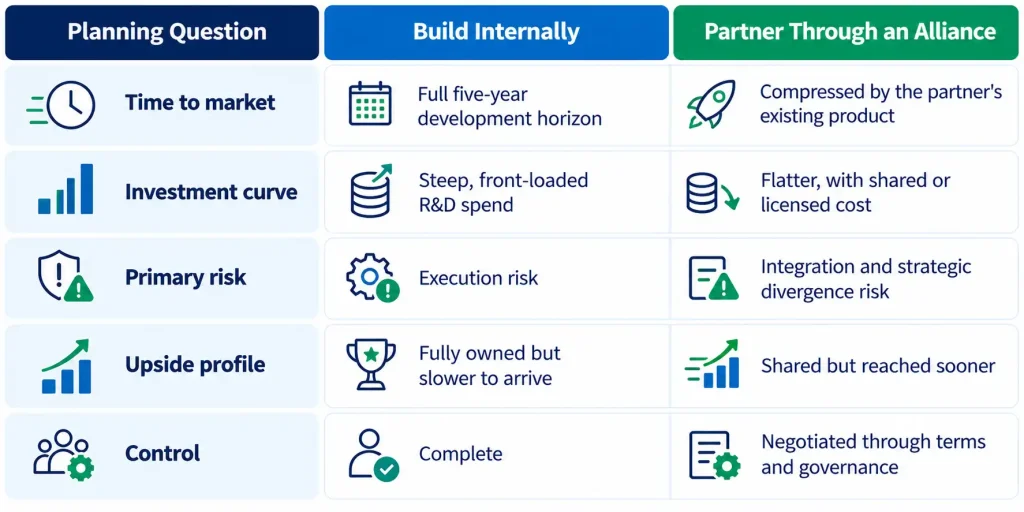
This is not about favoring alliances over ownership; it is about design plurality. For every major initiative, finance should ask three partnership questions while the planning table is still clear:
- Can the company license the capability instead of building it internally?
- Would sharing a partner’s shelf beat acquiring a new footprint?
- Could a partner’s salesforce replace the cost of hiring one?
Workforce design follows the same partnership logic across borders. A services-heavy SaaS business can plan its subcontractor mix as a deliberate lever, keeping the idle bench low during rapid growth.
Using strategic alliances this way demands more control, not less. Chosen well, alliances work like compounding, tying growth to a partner’s momentum. With finite capital and fast cycles, the strongest plans connect a company wisely instead of stretching it thin.
Three Key Takeaways
- Treat every strategic alliance as a vector in the financial model, not a late-stage assumption. Map how it shifts cost structure, revenue velocity, capital intensity, and risk before it enters the plan.
- Model alliance economics with scenario trees, timing asymmetry, embedded options, and integration friction in view. A confident range tied to early warning signals is worth more than a precise single forecast.
- Govern each strategic alliance with shared KPIs, a fixed review cadence, and a clear owner. Asking the partnership question early expands the design space of the plan, not only its accuracy.
Disclaimer: This article is intended for informational purposes only and does not constitute legal, tax, or accounting advice. You should consult your own tax advisor or counsel for advice tailored to your specific situation.
Hindol Datta is a four-time CFO and senior finance executive with over 25 years of leadership experience across cybersecurity, SaaS, gaming, logistics, digital marketing, medical devices, consumer products, and nonprofit organizations. He has led more than $120M in fundraising and over $150M in M&A transactions while building the financial and operational systems that let complex businesses scale with confidence. He is the author of seven books in the Systems CFO Series and holds active CPA, CMA, and CIA credentials.
AI-assisted insights, supplemented by 25 years of finance leadership experience.