
Executive Summary
Stakeholder management is the discipline of aligning the expectations of investors, employees, boards, customers, and partners. Together they need one accurate, shared picture of where a business stands and where it is going. The question of what stakeholder management means stops being academic the moment a market turns. A shareholder asks on the quarterly call why cash burn spiked. A board member requests more visibility into pipeline velocity. A founder who has gone quiet finally asks whether the organization still holds together. In calm conditions these tensions stay dormant. In volatile ones they surface inside the same quarter and demand a single coherent answer.
This guide walks through what effective stakeholder management looks like across five groups a finance leader answers to most closely. Those groups are investors, employees, boards, customers, and partners. It closes with a practical framework for communicating through uncertainty. The framework comes from finance functions that had to hold together while the market outside them was not.
What Stakeholder Management Means When the Ground Begins to Shift
Volatility does not only test the balance sheet. It tests the relationship sheet as well. That network of expectations and unspoken contracts binds an organization to everyone with a claim on its future. Each stakeholder group brings capital of one form or another. Each expects something specific in return: certainty, return, purpose, or simply a plan they can trust. In a market that moves by headline and reacts within hours, those expectations begin to collide. Stakeholder management becomes the mechanism that keeps the collision from becoming a fracture.
Stability conceals what volatility reveals. Forecasts land on plan. Boards nod the decks through. Town halls end without friction. So, the underlying misalignments never surface. When growth softens or runway shrinks, the same investors who once prized velocity begin demanding discipline. Teams that thrived on autonomy start craving direction. Founders who built the company on narrative must now answer to numbers. In that moment, the finance function becomes the translator. It connects what the business is doing to what each stakeholder group needs to believe about it. That translation work, done well and done consistently, is the practical meaning of stakeholder management. It is not about pleasing everyone. It is about orchestrating clarity when clarity is scarce.
Investor Communication as the Front Line of Stakeholder Management
Investor relations in a volatile market becomes part performance, part interpretation. The financial results matter. The interpretation of those results tends to matter more, because numbers without context read as ammunition rather than insight. A seventeen percent drop in annual recurring revenue can provoke panic unless it is placed against a deliberate pricing shift. A jump in churn can look catastrophic unless it reflects a chosen customer tiering policy. Effective stakeholder management asks the finance leader to connect financial events to strategic intent. That way, short-term turbulence reads within a longer arc rather than as a standalone alarm.
A CFO who scaled a venture-backed digital marketing company from $9M to $180M in revenue across twenty-four months, while raising $36.5M through three funding rounds, learned that investor confidence was rarely won by the cleanest deck. It was won by naming the uncertainty inside the forecast rather than hiding it, and by mapping which investors needed which message before the call began rather than improvising in the moment. Silence during a volatile quarter is not neutral; it reads as narrative in absentia. Stakeholders do not need precision as much as they need preparedness, and preparedness is what turns an update into trust rather than another data point to parse.
Employee Trust as Structural Integrity
Employees carry a different calculus than investors. Where investors seek return, employees seek meaning, and a layoff, a pivot, or a delayed raise ripples past the spreadsheet into questions of identity and belonging. A well-crafted memo alone rarely closes that gap. During an operational turnaround that cut monthly burn from $800K to $200K, the deciding factor was not the memo announcing the cuts but the sustained willingness to open the books afterward, to explain the reasoning behind each decision, and to admit plainly what remained unknown. Anxiety did not disappear, but it became channeled rather than corrosive, and trust, even inside disappointment, had room to grow.
This is where stakeholder management stops being a communications exercise and becomes a matter of structural integrity. A restructuring announced without clarity leaves a vacuum, and unanswered questions inside that vacuum spread faster than any official statement can catch up to them. The finance leader who treats employee communication as a secondary output of the real work, rather than as part of the work itself, usually finds that poor communication costs the organization more than the underlying strategic shift ever did.
Elevating the Board Conversation Beyond the Financials
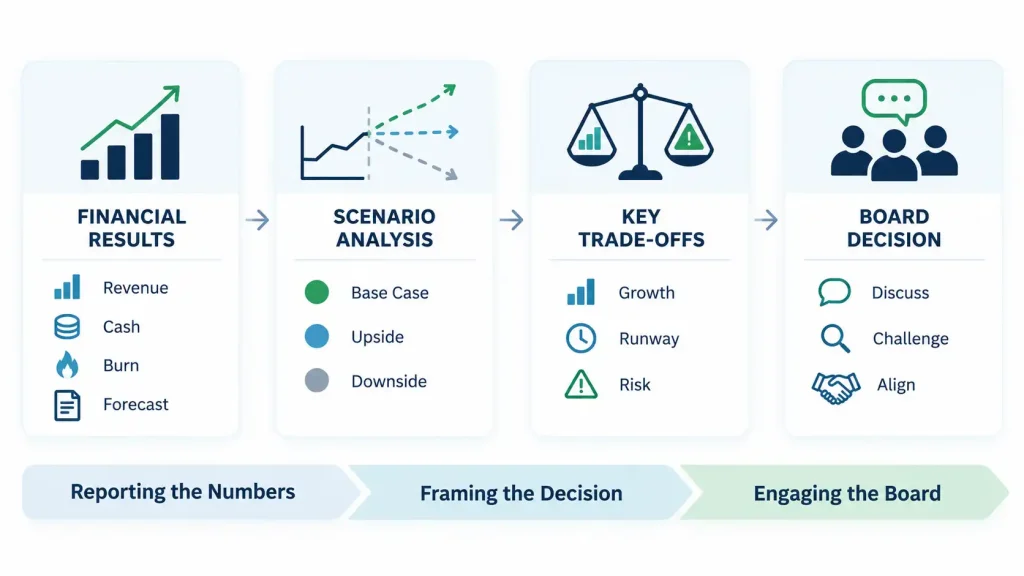
Boards occupy an uneasy middle ground. They are neither operators living inside the daily decisions nor investors with capital directly at stake, yet they carry the burden of stewardship, and in downturns they often drift into the weeds of individual line items. It falls to the finance function to elevate the conversation, resisting the temptation to simply rehash the financials and instead bringing forward the decision points, trade-offs, and structured dilemmas the board actually needs to weigh.
At a mission-driven education and research institution where the finance function raised $37M across equity and venture debt while staffing the audit committee directly, the boards that engaged most productively were the ones pre-wired with scenario analysis before the meeting began rather than surprised by it during discussion. When a looming strategic pivot threatened a key channel, surfacing the risk early through modeled scenarios and structured feedback let the board shape the outcome instead of reacting to it after the fact. Stakeholder management at the board level means the difference between a board that is informed and a board that is genuinely engaged.
Customers and Partners: The Outer Ring of Trust
Customers and partners sit at the outer ring of the stakeholder sphere, and their anxiety tends to be subtler but no less real. In business-to-business relationships, customers read between the lines: a change in tone, a missing feature, a delayed roadmap item, all register as signals even when nothing has been said outright. The challenge is speaking candidly without breeding panic, a balance that a $30M ARR cybersecurity and identity access management company managed by sharing usage metrics directly with enterprise clients, not to impress them, but to give them a concrete basis for confidence in the relationship. Joint scenario planning with key partners, built the same way, created a shared clarity that standard contract language could never provide on its own. Transparency in these relationships rarely removes risk outright, but it consistently buys the patience a business needs to work through it.
A Practical Framework: Naming, Interpreting, and Acting
The most useful communication a finance leader can deliver during a volatile stretch follows a consistent structure rather than a clever phrase. It begins by naming what is known, moves to interpreting what the signals mean, and closes by describing the action being taken in response. The table below sets out how that structure plays out in practice.
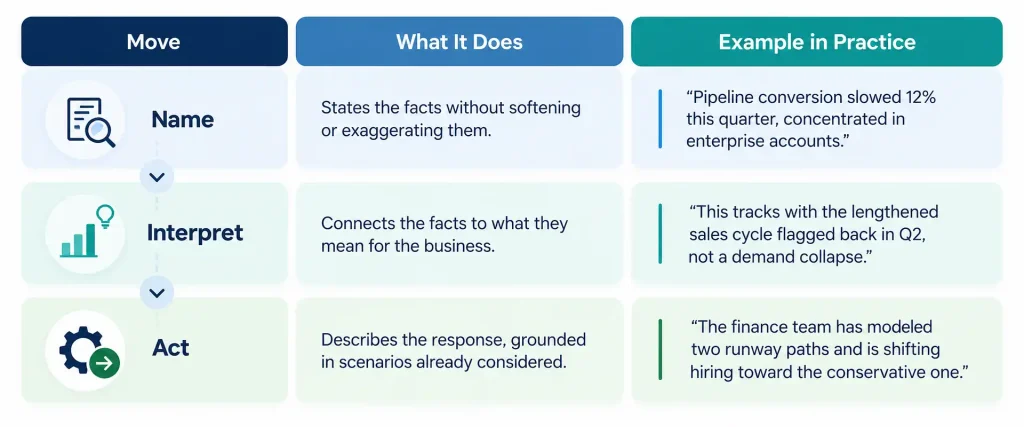
This sequence works because it treats reality, once named, as a shared problem rather than a private dread. Stakeholders across every group, whether investors, employees, board members, or customers, are ultimately looking for the same thing in a volatile market: a story they can believe because it was built from what is actually happening, not from what the business wishes were happening. Communication built this way rarely needs to be reassuring. It only needs to be composed, specific, and honest about where the uncertainty still sits.
Three Key Takeaways
- Stakeholder management in volatile markets is not about controlling every message; it is about maintaining a steady cadence of honest, well-timed communication that turns uncertainty into a shared problem rather than five separate private anxieties.
- Each stakeholder group, investors, employees, boards, customers, and partners, responds to a different calculus, and the finance leader who tailors the message to that calculus, rather than sending one generic update to all of them, earns trust faster and holds it longer.
- A simple structure of naming the facts, interpreting what they mean, and describing the action taken outperforms both over-reassurance and silence, because it gives every stakeholder a story grounded in what is actually happening rather than in what the business hopes will happen next.
Disclaimer: This article is intended for informational purposes only and does not constitute legal, tax, or accounting advice. You should consult your own tax advisor or counsel for advice tailored to your specific situation.
Hindol Datta is a four-time CFO and senior finance executive with over 25 years of leadership experience across cybersecurity, SaaS, gaming, logistics, digital marketing, medical devices, consumer products, and nonprofit organizations. He has led more than $120M in fundraising and over $150M in M&A transactions while building the financial and operational systems that let complex businesses scale with confidence. He is the author of seven books in the Systems CFO Series and holds active CPA, CMA, and CIA credentials.
AI-assisted insights, supplemented by 25 years of finance leadership experience.