
Executive Summary
A stakeholder engagement strategy for finance leaders rests on more than accurate numbers. Boards, investors, partners and employees already hold the data, so what they want from the CFO is meaning. The financial narrative is the structure that turns raw measurement into belief. That belief behaves like an asset, compounding or eroding with every quarterly update.
This article examines what makes a financial narrative resonate, how stakeholders listen, where narrative turns into spin, and how medium shapes meaning. Each section offers practical frameworks for building a stakeholder engagement strategy around the next board meeting or investor update.
Why Financial Narrative Anchors Every Stakeholder Engagement Strategy
Before a CFO presents results, there is a quiet moment when the spreadsheets fall away and only intent remains. The room wants to know what the numbers signal and where they might lead. What gets said next is interpretation, and interpretation travels further than arithmetic.
A stakeholder engagement strategy is not a campaign or a pitch, but a relationship built on coherence and on the pattern that quarterly updates reveal over time. Rooms with perfect numbers can still hear a brittle story, and trust can erode when results arrive too clinically, too cleverly or too cautiously.
Financial storytelling at its best is stewardship, not spin. A strong narrative links performance to purpose and data to direction, and it includes uncertainty instead of hiding it. In a world of mobile capital and constant scrutiny, the meaning assigned to a number often outweighs the number itself. That makes narrative a hard responsibility, not a soft skill.
The Anatomy of a Financial Narrative That Builds Stakeholder Trust
A financial narrative is not a string of numbers dressed up for public consumption. It is an act of alignment, holding three truths together: what happened, why it happened, and how it fits a larger story. If the numbers are the bones of an organization, the narrative is its connective tissue, flexible across time horizons yet strong under scrutiny.
Four Elements of a Resonant Financial Narrative
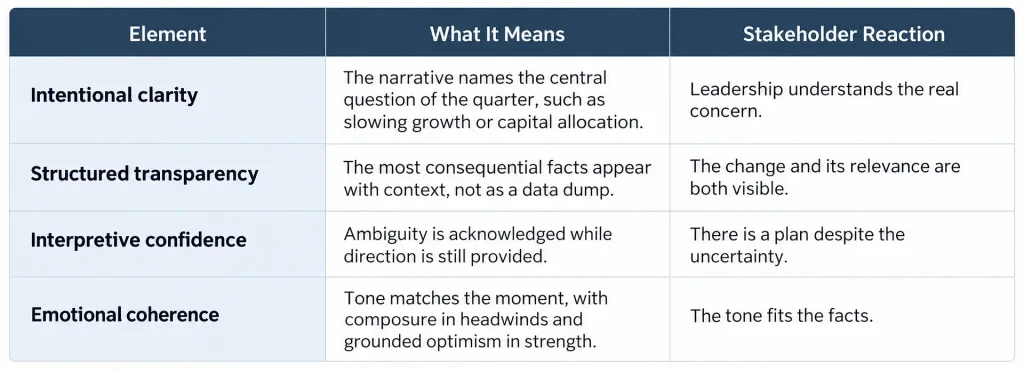
Interpretive confidence is the element most often missing. At a cybersecurity and identity access management company with roughly $30M in ARR, margin pressure was a recurring board topic. Finance chose to show the competing pressures on unit economics directly instead of calling them a temporary mix shift. That candor laid the groundwork for a twelve percent gross margin improvement through pricing discipline, workforce composition and delivery cost management. The board rewarded that honesty with patience and sharper, more constructive questions.
No finance leader can bolt emotional coherence on at the end. It comes from the internal alignment of the finance leader, who must absorb the numbers before narrating them. Stakeholders can sense when a CFO does not believe the story on the slide, and no stakeholder engagement strategy survives that doubt.
How Stakeholders Hear Financial Communication
Stakeholders do not experience a financial narrative as information. They experience it as interpretation, filtered through their own priors, incentives and scars. A board member who has lived through three downturns listens for signs of retrenchment. Growth investors scan for upside, while employees hear tone before numbers. Every effective stakeholder engagement strategy begins by anticipating this silent negotiation.
When the Message Diverges from the Mental Model
| What the CFO Says | What the Stakeholder Hears |
| Softness in demand | Revenue is unstable |
| Disciplined capital deployment | Leadership lacks confidence in growth |
| Strategic pause | The company has lost momentum |
| Temporary headwind | A problem that may last several quarters |
None of these gaps involve deception, only dissonance between intent and perception. The fix is to adjust the framing, never the truth.
Three Disciplines for Engaging Every Audience
- Attentional empathy: Stakeholders ration their attention, so they remember what is salient, not what matters most. A single chart or well-framed metric often sticks better than a full deck.
- Narrative layering: Some listeners want the why, others the what, and many only the so what. A layered message lets each audience find its thread without distorting the whole.
- Emotional precision: Tone must match business reality, neither too sunny nor too grim. When tone fits the moment, belief flows more easily because the message feels true.
When alignment exists, stakeholders begin repeating the story because they believe it, not because they were told to. That shared belief is the true multiplier of strategy.
Where Narrative Ends and Spin Begins in a Stakeholder Engagement Strategy
Numbers do not lie, but they do lean toward the hand that interprets them. Distortion rarely arrives as a declaration and tends to creep in by degrees. A glossed-over risk, a reframed forecast or an omission justified by timing can each be technically accurate. Together, they cross a line that has no bright red boundary.
The cost of spin is relational, not just reputational. A stakeholder who senses gentle manipulation will remember that “temporary softness” lasted three quarters. Trust is seldom lost in dramatic acts, because it slips away through small edits.
A Practical Test for Ethical Financial Storytelling
The simplest test is private: would the CFO frame the message the same way for a trusted confidant with no agenda? If the answer is no, the story has become a version of the truth rather than the truth itself.
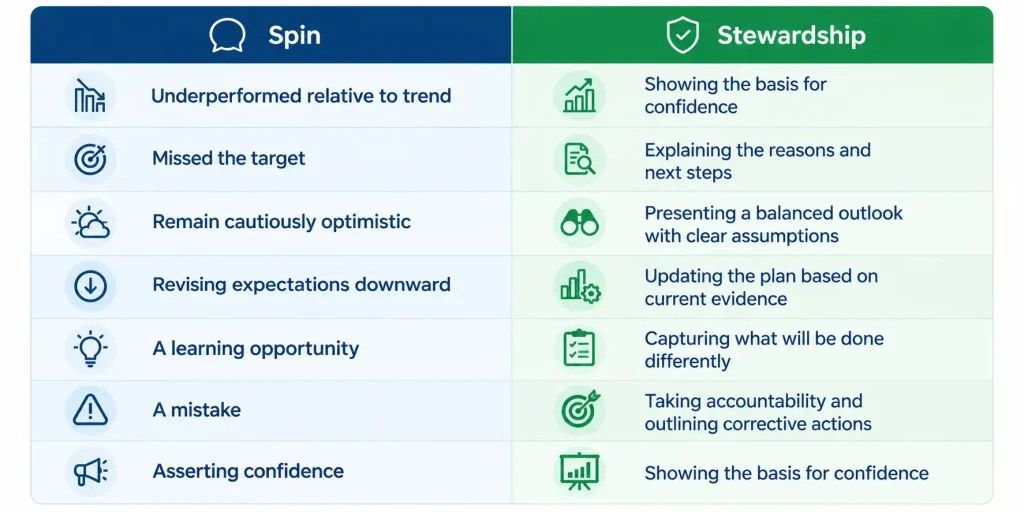
The paradox is that honesty about uncertainty makes a finance leader more believable. At the cybersecurity company, a forecast held within five percent of actuals for 8 consecutive quarters built credibility no adjective could match. Stakeholders do not demand perfect foresight; they want responsible vision and consistency under pressure.
Choosing the Right Medium for CFO Stakeholder Communication
Medium shapes meaning as much as the message does. Every board deck, earnings call and investor letter is a vessel, and its shape affects the substance inside. Overloaded slides teach boards to skim, and dashboards without narrative teach stakeholders that interpretation is someone else’s job. A sound stakeholder engagement strategy treats format as a deliberate choice.
Matching the Format to the Moment
- Board decks: The best board materials stay oriented instead of overloaded. They show what the board needs, point toward decisions and leave room for conversation.
- Written memos: A two-page memo can align a team better than 40 slides. It slows the eye and restores gravity to the message.
- Annotated visuals: A forecast trend line with marked inflection points can tell a year’s story in seconds, if framed for meaning.
- Cadence: The timing of an update signals confidence as much as its content. Surprising a board with a pivot erodes alignment, while early and steady updates build it.
- Voice: Presence and tone carry the integrity of the speaker. An overly polished delivery can make honest optimism sound like salesmanship.
A mission-driven education and research institution offers a useful example. Its finance and audit committee received monthly reports on a consistent rhythm. That cadence, central to the institution’s stakeholder engagement strategy, helped the board absorb difficult news early, and it supported a $37M raise across equity and venture debt. A marketplace SaaS company showed a similar pattern during its $20M Series B. Its cohort and unit economics models withstood diligence because plain, defensible explanation accompanied every figure.
Sometimes the right move is to abandon slides entirely. After a rough year, a short letter that acknowledges gaps can restore trust a choreographed presentation lost.
How a Stakeholder Engagement Strategy Transforms the Finance Leader
Over time, the CFO stops speaking about the numbers and starts speaking from them. The role shifts from reciting facts to stewarding attention and carrying the thread of coherence across volatile seasons.
The change begins with careful framing of variances, then deepens into narrative responsibility, the recognition that language does not just inform people but forms them. At a Euronext-listed gaming company operating across five countries, one unified definition of revenue across every subsidiary did more than shorten reporting cycles. It gave the board, auditors and teams a shared language, and that language shaped behavior.
The work is exacting, because honest narrative leaves no refuge in complexity. A finance leader must acknowledge the miss yet defend the purpose, and name the uncertainty yet anchor belief. The reward is coherence, the outcome every stakeholder engagement strategy exists to produce, and it holds long after the headlines fade.
Three Key Takeaways
- A stakeholder engagement strategy succeeds when the financial narrative combines intentional clarity, structured transparency, interpretive confidence and emotional coherence. Numbers inform stakeholders, but narrative is what earns their belief.
- Stakeholders filter every message through their own fears and incentives, so effective CFOs adjust framing to bridge mental models without bending the truth. Plain admissions of a miss build more credibility than clever qualifiers.
- The medium and cadence of financial communication are part of the message. Choosing memos, annotated visuals and steady updates over overloaded decks signals how seriously leadership takes stakeholder attention.
Disclaimer: This article is intended for informational purposes only and does not constitute legal, tax, or accounting advice. You should consult your own tax advisor or counsel for advice tailored to your specific situation.
Hindol Datta is a four-time CFO and senior finance executive with over 25 years of leadership experience across cybersecurity, SaaS, gaming, logistics, digital marketing, medical devices, consumer products, and nonprofit organizations. He has led more than $120M in fundraising and over $150M in M&A transactions while building the financial and operational systems that let complex businesses scale with confidence. He is the author of seven books in the Systems CFO Series and holds active CPA, CMA, and CIA credentials.
AI-assisted insights, supplemented by 25 years of finance leadership experience.



