Executive Summary
Software license revenue recognition is rarely the semantic exercise it appears to be on the surface. It is the mechanism by which a company tells the market, its board, and its auditors what it actually sold. Under ASC 606, the right-to-use versus right-to-access distinction determines the recognition pattern. That single choice decides whether revenue lands on delivery or unfolds across the life of the contract. License accounting frameworks built across companies from early-stage software builds to a publicly listed gaming enterprise reveal the same pattern. Long after the parties sign the contract, this classification decision ripples through forecasting, valuation, and audit outcomes.
This guide covers classifying license arrangements and allocating revenue across bundled performance obligations. It also shows how refund rights, financing terms, and contract modifications complicate what looks like a simple accounting question. The goal is a license accounting system a board can trust and an acquirer can underwrite.
Distinguishing License Types Under ASC 606
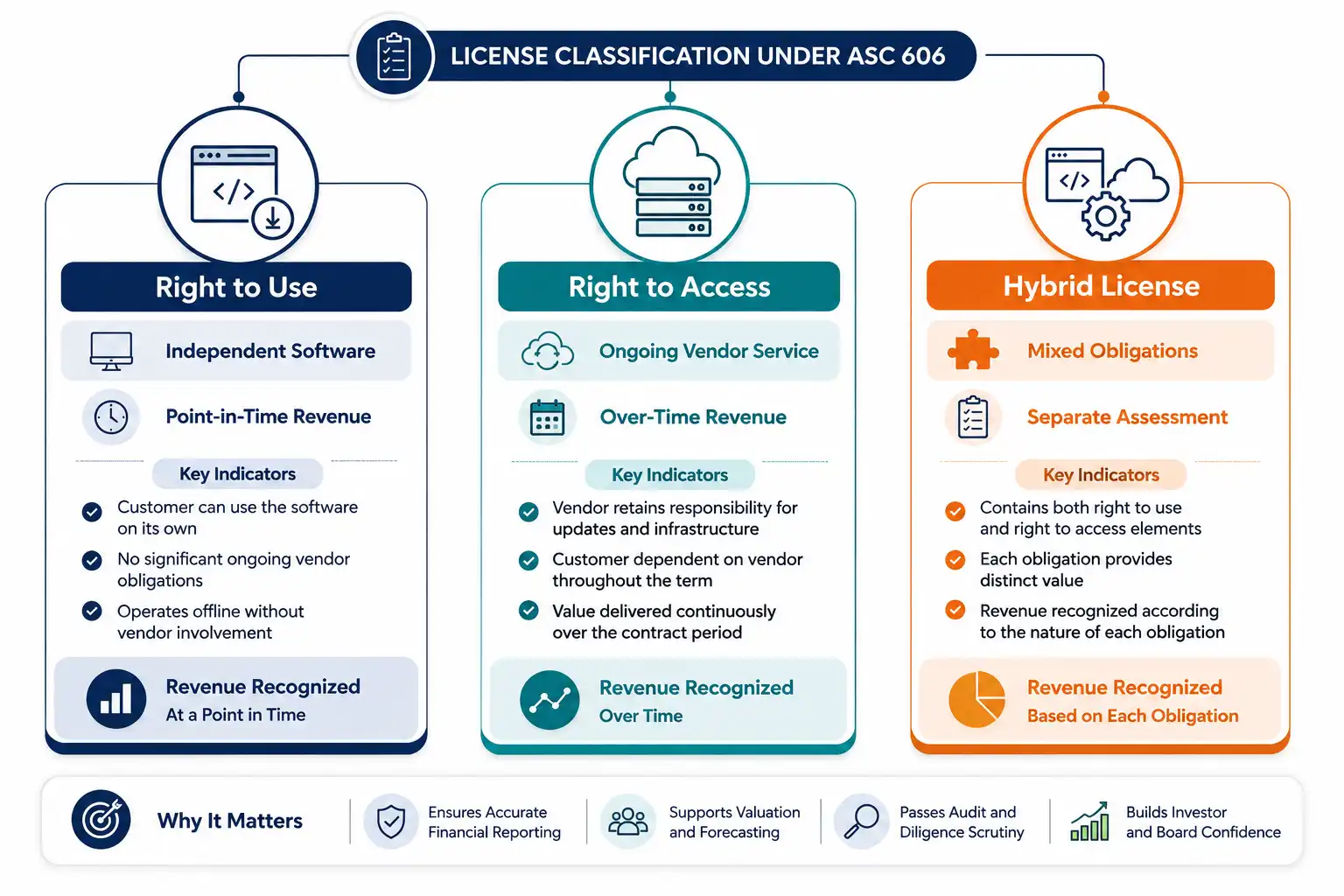
Every software license contract answers a single underlying question: does control transfer to the customer at a point in time, or does the vendor remain obligated across the term. ASC 606 organizes the answer into three categories. A right-to-use license grants the customer a perpetual or finite license to operate the software from delivery, with no meaningful ongoing vendor obligation. A right-to-access license places the customer inside a system the vendor continues to run, update, and support, so value keeps arriving throughout the term. Hybrid arrangements combine both, and in my experience, they generate the most audit friction, because finance teams’ default to whichever treatment is simpler to administer rather than the one the facts support.
Determining which category applies means reading the contract the way an auditor will, not the way sales wrote it. Three questions tend to resolve it: whether the customer receives installable code capable of operating independently, whether the vendor retains responsibility for updates or infrastructure, and whether the customer can use the software offline without vendor intervention. If the customer walks away with a functioning, self-sufficient asset, revenue generally belongs at delivery. If the vendor’s fingerprints remain on the product for the life of the contract, the arrangement counts as access, and ASC 606 requires recognizing that access over time.
A Cautionary Example from Practice
A cybersecurity and identity access management company once drafted its contracts in the language of a perpetual license, while the vendor hosted, updated, and operated the underlying product for the full term. The paperwork said one thing; the delivery model said another. Building the ASC 606 revenue recognition framework and controls environment for that business meant showing finance and legal why the contract label could not override the substance of what the customer received. The resulting shift from point-in-time to over-time recognition smoothed the revenue curve and carried the business through acquisition diligence without a single revenue-related finding.
Point-in-Time Versus Over-Time License Revenue Recognition
Settle the classification, and the recognition pattern almost sets itself. Point-in-time recognition applies when the license is a standalone right and control transfers at delivery, though surrounding obligations such as implementation or training may still require separate allocation. Over-time recognition applies when the license grants access and the vendor carries ongoing responsibility, and ASC 606 permits either a straight-line, time-based method or an output measure tied to usage or uptime.
The practical differences show up across common license structures:
| Arrangement | Classification | Recognition Pattern |
| Embedded software in hardware, no updates | Right to use | Recognized at shipment |
| Cloud-based software with vendor-managed infrastructure and updates | Right to access | Recognized ratably over the term |
| Perpetual license plus annual support | License at delivery; support separate | License at delivery, support over support period |
| Term license delivered locally with periodic vendor-server updates | Mixed obligations | Separate recognition by obligation |
Consider a SaaS company selling a two-year license for $240K that bundles access, updates, and vendor-hosted infrastructure. That is right-to-access, so the company recognizes the $240K straight-line at $10K per month across 24 months. Compare that to a perpetual right-to-use license sold for $150K, where the customer downloads the code, receives no future updates, and operates independently. Control transfers at delivery, and the full $150K is recognized the month the software ships.
Allocating Revenue Across Bundled Performance Obligations
License sales rarely arrive alone. Implementation, training, and support are common companions, and ASC 606 requires each distinct performance obligation to be identified, priced at its standalone selling price, and recognized on its own timeline. I have seen revenue misstated simply because a finance system booked a bundled invoice as a single general ledger event, an error that survives comfortably at the earliest stage of a company and becomes untenable once institutional investors or acquirers start asking questions.
Take a contract combining a two-year license priced at $200K, implementation at $40K, and two years of support at $60K, for a total contract value of $300K billed upfront. The standalone selling prices differ from the contract price: license at $220K, implementation at $40K, and support at $80K, for a total standalone selling price of $340K.
| Component | Standalone Selling Price | Allocation % | Allocated Revenue | Recognition Timing |
| License | $220K | 64.7% | $194.1K | Ratable over 24 months |
| Implementation | $40K | 11.8% | $35.4K | Over project timeline (percentage of completion) |
| Support | $80K | 23.5% | $70.5K | Straight-line over 24 months |
| Total | $340K | 100% | $300K |
The ability to execute this allocation with any consistency depends on whether the finance system captures contract metadata: obligation type, service duration, billing trigger, and standalone selling price. While building the finance function for a public gaming and entertainment company operating across five countries, rolling out a common financial platform across every subsidiary produced a single, defensible definition of revenue rather than five slightly different ones, and cut the statutory reporting cycle under both IFRS and US GAAP.
Refunds, Financing, and Contract Modifications
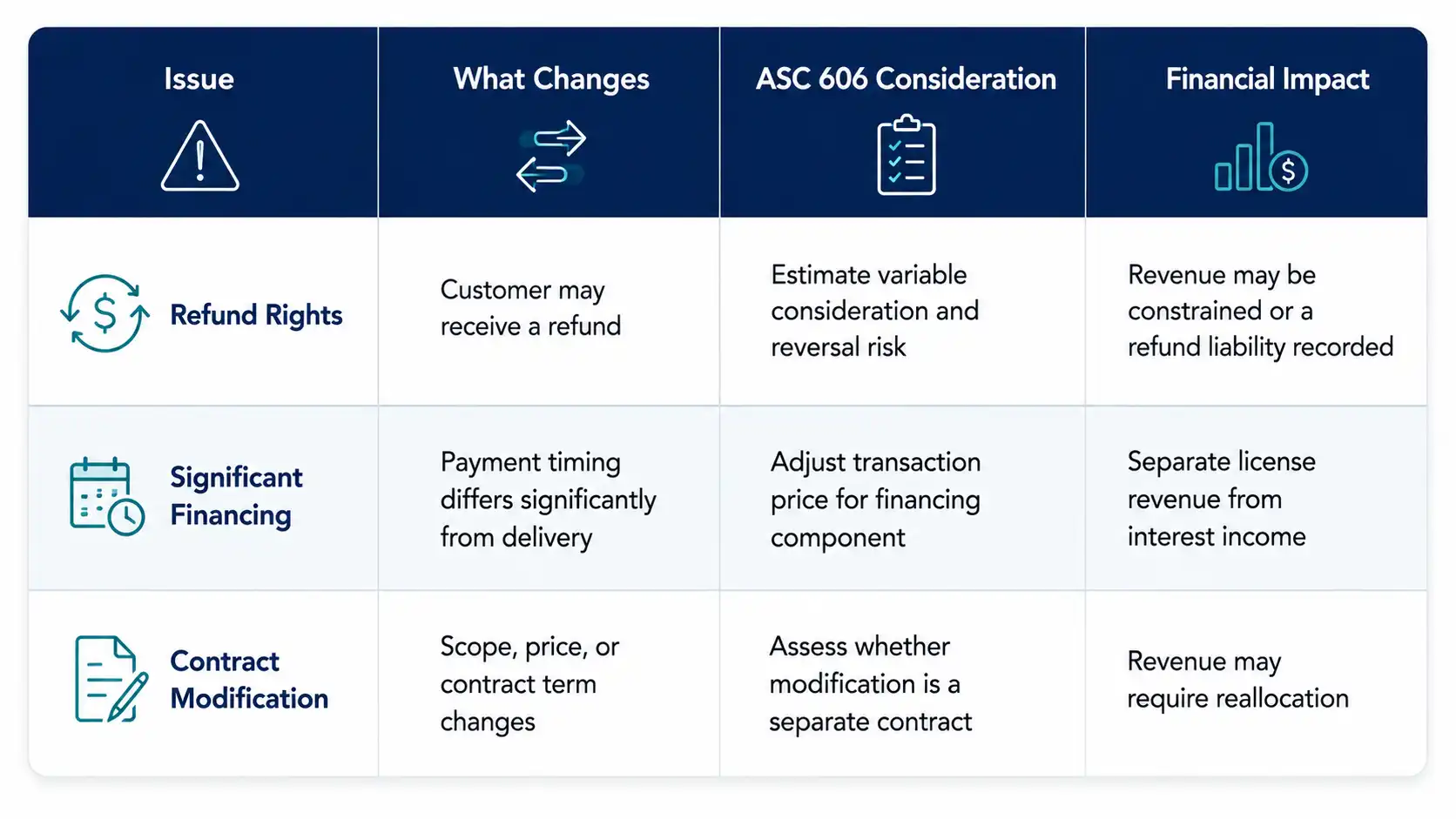
Three complications deserve deliberate treatment. Refund rights and termination clauses introduce variable consideration, and ASC 606 requires management to estimate the consideration it expects to be entitled to, constrained against significant future reversal. A customer purchasing a $100K annual license with the right to cancel after six months for a 40 percent refund means $40K of that price may need exclusion from the transaction price unless historical retention data supports otherwise, which often means recognizing revenue straight-line over the noncancelable period, or booking a refund liability that unwinds as risk clarifies.
Embedded financing arrives when a vendor lets a customer defer payment while using the software, and ASC 606 requires the transaction price to be adjusted for any significant financing component. A $120K license due in full after 12 months, discounted at a market borrowing rate of six percent, carries a present value of roughly $113.2K, with the remaining $6.8K recognized as interest income over the financing term rather than folded into license revenue. That distinction is easy to treat as immaterial in an early-stage company and harder to ignore once multi-year enterprise contracts with delayed payment terms appear in international markets.
Renewals and modifications create their own judgment call. A renewal that extends the term by 12 months at a 10 percent discount is treated as a new contract when the added goods or services are distinct and priced at standalone selling price; otherwise, the original contract must be revised and the remaining revenue reallocated. Every finance team benefits from logging the scope change, the price change, the modification date, and whether reallocation occurred, because that log becomes the evidence an auditor or acquirer will ask for during diligence.
Journal Entries and Systems Design
A right-to-access example makes the mechanics concrete. A contract totaling $340K, billed upfront, covers a $240K license over two years, $40K of implementation over 60 days, and $60K of support over two years, allocated per the table above. At signature, cash of $340K is debited, with deferred revenue credited across license ($194.1K), implementation ($35.4K), and support ($70.5K). Each month, deferred revenue for the license is debited and revenue credited for roughly $8.1K, with support following the same pattern at approximately $2.9K. Around day 30, as implementation work lands, deferred revenue for implementation is debited and revenue credited for $17.7K. Each stream is pulled from deferred revenue on its own schedule, which lets a CFO present monthly recurring revenue, annual recurring revenue, and support revenue as clean, separable numbers.
None of this holds together without deliberate systems design. Sales teams need contract language distinguishing access from use, termination rights, and upgrade commitments in terms finance can operationalize. Configure-price-quote and billing systems need to tag license type at the point of sale, not reconstruct it after the fact. A license classification matrix, reviewed quarterly, gives auditors a consistent sample to test rather than a fresh argument every cycle, and that same discipline is what an acquirer’s diligence team looks for when license revenue ties to delivery and churn.
Three Key Takeaways
- Classification comes before calculation. Determine whether the license is a right to use or a right to access based on delivery substance rather than contract labeling, because that single judgment determines whether revenue lands at signing or unfolds over years.
- Bundled contracts demand bundled discipline. Standalone selling price allocation, contract metadata capture, and obligation-level tracking are what stands between a defensible revenue number and a finding an auditor or acquirer will not let go.
- Build the system before the scale arrives. Classification matrices, refund and modification logs, and CPQ-level tagging are inexpensive when a company is small and expensive to retrofit once contract volume, geography, and investor scrutiny increase at once.
Disclaimer: This article is intended for informational purposes only and does not constitute legal, tax, or accounting advice. You should consult your own tax advisor or counsel for advice tailored to your specific situation.
Hindol Datta is a four-time CFO and senior finance executive with over 25 years of leadership experience across cybersecurity, SaaS, gaming, logistics, digital marketing, medical devices, consumer products, and nonprofit organizations. He has led more than $120M in fundraising and over $150M in M&A transactions while building the financial and operational systems that let complex businesses scale with confidence. He is the author of seven books in the Systems CFO Series and holds active CPA, CMA, and CIA credentials.
AI-assisted insights, supplemented by 25 years of finance leadership experience.