
Executive Summary
Shareholder value gets invoked constantly in annual reports and earnings calls, almost as a reflex. Yet the understanding of how decisions actually create it often stays confined to finance. This article argues that the fix is not more data. It is shared financial fluency. Product, marketing, engineering, and design teams see their daily choices through a financial lens, not as an obligation but as instinct.
The article covers what financial fluency actually means beyond reading a balance sheet, and how to operationalize it into daily decisions. It also covers how a CFO teaches this without alienating other functions, and how financial thinking becomes lasting cultural capital that protects shareholder value. Readers will find practical approaches for each stage.
The Architecture of Financial Fluency
Financial literacy is often mischaracterized as the ability to read financial statements or calculate return on capital. That is technical literacy. Financial fluency goes further. It is an intuitive grasp of how value actually flows through an organization, not confined to the finance department.
Breaking Down Departmental Tribalism
Finance often views product and creative teams with suspicion, seeing them as unstructured or too emotional. Operational units often see finance as the department of no. This mutual misunderstanding corrodes alignment and wastes potential, not just dollars. The fix is not a top-down literacy campaign. It is seeding financial empathy, starting from the belief that financial insight expands creative options rather than constraining them.
Consider a product manager who greenlights a feature that increases stickiness but raises upfront costs. A purely technical view sees gross margin dilution. A financially fluent view sees deferred revenue potential and a play on lifetime value. Teams that can articulate choices in terms of contribution margin or customer acquisition cost stop being operational agents. They become value architects instead. The CFO’s role is not to audit their ideas. It is to give them a grammar that makes those ideas legible to investors.
Adapting the Message to Each Team
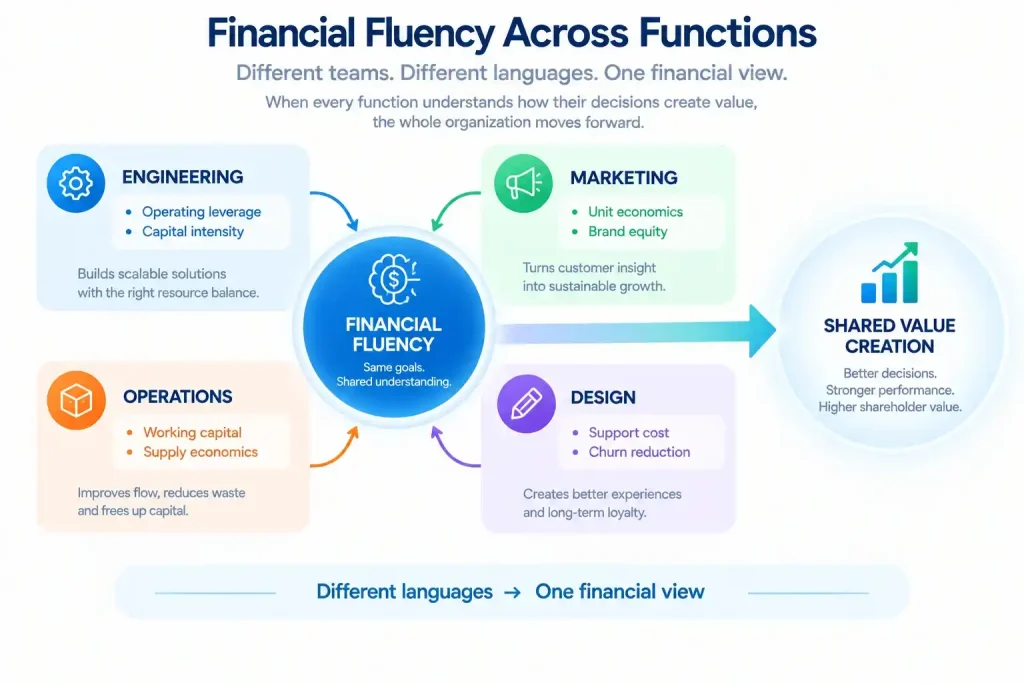
Financial messaging needs adaptation to each team’s existing language, the same way an architect adjusts blueprints for a different audience. Engineering teams already think in systems and precision, so concepts like operating leverage translate well through throughput and latency analogies. Marketing teams think in narrative and consumer journey, so unit economics and brand equity as intangible capital fit naturally. Operations teams think in flow and efficiency, so working capital becomes a natural extension of supply chain language.
| Team | Native language | Financial concept it maps to |
| Engineering | Systems, throughput, latency | Operating leverage, capital intensity |
| Marketing | Narrative, consumer journey | Unit economics, brand equity as capital |
| Operations | Flow, efficiency | Working capital, supply chain economics |
| Design | User experience, retention | Support cost savings, churn reduction |
This kind of fluency shows up in small moments rather than formal training. A design lead who models how an interface change affects support cost and churn has moved financial thinking from a rulebook into instinct. So has a data science team that ties model pipeline decisions to customer lifetime value relative to compute cost. That shift needs deliberate design and repetition, though. It rarely happens through osmosis alone. This kind of thinking lives in the stand-up where engineering choices weigh resource allocation, and in the content meeting where a campaign gets judged by payback period, not just reach.
Operationalizing Financial Literacy Across Functions
Understanding the relationship between margin and momentum is one thing. Embedding that understanding into daily decision-making across departments is another matter entirely. This is where financial literacy either becomes real or stays theoretical.
Embedding Finance as a Native Feature
Financial intelligence needs to enter meeting rooms, product boards, and engineering backlogs as a native feature, not a foreign audit. Embedded finance partners, drawn from FP&A and placed directly with product, engineering, and go-to-market teams, do this well. They act as collaborative strategists, not policy enforcers, reframing tradeoffs in terms of contribution margin and recasting marketing ROI as discounted payback. Their value comes from amplifying decisions, and the best ones speak the native language of the team they join.
Product roadmaps rarely surface unit economics alongside velocity and shipping cadence. Design reviews of user experience flows rarely connect to support cost per customer, mostly because that connective tissue has never been made visible.
Making Financial Flow-Through Visible
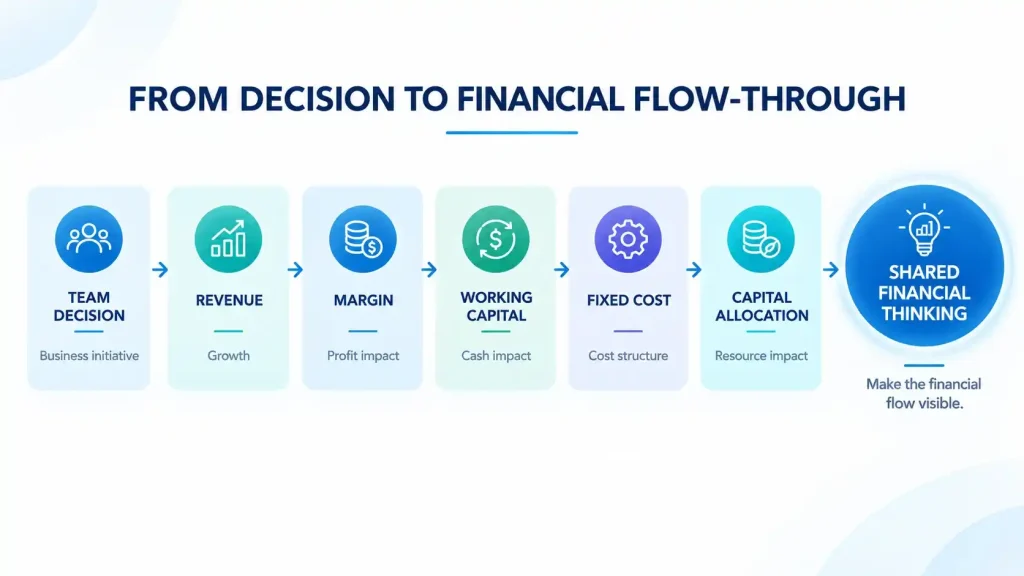
A simple visual tool can close that gap directly. One company built what it called a Flow Map, a shared board where any team could place a proposed initiative. It immediately showed how that initiative flowed through five metrics: revenue growth, gross margin impact, working capital change, fixed cost ratio, and capital allocation. It functioned as a thinking tool rather than an accounting tool, and over time the structure of team proposals changed. They became more concise and more grounded in a shared financial substrate instead of subjective alignment debates.
Culture needs to reward this kind of curiosity rather than penalize it. A junior team member might ask how a design simplification could reduce average support call duration. When the answer turns out to matter, that question deserves visible recognition. That recognition is what teaches an organization that financial curiosity belongs to everyone, not only to finance.
The Empathic CFO: Teaching Without Preaching
Financial fluency collapses under its own weight without empathy behind it. A forecast that alienates a team accomplishes nothing. A cost structure that cannot be communicated without triggering defensiveness fails, regardless of how accurate it is.
Leading With Questions Instead of Answers
Presenting margins and benchmarks with detached confidence rarely persuades anyone. People do not reject financial truth because they are irrational. They reject it when it arrives without context or respect for their domain. A more effective approach starts with curiosity rather than judgment. When engineering proposes a delay, asking what assumptions have changed works better than citing the budget impact directly. When marketing overspends on a campaign, asking what the team believed they were solving for works better. Questioning their discipline directly rarely helps.
Humility matters as much as curiosity here. Financial metrics are the residue of value creation, not its origin. Creative risk-taking often precedes the most profitable outcomes, even when those early bets are not bankable at inception. Treating financial fluency as a collaborative effort, rather than an assertion of primacy, shifts the CFO’s role. Critic becomes genuine partner in value creation.
Building Spaces for Financial Thinking Without Fear
A workshop format built around simple cards, representing cost, value, and risk, needs no spreadsheet at all. Cross-functional teams can simulate hiring, launch, and pricing decisions and feel the tension between ambition and constraint directly. Participants in this kind of exercise often begin grasping capital allocation tradeoffs intuitively. Just as important, they start using financial language with each other afterward because they respect it, not because anyone enforced it.
None of this means abandoning standards. An empathic approach can actually hold a line more firmly. People who feel understood tend to listen more deeply and take ownership of a metric, rather than merely comply with it. This emotional fluency extends upward too, since boards increasingly want to know how a company’s culture internalizes financial thinking, not just what the numbers say.
Cultural Capital: Making Financial Thinking a Shared Asset
Culture behaves like capital when properly tuned, and it protects shareholder value the same way any other asset does. It compounds the same way capital does, and it erodes just as destructively when mismanaged. Financial thinking distributed across an organization is one of its quietest, most transformative forms.
From Toolkit to Worldview
Many companies celebrate product launches with no embedded profit-and-loss awareness, while fearing budget variances elsewhere. That asymmetry creates a quiet fracture between action and understanding. Financial thinking only becomes powerful as a philosophy that gets lived daily, not lectured occasionally.
In organizations where finance stays sequestered, a missed forecast or failed campaign becomes a battleground for blame. In organizations where financial thinking is culturally distributed, the same event becomes a laboratory for learning. Teams re-underwrite decisions instead of only reacting to them. At a $127M global consumer products company, this kind of thinking showed up directly in demand planning and inventory decisions. Choices made close to the operational front line, not dictated from finance, lifted inventory turns from 3x to 7x and directly supported shareholder value.
Language as the Carrier of Cultural Capital
Terms like unit economics and capital efficiency need rooting in narrative and context to spread, not jargon dropped without explanation. Telling a designer that customer acquisition cost is rising means little on its own. Explaining that each new user now costs more gives the term somewhere to land. Design choices can influence that curve directly.
A cross-functional exercise built around an economic value canvas maps how quarterly goals affect cash flow timing and existing cost structures. It can move a room from resistance to fluency within a single day. When financial thinking becomes genuinely shared, shareholder value stops being a distant abstraction. It becomes something employees experience directly. Every local decision echoes into the company’s capital structure, whether or not anyone names that connection out loud.
Three Key Takeaways
- Build financial fluency, not just financial literacy. Translate core concepts into each team’s native language, rather than expecting every function to learn finance vocabulary from scratch.
- Operationalize the shift with embedded finance partners. Use visible tools that show how a decision flows through revenue, margin, and capital metrics in real time.
- Treat financial thinking as cultural capital. Teach it with empathy, reward curiosity publicly, and let the language of value creation spread through daily work, not mandate.
Disclaimer: This article is intended for informational purposes only and does not constitute legal, tax, or accounting advice. You should consult your own tax advisor or counsel for advice tailored to your specific situation.
Hindol Datta is a four-time CFO and senior finance executive with over 25 years of leadership experience across cybersecurity, SaaS, gaming, logistics, digital marketing, medical devices, consumer products, and nonprofit organizations. He has led more than $120M in fundraising and over $150M in M&A transactions while building the financial and operational systems that let complex businesses scale with confidence. He is the author of seven books in the Systems CFO Series and holds active CPA, CMA, and CIA credentials.
AI-assisted insights, supplemented by 25 years of finance leadership experience.