
Executive Summary
Scenario planning in strategic management often shrinks to a single slide with best, base, and worst cases. That ritual offers little protection when markets shift, because it describes outcomes without preparing responses. Real strategy is plural, and the CFO is well placed to design the range of futures a company should rehearse.
The sections ahead reframe scenario planning as a strategic muscle instead of a compliance exercise. They cover how to design scenarios that drive decisions, how to embed them in culture, and how rehearsal speeds up decisions. They also address the courage to model loss and the return that disciplined preparation delivers. Together they show how finance leaders turn uncertainty into readiness.
Why Most Scenario Planning Falls Short
The typical planning deck ends with three columns that shift revenue and margin by a few points. A label such as “stress-tested” suggests foresight, yet a case 10% below forecast seldom tests anything meaningful. Such exercises satisfy optics without changing how leaders would act.
From Scenario Description to Scenario Design
The real value of scenario planning lies in surfacing decisions instead of adjusting variables. Most models ask what happens if revenue falls 15%. The better question asks what the company will do if that happens. Options might include pausing hiring, repricing offerings, renegotiating contracts, or delaying investments.
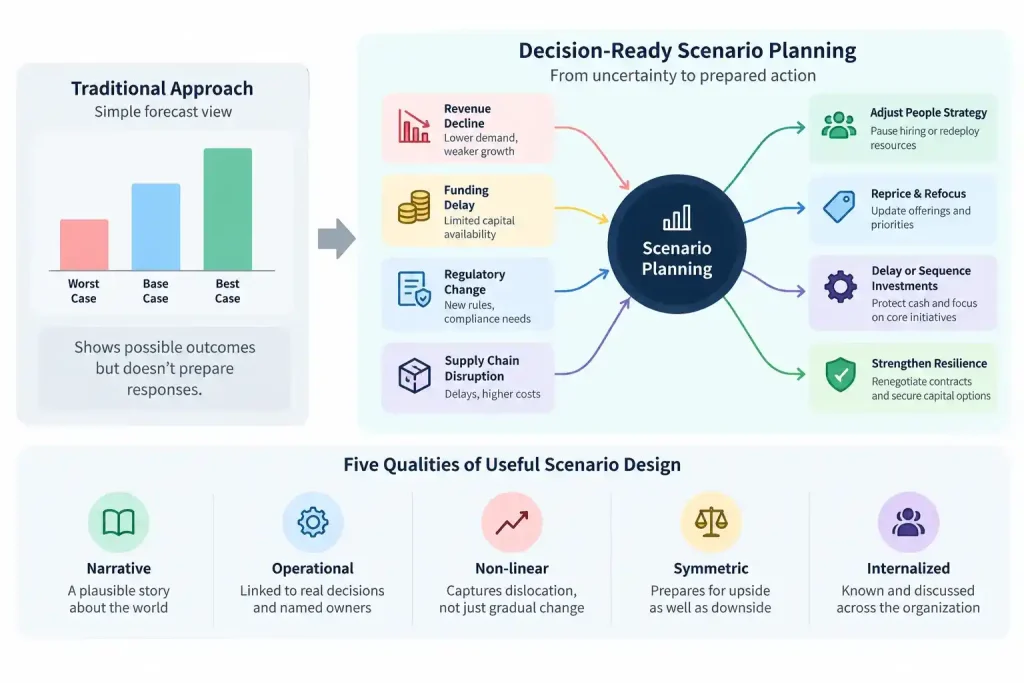
Five Qualities of Useful Scenario Design
| Quality | What It Means | Example |
| Narrative | Each scenario tells a plausible story about the world | A competitor launches a freemium product |
| Operational | It links to real decisions and named owners | Headcount, sequencing, and resourcing changes |
| Non-linear | It captures dislocation, not just gradual decline | A revenue drop that also shakes customer confidence |
| Symmetric | It prepares for upside as well as downside | A sudden surge in demand or a regulatory win |
| Internalized | Leaders know and discuss it, not just finance | Teams can state their response without the model |
To achieve these qualities, the CFO must move from modeling to facilitation. Effective scenario work happens in dialogue with sales, product, HR, and marketing. Leaders ask what breaks under each condition, what the company must give up, and where it will trade growth for resilience. In a real crisis, there is no time to develop new principles, so companies act on the ones they have already set.
A pre-Series A AI governance and assurance platform shows how this work supports strategy from an early stage. Finance built the operating model, multi-year scenario analyses, and capital strategy alongside the investor narrative. Those scenarios gave leadership a structured way to weigh funding paths before committing to one.
Making Scenario Planning a Shared Discipline
A spreadsheet begins as a private document, yet no model can carry a firm’s future unless leaders use it beyond the laptop. Scenario planning becomes strategy only when people speak it aloud, debate it, and own it. Most finance teams know how to test sensitivities but find this cultural work harder.
Planning in Public
Robust scenarios come from co-authorship with the operators who would execute them. Modeling a 15% revenue decline differs from asking the head of sales what she would do if it came true. Those conversations can feel uncomfortable, but they reveal where strategy rests on fragile assumptions.
A cross-functional offsite offers a practical format for this work. Leaders walk through a few plausible shocks, such as a funding delay, a regulatory change, or a supply chain break. Each team lead then states aloud what the function would do. The result is coherence more than consensus, as the table below illustrates.
Sample Functional Playbook for a Funding Delay Scenario
| Function | Pre-Agreed Response |
| Sales | Prioritize retention over new logos |
| Marketing | Pause top-of-funnel spend and focus on mid-funnel activation |
| HR | Freeze external hiring and accelerate internal mobility |
| Legal | Pre-draft clauses for vendor renegotiation |
| Finance | Activate cash contingencies and update runway models |
Some leaders worry that planning for failure breeds anxiety. In practice, the lack of planning breeds anxiety, while companies that rehearse move with calm and coordination. When scenario planning becomes a regular cadence instead of a quarterly exercise, it shapes how the company thinks.
Scenario Planning as a Driver of Decision Velocity
Speed impresses at all-hands meetings, yet a fast decision is not always a good one. In many companies, speed simply reflects missing process or fear. True decision velocity comes from readiness built in advance.
Front-Loading the Debate
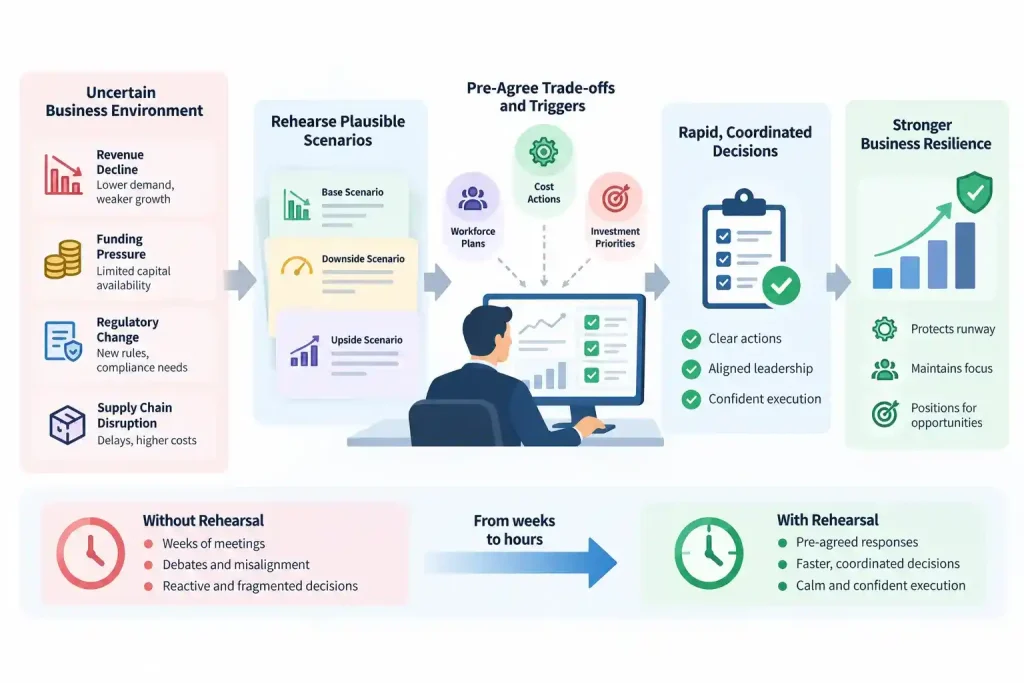
Scenario planning gives time back to leaders at the moment it is most scarce. Imagine a sudden economic contraction that no forecast predicted. A company with a rehearsed capital shock scenario already knows which roles to prioritize, which investments to delay, and which costs can flex. A response that might have taken three weeks of meetings can then happen in a few hours.
That readiness builds a strategic reflex, a practiced response that lets the company move together. Good scenario design does not make a company rigid; it front-loads the thinking. Leaders name trade-offs and draw tolerance bands early. When new information arrives, the question becomes whether it falls within prepared boundaries. If so, teams act, and if not, they revisit quickly together.
An early-stage email marketing SaaS company shows the value of acting decisively under pressure. A financial turnaround there reduced monthly burn from $800K to $200K, which extended runway and protected the core business. Clear priorities made those cuts faster and less disruptive.
The CFO holds a unique vantage point for this work. No other leader sees how trade-offs intersect between spend and scale, people and capital, or risk and runway. That view makes finance the natural owner of turning scenarios from decks into decisions.
The Courage to Model Loss
Real risk modeling makes many leadership teams uncomfortable. People warn against overreacting or argue that a downside case sends the wrong signal. Yet refusing to model a hard scenario often causes the delay that makes it worse.
Naming What Must Be Protected
The phrase “this might break” is architectural, not defeatist. It helps teams find pressure points and decide what the company must never compromise, such as the mission, key people, and long-term bets. It also names what the company can let go, such as experiments, excess optionality, and lower-priority spend.
A powerful opening question for scenario planning in strategic management asks what the company would protect first if it lost 40% of revenue overnight. Every leader usually has an answer, and the answers seldom match. Working through that misalignment takes time, yet it produces a shared map of priorities. That map keeps the company focused when pressure arrives months later.
A mission-driven education and research institution in Silicon Valley offers a relevant example. Finance leadership there built multi-year models under variable funding conditions while overseeing Finance, HR, IT, Legal, and Facilities. Planning for funding shortfalls in advance helped protect core programs when conditions changed.
The Return on Scenario Planning
Every planning discussion eventually raises a fair question about cost and gain. Scenario planning consumes time, attention, and trust, so the CFO must ask about its yield. The answer starts with a reframe: the goal is better strategic response, not better forecast accuracy.
Three Categories of Return
Companies that build scenario capability before a downturn already know which spending is discretionary and which projects can pause. Leaders rely on a shared language for thresholds and actions. When volatility arrives, they conserve capital earlier, retain talent longer, and avoid the cost of reactive thrashing. The return tends to appear in three areas:
- Decision efficiency: faster choices with fewer internal debates, because leaders modeled trade-offs in advance
- Capital resilience: debt structured with contingencies, and hiring paced within upper and lower bounds
- Strategic integrity: the ability to adjust means without abandoning the mission under stress
These benefits show up in measurable outcomes such as lower attrition, tighter cash burn, higher renewal rates, and stronger recovery. A cybersecurity SaaS company with roughly $30M in ARR shows the payoff of disciplined planning. Its driver-based forecasting engine and capacity model kept actuals within plus or minus five percent of forecast for 8 consecutive quarters.
Uncertainty is now a permanent feature of business, not a passing condition. In that environment, scenario planning acts as a form of governance. It gives the company a compass that works when the weather turns, and it prepares leaders to act before circumstances force their hand.
Three Key Takeaways
- Effective scenario planning models responses as well as outcomes, with narrative, operational, non-linear, symmetric, and internalized scenarios.
- Scenario planning in strategic management works best when operators co-author the playbooks, which speeds decisions and builds calm under pressure.
- The return on scenario planning appears in decision efficiency, capital resilience, and strategic integrity when volatility arrives.
Disclaimer: This article is intended for informational purposes only and does not constitute legal, tax, or accounting advice. You should consult your own tax advisor or counsel for advice tailored to your specific situation.
Hindol Datta is a four-time CFO and senior finance executive with over 25 years of leadership experience across cybersecurity, SaaS, gaming, logistics, digital marketing, medical devices, consumer products, and nonprofit organizations. He has led more than $120M in fundraising and over $150M in M&A transactions while building the financial and operational systems that let complex businesses scale with confidence. He is the author of seven books in the Systems CFO Series and holds active CPA, CMA, and CIA credentials.
AI-assisted insights, supplemented by 25 years of finance leadership experience.



