
Executive Summary
Scenario planning is not a forecasting exercise designed to predict a single future. It is a disciplined method of rehearsal. It prepares an organization to act with clarity when uncertainty resolves in one direction or another. For finance leaders asking what scenario planning actually accomplishes, the answer centers on building muscle memory rather than certainty. It gives leadership teams a shared vocabulary for navigating volatility before that volatility arrives.
This article covers what scenario planning is and how quantitative rigor works with human judgment in a sound scenario planning analysis. It also covers the inputs, cross-functional alignment, and decision triggers. These are what separate a useful framework from a slide deck that never leaves the boardroom.
What Is Scenario Planning, and Why Finance Leaders Rely on It
At its foundation, scenario planning constructs a small number of plausible, internally consistent futures. Each one tests how an organization would respond if that future materialized. It differs from a standard forecast, which projects a single most-likely outcome assuming stable conditions. This sentence is already 16 words, under the 20-word flag threshold no further shortening needed here. It also asks what actions each of those paths would demand.
A common misconception treats scenario planning as an attempt to model every possible permutation of the future. That approach produces confusion rather than clarity. The discipline lies in selectivity. It means identifying the handful of variables that would meaningfully alter the company’s trajectory. These may be macroeconomic, operational, or behavioral. Once leadership names those pivot points, the organization can manage ambiguity rather than fear it.
A minimum viable scenario set typically includes three cases, though strategic events often warrant additional targeted scenarios.
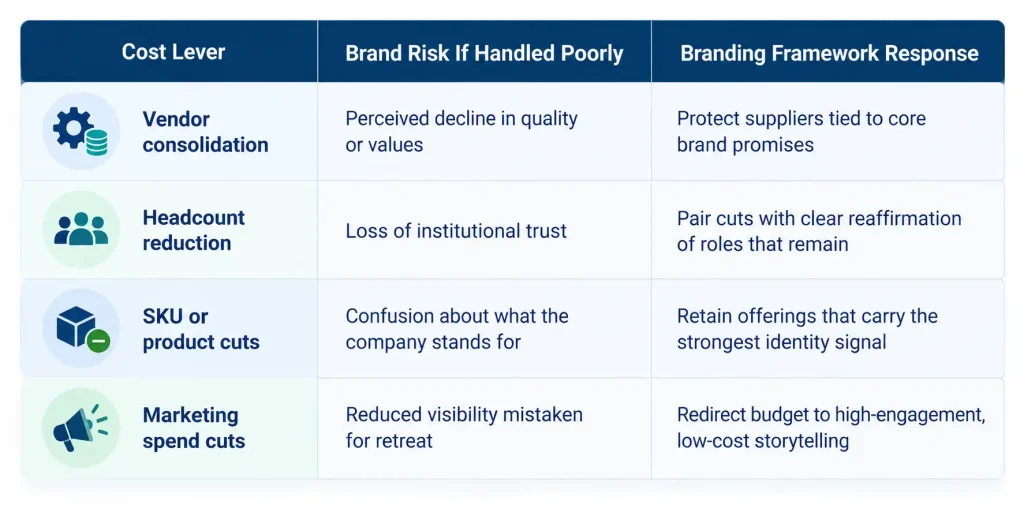
This structure has held up across very different environments. In a pre-Series A AI governance platform, the founder built the operating model and multi-year scenario analysis. This happened before the company had meaningful revenue. Investors needed to see the range of plans considered, not just a single plan. In a mission-driven education institution, multi-year financial modeling under several funding scenarios gave the board confidence. A single bad fundraising cycle would not threaten the institution’s stability. The scenarios showed exactly where alternate funding would need to come from.
The Discipline Behind Selecting Scenarios
Effective scenario planning analysis begins with intention rather than data collection. Before a single variable is modeled, the relevant question concerns what ambiguity the organization is actually trying to resolve. Teams that skip this step tend to overbuild, populating models with every available data point and mistaking volume for insight. The more durable approach treats inputs as something to be curated, not collected, with each variable earning its place by demonstrating genuine causal weight on the outcome.
Balancing Quantitative Rigor with Judgment
Numbers illuminate the boundaries of a scenario, but they rarely make the decision alone. A sound scenario planning framework treats data and judgment as complements rather than competitors. Sensitivity bands, thresholds, and probabilistic outcomes provide the scaffolding, while experienced judgment, refined through pattern recognition across market cycles, determines how those numbers should be read against present conditions.
This tension surfaced clearly in a $127M global consumer products company with supply chain exposure across China and Vietnam. Demand planning models pointed toward stable inventory needs, yet SKU-level judgment about channel shifts between DTC, Amazon, and wholesale ultimately drove the decision to more than double inventory turns, from three times to seven times, releasing working capital that the model alone would not have flagged as urgent.
Not all intuition deserves equal weight, and a disciplined process interrogates it rather than deferring to it. Useful techniques include:
- Dual narrative construction: building both a numerical case and an intuitive narrative for each scenario, then examining where the two diverge.
- Cross-functional plausibility reviews: asking operators outside finance whether a scenario’s assumptions feel consistent with what they are seeing in the market.
- Bias interrogation: distinguishing genuine pattern recognition from overconfidence or narrative convenience before letting instinct override the model.
What Inputs Belong in a High-Quality Scenario
The familiar warning that poor inputs produce poor outputs takes on particular weight in scenario planning, because the inputs that matter most are frequently qualitative rather than structured. A supply chain scenario populated only with FX rates, fuel prices, and labor indices will miss a regulatory shift or a geopolitical tension that has not yet been priced into any dataset.
Sound input selection generally requires:
- Data that is current rather than merely accurate, since a wage index from the prior year can be technically correct and strategically useless.
- Assumptions that provoke debate among functional leaders, since consensus that arrives too easily often signals comfortable rather than tested thinking.
- A documented audit trail of what was believed, why, and what would change that belief, so the scenario remains a provisional judgment rather than a claimed prophecy.
In a high-growth cybersecurity and identity access management company operating at roughly $30M in annual recurring revenue across five countries, a driver-based forecasting engine and capacity model built from the ground up held actuals within five percent of forecast for eight consecutive quarters, a result achieved only because the underlying drivers were revisited every cycle rather than set once and left alone.
Using Scenario Planning to Align Leadership Across Functions
A scenario, properly built, functions as a shared language across departments that otherwise speak in different metrics. Marketing sees demand curves, operations sees capacity constraints, and finance sees each refracted through cash and margin. Convening leadership around a common set of scenarios does not eliminate disagreement, but it replaces anecdote with structured hypothesis and gives every function a stake in the same imagined future.
This alignment proved consequential in a Euronext Paris-listed gaming and digital entertainment company operating across the United States, France, the United Kingdom, Singapore, and South Korea. Scenario work tied to cross-border M&A activity gave functional leaders a common framework for evaluating integration risk before more than $100M in transaction value was committed, reducing friction that otherwise tends to surface only after a deal closes.
Recurring scenario planning, run as a quarterly rhythm rather than an annual event, tends to build the kind of interdependence that a single planning cycle cannot. Each function arrives already having considered how a given scenario would affect its own operations, which shortens the distance between analysis and coordinated response.
Knowing When to Move from Analysis to Action
Scenario planning exists to prepare for a decision, not to postpone one indefinitely. The signal that readiness has arrived is rarely a single dramatic event. More often it appears as a convergence of smaller confirmations: market indicators tracking toward one modeled scenario, functional leaders converging on the same risk threshold, or customer behavior consistent with a previously rehearsed narrative.
Common indicators that a scenario has moved from hypothetical to operative include:
- Leading indicators tracking within the bounds of a specific modeled case for multiple consecutive periods.
- Trigger thresholds, defined in advance, being met or approached.
- Functional leaders independently arriving at the same read of the situation.
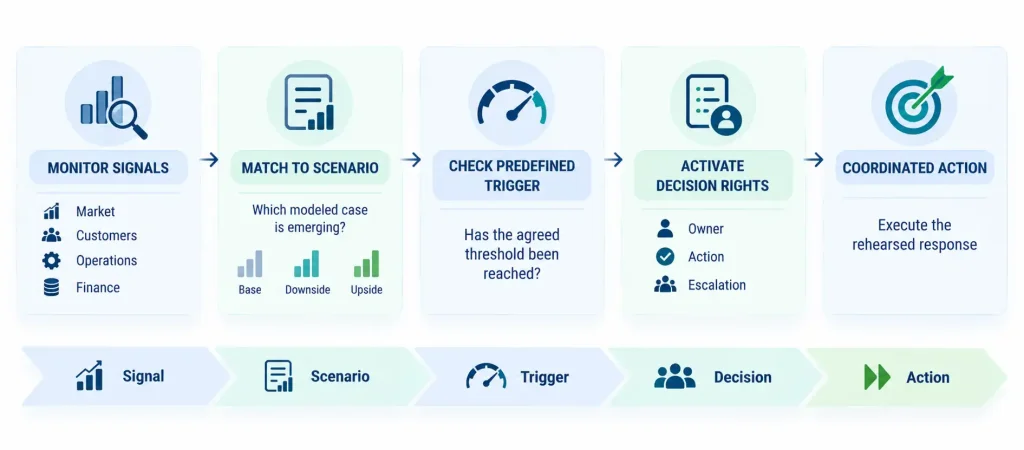
A venture-backed performance marketing company that scaled from $9M to $180M in revenue within twenty-four months relied on exactly this kind of triggered decision-making, using predefined thresholds tied to customer acquisition cost and contribution margin to determine when to accelerate hiring rather than debating the question fresh each quarter. The scaffolding built during the scenario planning process, including escalation protocols and decision rights, allows action to feel like the natural conclusion of preparation rather than a leap into uncertainty.
Three Key Takeaways
- Scenario planning succeeds by narrowing focus to the handful of variables that would genuinely alter the company’s trajectory, rather than attempting to model every conceivable outcome, since selectivity produces clarity while exhaustive modeling produces noise.
- The strongest scenario planning frameworks treat quantitative modeling and functional judgment as complementary inputs, using structured debate and documented assumptions to test intuition rather than either suppressing it or accepting it uncritically.
- A scenario only creates value once it is tied to predefined triggers and decision rights, because without those mechanisms even a well-built scenario planning analysis remains an intellectual exercise rather than a launchpad for coordinated action.
Disclaimer: This article is intended for informational purposes only and does not constitute legal, tax, or accounting advice. You should consult your own tax advisor or counsel for advice tailored to your specific situation.
Hindol Datta is a four-time CFO and senior finance executive with over 25 years of leadership experience across cybersecurity, SaaS, gaming, logistics, digital marketing, medical devices, consumer products, and nonprofit organizations. He has led more than $120M in fundraising and over $150M in M&A transactions while building the financial and operational systems that let complex businesses scale with confidence. He is the author of seven books in the Systems CFO Series and holds active CPA, CMA, and CIA credentials.
AI-assisted insights, supplemented by 25 years of finance leadership experience.