
Executive Summary
A budget rarely fails with a dramatic collapse. It fails quietly. It drifts into irrelevance the moment conditions shift. A rate hike, a supply shock, or a sudden change in demand can do it. Each one exposes how narrow its assumptions were. Each one exposes how narrow its assumptions were. Scenario planning exists to close that gap between a single forecast and the range of futures a business actually faces. Done with rigor, it becomes the architecture behind capital allocation and board communication. It also sets the pace at which an organization moves when conditions change.
Despite its value, many finance functions still treat scenario planning as a spreadsheet exercise. Best, base, and worst cases get built, then nobody revisits them after the board meeting. This article reframes scenario planning as a discipline spanning forecasting philosophy, capital tiering, cross-functional execution, and institutional culture. The lessons here come from finance teams that built this muscle under real pressure, not in theory.
Why the Base Case Alone Cannot Carry the Business
Every finance team knows the annual operating plan and the assumptions underneath it. Customer growth, pricing, churn, hiring pace, and macro inputs all feed into it. These forecasts are precise and collaborative, and they are frequently wrong. Not because the people building them are careless, but because the underlying philosophy assumes the future behaves like the recent past, adjusted by a few percentage points in either direction.
Markets do not move that way. Competitive dynamics shift, regulations change, currencies swing, and capital tightens or loosens without much warning. Forecasting answers the question of what is most likely. Scenario planning asks a different and more durable question: what are the plausible futures the organization needs to be ready for, regardless of which one arrives first.
From Sensitivity Analysis to Genuine Scenario Design
Many finance teams confuse scenario planning with sensitivity analysis, which flexes one or two variables in isolation, or with stress testing, which checks a model’s resilience under extreme conditions. Real scenario planning constructs distinct, internally coherent futures built from different assumptions about behavior and external forces. A rigorous process typically involves four moves:
- Identifying the critical uncertainties that matter most and are hardest to predict, such as interest rates, regulatory shifts, or competitive disruption.
- Framing each scenario as both a qualitative narrative and a quantitative model, tying a story like “capital turns scarce and acquisition costs double” to its resulting profit and loss, cash runway, and return profile.
- Mapping what each scenario implies for funding needs, hiring plans, go-to-market posture, and M&A appetite.
- Developing trigger-based action plans that specify which indicators to monitor and which decisions are pre-approved once a threshold is crossed.
At one high-growth cybersecurity and identity access management company generating close to $30M in annual recurring revenue across five countries, building this kind of scenario-modeling discipline from scratch, alongside a driver-based forecasting engine and capacity model, held actual results within five percent of forecast for eight consecutive quarters. That kind of predictability does not come from a better guess. That kind of predictability comes from modeling the paths the business was likely to take well before it needed to.
Designing Scenarios with Strategic Contrast, Not Cosmetic Variation
A common trap is producing scenarios that differ mathematically but not strategically. Nudging growth rates by five percent or adjusting customer acquisition cost by a modest margin generates extra spreadsheets without generating insight. The goal is contrast along dimensions the company cannot control.
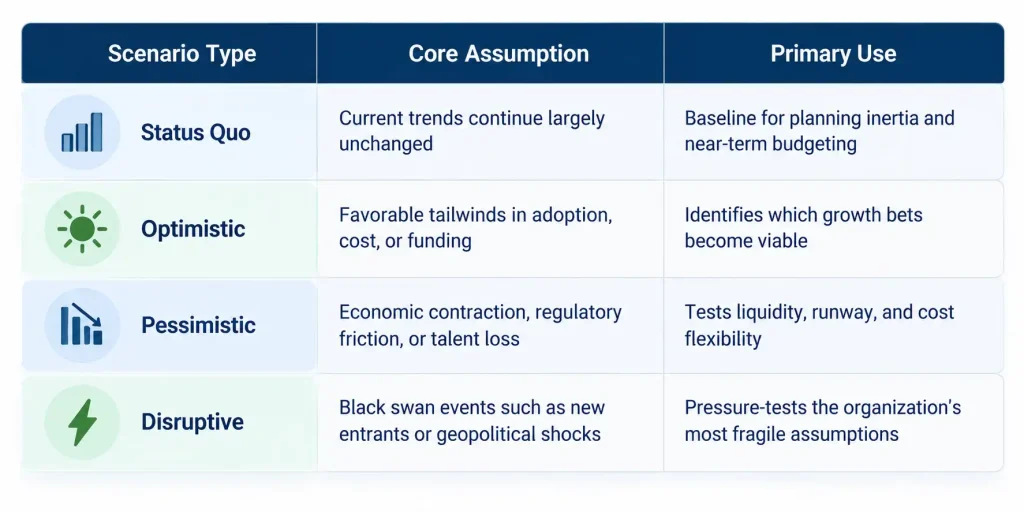
Each scenario should begin as a narrative, with the financial output following rather than leading. That ordering forces leadership to reason about causality and interdependence rather than just toggling inputs in a model. At a mission-driven education and research institution, partnering with development leadership on funding scenarios under variable philanthropic and earned-revenue conditions brought a level of clarity to long-term sustainability planning that a single-point forecast never could have offered, particularly while structuring a $37M capital raise across equity and venture debt.
Linking Scenario Planning to Capital Allocation and Cross-Functional Execution
Scenarios only create value once they inform real decisions. Capital is finite, and scenario planning brings discipline to where it goes by tiering investments according to how many futures justify them.
- Tier 1, core investments: justified across every scenario, including product reliability, security infrastructure, and compliance.
- Tier 2, strategic bets: viable in the base case or better, such as entering a new region if macro conditions or competitive dynamics cooperate.
- Tier 3, optional plays: triggered only by upside signals, including M&A, large go-to-market pushes, or product adjacencies.
This tiering gives boards transparency into what the company is ready to execute, what it is deliberately deferring, and what would need to happen before it activates a deferred initiative. At a $127M global consumer products company operating across direct-to-consumer, Amazon, and wholesale channels with supply chains spanning China and Vietnam, tying inventory and working capital scenarios to demand planning more than doubled inventory turns, from three times to seven times, and freed capital that the supply chain had trapped.
Scenario logic loses power if it stays confined to finance. It needs to reach the functions that will execute against it:
- Sales and marketing adjust lead generation targets and shift from paid to inbound or partner-led motions under a downside customer acquisition cost scenario.
- Product and engineering sequence the roadmap around which features are non-negotiable across every future and which depend on funding outcomes.
- People and talent align hiring velocity and equity budgets with scenario-predicted burn rates rather than a single hiring plan.
- Operations teams use foreign exchange, inflation, and geopolitical inputs to inform vendor diversification and contract length.
Building the Governance That Makes Scenarios Real
The mechanism that turns scenario planning from a slide deck into an operating system is the trigger, a pre-agreed if-then statement that removes debate from the moment a threshold is crossed.
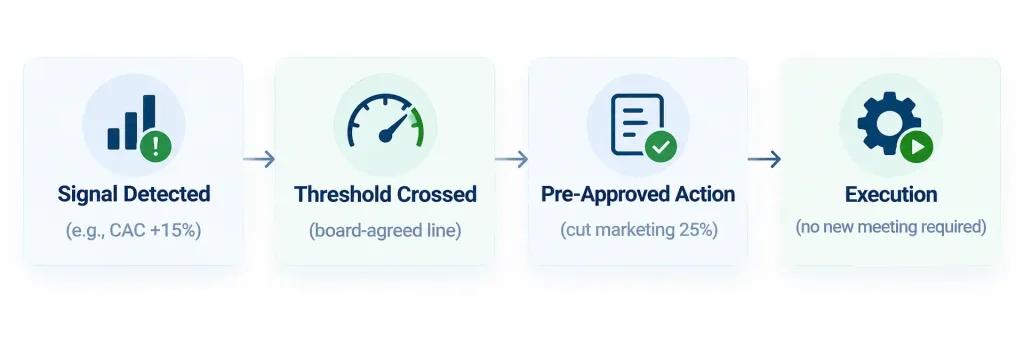
Typical triggers might specify that if annual recurring revenue growth drops below 20 percent while acquisition cost rises by 15 percent, marketing spend contracts by 25 percent and the organization shifts toward product-led growth. Another might state that if a funding round is delayed beyond a defined quarter, non-core research and development pauses and the company prioritizes cash neutrality. These are not theoretical debates conducted in the heat of a crisis. They are documented in advance, aligned with the board, and ready to execute the moment the signal appears.
Institutionalizing this practice requires a few recurring disciplines: quarterly scenario reviews held separately from the standard forecast update, board-level scenario discussions at least twice a year, explicit functional ownership of each scenario’s response, and a dashboard tracking leading indicators against their thresholds. During a public-company chapter at a Euronext Paris-listed gaming and digital entertainment business operating across five countries, board-level scenario discussion became a standing feature of governance rather than an occasional briefing, which shortened the distance between a shift in the operating environment and a coordinated executive response.
Scenario Planning as a Long-Term Source of Value
The final and most underappreciated benefit of scenario planning is cultural. Organizations that consistently plan for multiple futures build fluency in probabilistic thinking, and that fluency compounds. It sharpens hiring, because candidates see a company that prepares rather than reacts. Investor trust strengthens as well, since boards observe leadership that is rarely caught flat-footed. Capital strategy benefits too, since finance leaders who have already modeled, the downside can commit to growth investments without overextending the balance sheet.
Investor communication benefits in a similar way. Presenting a range of outcomes tied to transparent assumptions and pivot points signals that the company understands its exposure and has a playbook for both directions, which replaces ambiguity with structure and tends to earn more credibility than a single confident number that later proves wrong.
Three Key Takeaways
- Scenario planning succeeds when it is built as a system rather than a seasonal ritual, with driver-based models, quarterly reviews, and dashboards that track leading indicators against pre-agreed thresholds.
- Capital allocation improves when investments are tiered by how many plausible futures justify them, giving boards a transparent view of what is funded now, what is deferred, and what would trigger a change.
- The organizations that recover fastest from disruption are rarely the ones with the most accurate forecast. They are the ones that had already rehearsed their response before the disruption arrived.
Disclaimer: This article is intended for informational purposes only and does not constitute legal, tax, or accounting advice. You should consult your own tax advisor or counsel for advice tailored to your specific situation.
Hindol Datta is a four-time CFO and senior finance executive with over 25 years of leadership experience across cybersecurity, SaaS, gaming, logistics, digital marketing, medical devices, consumer products, and nonprofit organizations. He has led more than $120M in fundraising and over $150M in M&A transactions while building the financial and operational systems that let complex businesses scale with confidence. He is the author of seven books in the Systems CFO Series and holds active CPA, CMA, and CIA credentials.
AI-assisted insights, supplemented by 25 years of finance leadership experience.