
Executive Summary
Scenario analysis in financial modeling has become a core requirement of the CFO role. A single forecast can no longer account for today’s volatility across markets, supply chains, and regulatory environments. Finance teams once built a single baseline and applied light stress tests. Now, they must create three or four distinct financial scenarios. Each scenario uses different assumptions about rates, demand, capital, and policy. Each scenario should guide real business decisions rather than simply sit on a shelf.
This article examines why scenario modeling has become the operating language of finance. It explains what separates a useful scenario from a theoretical exercise. It also explores how CFOs can build a scenario planning practice that holds up under board scrutiny. The article draws on engagements across cybersecurity, consumer products, gaming, education, and venture-backed technology. In these cases, scenario analysis played a critical role in determining whether a capital raise closed successfully.
Why Scenario Analysis Has Replaced Single-Point Forecasting
For much of the last two decades, financial modeling followed a simple approach. Finance teams built the most defensible baseline and applied a sensitivity table around it. This approach worked when interest rates moved gradually and supply chains remained relatively stable. Regulatory changes also provided enough time for businesses to adjust. That world has largely ended. Inflation has remained difficult to predict, while supply chains continue to shift along geopolitical lines. At the same time, artificial intelligence is reshaping labor and cost structures faster than most annual planning cycles can adapt.
Scenario analysis in financial modeling addresses this shift by considering several plausible outcomes. It moves finance teams away from relying on a single forecast. Instead, they ask what could happen and how the organization should respond. This is a meaningfully different posture. A single-point forecast invites debate about whether the number is right. A well-built scenario model invites debate about which world is emerging and what that implies for capital allocation, headcount, and pricing.
From Certainty to Elasticity
The transition from deterministic forecasting to probabilistic scenario modeling requires structural change, not just an additional tab in a spreadsheet. During a fractional CFO engagement with a pre-Series A AI governance platform, the entire operating model had to be built from nothing, including multi-year scenario analyses that anchored the company’s capital strategy and investor narrative. In an early-stage environment with no historical actuals to lean on, scenario analysis was not a refinement of an existing model; it was the model. Investors did not want a single projection. They wanted to see how the business behaved under slower adoption, faster adoption, and a delayed funding environment, and they wanted the founder to demonstrate command of all three.
The Discipline of Scenario Modeling Under Pressure
Scenario modeling earns its value most clearly when conditions deteriorate quickly and the organization has no time to build new logic from scratch. At a high-growth cybersecurity and identity access management company generating approximately $30M in annual recurring revenue across five country entities, the forecasting engine and capacity model were built specifically to hold up under scenario stress, not just baseline planning. That discipline kept actuals within plus or minus five percent of forecast for eight consecutive quarters, a level of predictability that came directly from having modeled the downside cases in advance rather than reacting to them as they emerged.
Building Multiple Worlds, Not One Baseline
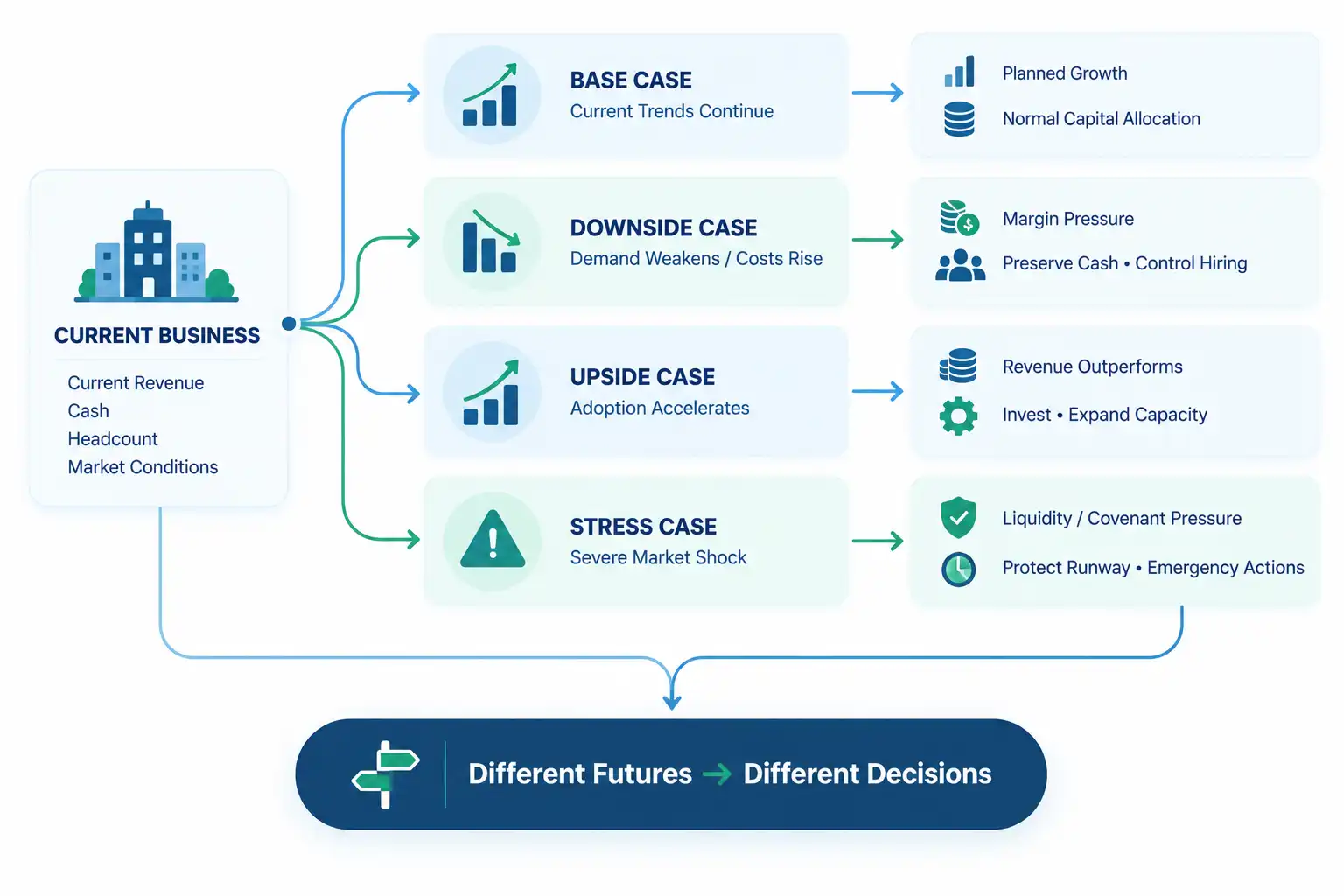
A useful scenario framework generally includes:
- A base case, reflecting the most probable trajectory given current data and known commitments.
- A downside case, built around a specific triggering event such as a regulatory shift, a demand contraction, or a currency devaluation, rather than a generic percentage haircut.
- An upside case, tied to a plausible accelerant such as faster adoption, a successful capital raise, or a new market entry.
- A stress case, reserved for tail risk that would threaten solvency or covenant compliance, used sparingly but modeled with the same rigor as the others.
At a $127M global consumer products company with a supply chain spanning China and Vietnam, scenario modeling around freight costs, tariff exposure, and currency movement was what allowed inventory turns to more than double, from three times to seven times, without stranding working capital when conditions shifted. The scenarios were not abstractions. They fed directly into demand planning and SKU rationalization decisions made every quarter.
Modeling the Unquantifiable
The hardest part of scenario analysis is rarely the arithmetic. It is deciding how to treat variables that resist precise quantification, such as reputational risk, talent retention, or customer loyalty under a changing brand narrative. These factors belong in the model as proxies rather than exclusions. A mission-driven education and research institution facing variable philanthropic and earned-revenue conditions required multi-year financial modeling that blended hard revenue assumptions with softer judgments about donor sentiment and enrollment behavior, work that ultimately supported a $37M capital raise across equity and venture debt. Leaving those qualitative pressures out of the model would have produced a cleaner spreadsheet and a less honest one.
A Practical Framework for Scenario Analysis in FP&A
The table below reflects a structure that has worked across multiple industries, adjusted for the specific drivers of each business.
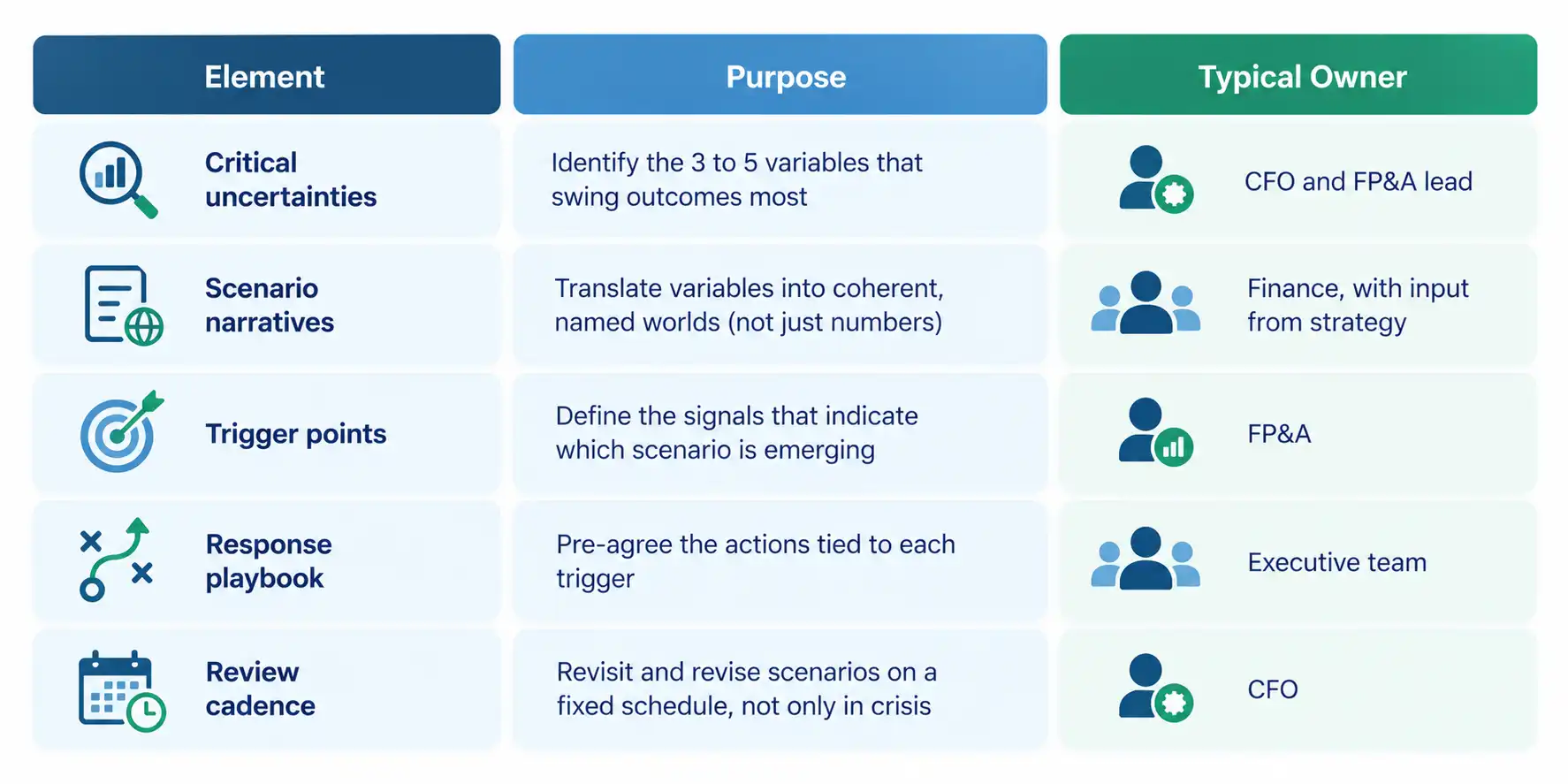
This structure was tested directly during a currency devaluation scenario for a global operation, where the base model had to be recast entirely to capture second- and third-order effects on customer behavior and vendor renegotiations, not merely the direct currency translation. The resulting scenario plan defined trigger points in advance, so that when volatility arrived, the response was executed from a playbook rather than improvised under pressure.
Communicating Scenario Analysis to the Board
A scenario model that lives only inside finance has limited value. Boards increasingly expect to see narratives and forks in the road, not just a single forecast with a range of confidence intervals attached. At a Euronext Paris-listed gaming and digital entertainment company operating across five countries, board and audit committee engagement depended on a single, unified definition of revenue that could be interrogated under multiple regulatory and currency scenarios simultaneously, following a global Oracle Financials rollout that unified reporting across every subsidiary.
Common pitfalls in board-facing scenario analysis include:
- Presenting only a base case and treating sensitivity commentary as an afterthought.
- Building scenarios so broad they offer no actionable trigger points.
- Failing to revisit scenarios after the initial planning cycle, so they become stale within a quarter.
- Overloading the board with variables instead of naming three or four coherent narratives.
Avoiding these pitfalls is less about modeling sophistication and more about discipline in how the work is framed and revisited.
Three Key Takeaways
- Scenario analysis in financial modeling succeeds when it produces trigger points and a pre-agreed response, not merely a range of outcomes; the value lies in the organization’s readiness to act, not in the elegance of the spreadsheet.
- The most resilient scenario models incorporate qualitative pressures, including reputational and talent risk, through disciplined proxies rather than excluding what cannot be reduced to a formula.
- Scenario modeling belongs in the boardroom as a narrative tool, presented as three or four coherent worlds with clear triggers, rather than buried as a sensitivity table attached to a single forecast.
Disclaimer: This article is intended for informational purposes only and does not constitute legal, tax, or accounting advice. You should consult your own tax advisor or counsel for advice tailored to your specific situation.
Hindol Datta is a four-time CFO and senior finance executive with over 25 years of leadership experience across cybersecurity, SaaS, gaming, logistics, digital marketing, medical devices, consumer products, and nonprofit organizations. He has led more than $120M in fundraising and over $150M in M&A transactions while building the financial and operational systems that let complex businesses scale with confidence. He is the author of seven books in the Systems CFO Series and holds active CPA, CMA, and CIA credentials.
AI-assisted insights, supplemented by 25 years of finance leadership experience.