
Executive Summary
RPA in finance rarely arrives with fanfare or dramatic announcements. Software bots take over invoice matching, reconciliations, and journal entries one workflow at a time, and the monthly close shortens as errors fall. The larger shift, however, has little to do with speed. Robotic process automation frees the attention of finance teams and changes what the CFO office can become.
The sections ahead examine five dimensions of that change, starting with how RPA works inside finance and what freed attention makes possible. They then address the cultural impact on teams, the hidden risks of automation, and the new skills finance leaders need. Together they show how CFOs can turn automation into an upgrade in judgment, not just a reduction in labor.
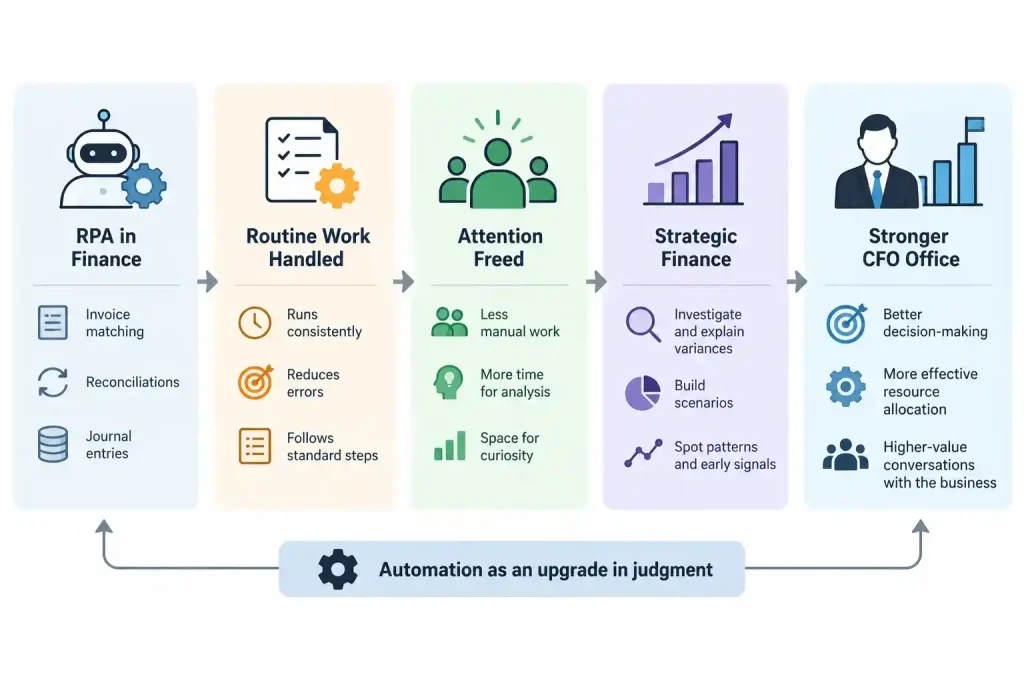
How RPA in Finance Works
The strength of robotic process automation lies in its simplicity. A bot does not think or improvise; it mimics. It follows the same clicks a person would make, such as opening a file, validating an entry, and updating a field. It then repeats them without fatigue or variance.
Where Bots Fit in the Finance Workflow
Much of traditional finance work is cognitive housekeeping: necessary tasks that demand attention but little imagination. These tasks offer the clearest starting point for RPA in finance.
Finance Tasks Suited to RPA and the Human Role That Follows
| Finance Process | What the Bot Handles | What People Focus on Instead |
| Accounts payable | Matching purchase orders, receipts, and invoices | Vendor terms, onboarding friction, and payment strategy |
| Account reconciliations | Comparing balances across systems | Investigating root causes of recurring breaks |
| Journal entries | Posting recurring and rule-based entries | Reviewing judgment-based accruals and estimates |
| Management reporting | Pulling and formatting data packs | Explaining variances and business drivers |
| Intercompany | Generating and matching intercompany entries | Improving transfer pricing and entity structure |
Consider an analyst who spends six hours a week matching purchase orders to invoices across two systems. A bot can run that task as a background script, and copy-and-paste errors disappear. More important, recurring exceptions become visible, and teams start asking why a process exists at all.
RPA works best on processes that are already sound. Deployed carelessly, it automates inefficiency and hardens outdated workflows. Deployed with intent, it strips away routine and exposes the logic of the business underneath.
A cybersecurity and identity SaaS company with entities in five countries shows how system discipline creates room for this work. Implementing NetSuite across five entities shortened the monthly close from 18 days to 10. A cleaner, standardized platform gives automation a stable foundation instead of a fragile one.
What Freed Attention Makes Possible
The first benefit of automation appears in small moments. A Friday no longer revolves around reconciliation deadlines, and a vendor payment issue no longer needs three escalations. What returns in those moments is attention, the most valuable resource a finance team has.
From Reactive to Generative Finance
When repetitive work consumes a team, curiosity fades and the work becomes procedural. RPA in finance reverses that pattern by opening mental space. Teams can then pose strategic questions of their own instead of waiting for others to ask:
- How does rising revenue concentration in one segment affect customer risk?
- What do softening deferred revenue patterns suggest about product-market fit?
- Which kind of scalability does a growing share of platform costs commit the company to?
These questions require attention that is no longer tied up in maintenance. A controller with fewer checklists might spot patterns in capital spending and propose a better depreciation approach. An FP&A analyst freed from formatting board decks can build scenarios that challenge long-held seasonality assumptions.
This benefit of RPA in finance does not arrive automatically. If leaders use automation only to cut headcount or fill time with more meetings, the freed attention disappears into busyness. The CFO must decide where reclaimed capacity goes, whether into scenario testing, early signal detection, or better resource allocation.
A professional services firm with five business units shows what redirected capacity can deliver. Finance built engagement-level profitability and utilization analytics from scratch. That work revealed where the business created margin and where it leaked, giving leaders insight they had never seen before.
The Cultural Side of Robotic Process Automation
Automation often leaves a strange quiet behind in the office. The urgent emails about mismatched lines stop, and the familiar rituals of the monthly close fade. People who once took pride in flawless execution may now monitor bot logs, and that shift can feel like erasure.
Rebuilding Purpose After Repetition Ends
This risk reflects a failure of narrative, not of technology. RPA removes drudgery but cannot create meaning, so leadership must do that work. The CFO can invite teams to help design new processes and to ask questions about intent instead of efficiency alone.
Consider an accounts payable team whose work becomes largely automated within six months. Error rates drop and throughput rises, yet the team begins to disengage as fast-paced work turns into passive monitoring. Energy can return when leaders redefine the roles around vendor experience, with a mandate to fix onboarding pain points and redesign the billing cycle. A cost center can then behave more like a design team.
Several practices help teams find new purpose after automation:
- Involve staff in redesigning processes as architects, not just validators
- Pair automation with visible investment in skills and career growth
- Assign ownership of outcomes such as vendor experience or forecast quality
- Celebrate insight and problem solving, not just speed of execution
The Hidden Risks of RPA in Finance
Repetition breeds a deep familiarity with each process. A team that touches the same process each week learns where it misbehaves and where the system approves something that reality does not support. When bots take over, that quiet instinct can disappear.
Automation Is Not Certainty
A bot executes logic without questioning it, so it scales errors as smoothly as it scales accuracy. Imagine a bot that matches journal entries using preset rules that pass audit. If the underlying business changes and the rules do not, reports still reconcile while meaning drifts away from the numbers.
Governance raises a further concern for finance leaders. When a bot fails, accountability can blur between finance, IT, and the vendor. Markets and boards do not accept logic drift in a script as an excuse for a misstatement.
Common RPA Risks and Governance Responses
| Risk | How It Appears | Governance Response |
| Logic drift | Rules no longer match how the business operates | Scheduled reviews of bot logic and assumptions |
| Loss of process knowledge | Staff monitor bots without understanding them | Rotating stewardship and process training |
| Unclear accountability | Failures fall between finance, IT, and vendors | Named owners for every automated workflow |
| Silent errors | Exceptions run unnoticed for quarters | Exception reporting and periodic manual sampling |
Training for finance teams must go beyond tool certification. Teams should regularly ask why a rule exists, what an exception reveals, and when a process last changed. Automation should create interpreters who understand bots well enough to question, improve, or pause them.
The New Language of the Finance Function
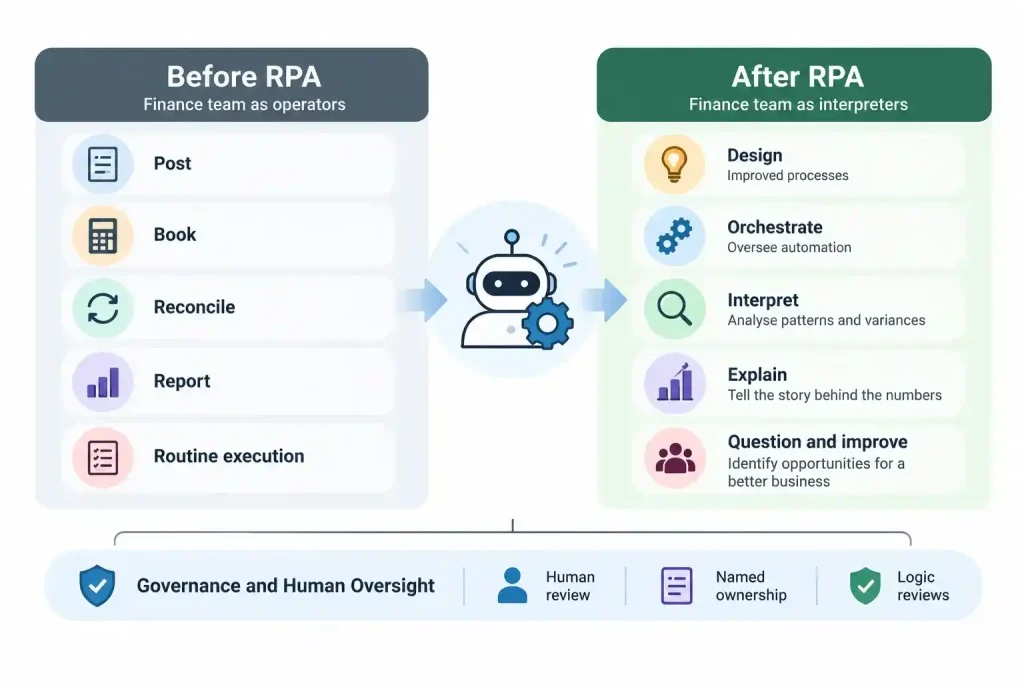
Every major technology shift eventually changes the vocabulary of work. Verbs such as post, book, reconcile, and report have long defined finance. As robotic process automation takes over those verbs, people move toward new ones: design, orchestrate, interpret, and explain.
From Operator to Interpreter
The monthly operating review offers a good example of this shift. Hours once spent assembling data now take minutes, so the meeting can move from recital to conversation. The finance lead becomes a translator of tension, explaining why costs rose in one segment or why margins held despite macro pressure.
Ethics also becomes part of this new professional language. Automation adds distance from tasks, people, and consequences. An automated collections process must still recognize customer hardship, and a machine-generated forecast must still face questions about its blind spots.
A pre-Series A AI governance and assurance platform shows how finance can design for this balance from the start. Finance there built an AI-first finance workflow alongside the operating model and capital strategy. Designing automation early made human review and judgment part of the system instead of an afterthought.
RPA in finance does not make people obsolete. It asks more of them: more presence, more synthesis, and more courage to ask whether a clean report still tells the truth. Bots will keep getting faster, but the future of finance will belong to leaders who keep questioning when everything appears to work.
Three Key Takeaways
- RPA in finance removes repetitive work such as matching, reconciling, and posting, which frees attention for analysis and strategy.
- The value of robotic process automation depends on how leaders redirect freed capacity and rebuild purpose for teams whose routines have changed.
- Automated workflows need named owners, regular logic reviews, and teams that understand bots well enough to question them.
Disclaimer: This article is intended for informational purposes only and does not constitute legal, tax, or accounting advice. You should consult your own tax advisor or counsel for advice tailored to your specific situation.
Hindol Datta is a four-time CFO and senior finance executive with over 25 years of leadership experience across cybersecurity, SaaS, gaming, logistics, digital marketing, medical devices, consumer products, and nonprofit organizations. He has led more than $120M in fundraising and over $150M in M&A transactions while building the financial and operational systems that let complex businesses scale with confidence. He is the author of seven books in the Systems CFO Series and holds active CPA, CMA, and CIA credentials.
AI-assisted insights, supplemented by 25 years of finance leadership experience.



