
Executive Summary
Rollover equity tax treatment decides whether a founder’s rollover becomes a tax-deferred bridge or an unexpected bill. A seller who trades target shares for HoldCo equity can defer gain, but only inside the narrow safe harbors of Sections 351, 721 and 368.
This guide covers each regime, the traps that collapse deferral, and the tax reckoning at exit, closing with a checklist for CFOs and founders.
Why Rollover Equity Tax Treatment Deserves Board Attention
Few M&A instruments carry as much promise, or as much hidden risk, as the equity rollover. The seller keeps a share of the upside, and the buyer gains a partner who still cares about results. Rollover equity tax treatment, however, is a long exposure that carries basis tracking, reporting duties and audit risk for years.
Deals rarely break over rollover tax issues before closing, but many decay quietly afterward. A founder who expected a tax-free exchange may owe capital gains tax on proceeds never received. That founder often turns disengaged or litigious, and the buyer loses the alignment it paid for.
The Non-Recognition Premise Behind a Tax-Deferred Rollover
The Code defers gain when an exchange looks like a restructuring instead of an exit. If the seller stays economically exposed to the business, the transaction resembles a reorganization, and tax waits until a genuine disengagement occurs. Deferral shrinks whenever that exposure shrinks, whether through cash, debt-like preferred stock or lost control.
A Worked Example of a HoldCo Equity Rollover
Consider a founder who owns OpCo outright, with a $20M value and a $2M basis, and a buyer who funds HoldCo with $16M. HoldCo buys 80% of OpCo from the founder, and that portion becomes a taxable sale. The founder contributes the remaining 20%, worth $4M with a $400K basis, for 20% of HoldCo.
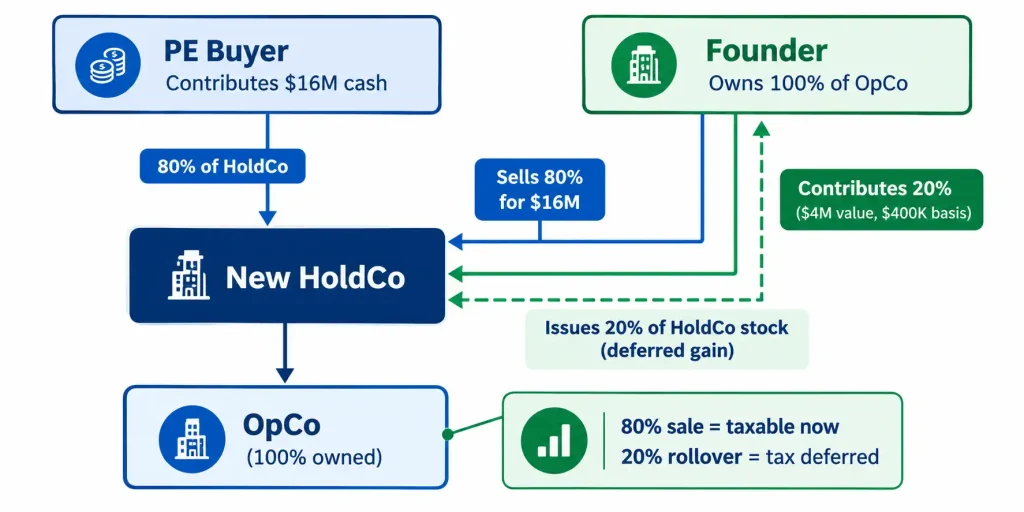
Whether this 20% rollover qualifies depends on form, sequence and post-closing rights, and four questions usually decide it:
- Did both parties contribute simultaneously under one binding plan?
- Did side agreements undermine the “solely for stock” requirement?
- Does the founder’s equity carry redemption rights, fixed returns or hidden cash payments?
Section 351 Rules That Shape Rollover Equity Tax Treatment
The 80% Control Test and the Transferor Group
Section 351 requires the transferors, as a group, to hold control immediately after the exchange. Control under Section 368(c) means at least 80% of voting power and 80% of each nonvoting class. A founder with 20% lacks control alone, but the buyer’s cash contribution also counts. When both parties contribute under one integrated plan, they form a single transferor group. Staged issuances or third-party dilution below 80% can break that group and expose the founder’s gain.
The Solely-for-Stock Rule and the Preferred Equity Trap
Deferral covers only qualifying stock, and the definition runs narrower than many term sheets assume. Section 351(g) treats nonqualified preferred stock, such as shares with mandatory redemption or fixed yields, as boot, and warrants or options do not count as stock. Rolling at the common level, with investor protections placed in a shareholder agreement, keeps the deferral intact.
Boot, Liabilities and Section 357(c)
Cash or notes received alongside stock trigger gain up to the value of that boot. Liabilities create a quieter problem, because under Section 357(c), liabilities assumed in excess of the contributed property’s basis produce immediate gain. A contribution with $1M of basis and $4M of liabilities generates $3M of gain with no cash in hand.
Step-Transaction Risk and Substance Over Form
The IRS can collapse formally separate steps into one taxable event when those steps were prearranged. A contribution followed weeks later by a planned sale of HoldCo shares invites that challenge. Post-closing bonuses or consulting fees may also become disguised boot, sometimes taxed as ordinary income.
Section 721 Contributions and the Disguised Sale Rules
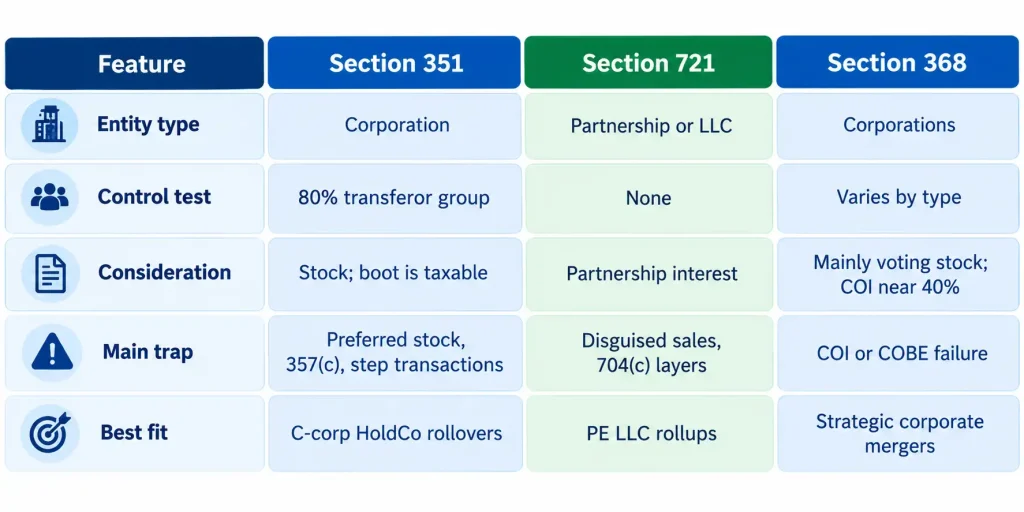
Many middle-market rollups use an LLC taxed as a partnership, where Section 721 governs. It has no control test and no solely-for-stock rule, but its flexibility carries three costs for rollover equity tax treatment.
The Two-Year Disguised Sale Presumption
Under Section 707(a)(2)(B) and Treasury Regulation 1.707-3(c), transfers to a partner within two years are presumed to be sales. Suppose a founder contributes $20M of assets and receives $5M of cash plus 25% of the units. That $5M will likely be taxed as sale proceeds unless the facts rebut the presumption. Delaying payments beyond 24 months, or tying them to documented performance, reduces this risk. Qualified liabilities help only when the debt attaches to the business itself.
Tracking Built-In Gain Under Section 704(c)
Section 704(c) preserves deferred gain inside the partnership. When a founder contributes property with a $2M basis and $10M value, the first $8M of gain stays with that founder. Later appreciation is then shared among partners pro rata. In serial rollups these layers multiply and shape everyone’s after-tax economics.
Profits Interests as an Alignment Tool
Profits interests grant rights only to appreciation after the grant date. IRS revenue procedures 93-27 and 2001-43 allow them to be issued without immediate tax. They require a supportable grant-date valuation, no guaranteed distributions and, in general, a two-year holding period.
Why Section 368 Reorganizations Rarely Fit Private Equity Deals
Section 368 permits tax-free reorganizations, mainly Type A mergers and Type B, C and D exchanges. Each demands statutory form plus two continuity doctrines. Continuity of interest (COI) generally requires at least 40% of the consideration in acquirer stock. Continuity of business enterprise (COBE) requires the acquirer to continue a significant line of business or use the target’s assets.
Private equity buyers often pay 70% to 90% in cash, use LLCs and integrate targets quickly. Those features rarely satisfy COI or COBE, so sponsors lean on Section 351 or Section 721 instead. Section 368 still serves strategic C-corporation mergers and internal realignments.
Comparing the Three Rollover Tax Frameworks
Exit Planning and Rollover Equity Tax Treatment at Liquidity
At exit, rolled equity carries the substituted basis of the property contributed. If the founder’s rolled stake, with its $400K basis, later sells for $10M, the recognized gain equals $9.6M.
Phantom Income and Basis Tracking
Partnership allocations can create taxable income without matching cash. A partner allocated $1M of gain but paid only $400K, with the rest in escrow, may owe tax before collecting. Installment reporting under Section 453 helps only when designed in at signing. Cash received after outside basis reaches zero becomes taxable gain.
QSBS Eligibility Under Section 1202
Section 1202 can exclude large gains on qualified small business stock (QSBS). For stock issued after July 4, 2025, the One Big Beautiful Bill Act raised the cap to $15M. It also lifted the gross asset limit to $75M and added partial exclusions at three and four years. The stock must still be original-issue C-corporation stock, so LLC units and tiered HoldCo structures usually forfeit QSBS.
Redemptions, Secondary Sales and Synthetic Liquidity
A secondary sale to a third party generally produces capital gain. A redemption by the issuer may become a dividend unless it meets a Section 302 test. Earnouts, swaps and guaranteed puts can trigger Section 1259 constructive sale rules or Section 409A problems, accelerating the very realization they aimed to avoid.
A Rollover Tax Structuring Checklist for CFOs
Deferral survives audit when structure and paperwork tell the same story, so finance teams should confirm these items before signing:
- Entity classification and the governing regime (351, 721 or 368) reviewed by tax counsel early
- Contributions and stock issuances sequenced simultaneously under one documented plan
- Rollover equity issued as common stock or true partnership units, not debt-like preferred
- Cash payments to rollover partners timed or documented to rebut disguised sale presumptions
- 704(c) layers, outside basis and QSBS status tracked from day one
- Sellers briefed in writing on what deferral does and does not cover
Three Key Takeaways
- Rollover equity tax treatment is a conditional privilege that holds only while the seller stays economically exposed. Cash, debt-like preferred stock or lost control can each turn planned deferral into current gain.
- Section 351 rewards control and true stock, while Section 721 trades flexibility for disguised sale and built-in gain scrutiny. Choosing the regime early and documenting intent matters more than any clever later step.
- Exit is where deferral becomes arithmetic, so basis tracking, QSBS planning and redemption design belong in the original deal. Founders who understand that reckoning at signing tend to stay aligned after closing.
Disclaimer: This article is intended for informational purposes only and does not constitute legal, tax, or accounting advice. You should consult your own tax advisor or counsel for advice tailored to your specific situation.
Hindol Datta is a four-time CFO and senior finance executive with over 25 years of leadership experience across cybersecurity, SaaS, gaming, logistics, digital marketing, medical devices, consumer products, and nonprofit organizations. He has led more than $120M in fundraising and over $150M in M&A transactions while building the financial and operational systems that let complex businesses scale with confidence. He is the author of seven books in the Systems CFO Series and holds active CPA, CMA, and CIA credentials.
AI-assisted insights, supplemented by 25 years of finance leadership experience.