
Executive Summary
Many dealmakers treat rollover equity in M&A as a late-stage negotiating tactic. Yet an equity rollover shapes alignment, governance and valuation long after both parties sign the closing documents. A seller who reinvests part of the proceeds into the acquiring entity makes a deliberate choice. That decision signals belief, bargaining power and an expected path of value creation. The structure then decides whether the deal rewards that belief or erodes it over time.
This article covers the logic, deal mechanics and failure modes of rollover equity. It also examines platform design and market sensitivity, then closes with three takeaways for CFOs, sellers and sponsors.
Why Rollover Equity in M&A Signals Continuity
What an Equity Rollover Actually Is
In an equity rollover, the seller keeps or reinvests a portion of the equity instead of taking all cash at closing. That stake typically takes the form of common or subordinated preferred equity in a newly formed holding company. The seller becomes a minority holder beside a private equity sponsor or strategic consolidator. This position defers liquidity in exchange for continued upside. In many buyouts the seller takes cash for 70% to 80% of the equity and rolls the remainder.
The structure serves three parties at the same time.
- The buyer gains a hedge against diligence gaps, short-term guarantees and the cultural rupture that follows a full exit.
- The seller gains a tether to future value, often with tax deferral.
- The business gains a visible statement that ownership continuity survives the change of control.
Size and Location as Signals
The size of the rollover carries information, since a small stake of 5% to 10% can point to low seller conviction or strong buyer leverage, while a stake of 20% to 40% usually reflects durable belief, a strong negotiating position or both. Location matters just as much, because equity issued at the HoldCo level participates in platform growth, whereas equity issued at the OpCo level is confined to local economics with less governance and less upside optionality.
A seller holding HoldCo equity with board rights is far more likely to stay engaged, while a seller holding silent OpCo equity often disengages within months.
Structuring an Equity Rollover for Strategic Leverage
Valuation and Position in the Waterfall
The amount of rollover equity a seller receives depends on the agreed value of both the target and the platform. Consider a business sold for $100M, with $80M paid in cash and $20M offered as HoldCo equity. If the HoldCo already carries preferred equity or layered debt, that headline 20% may translate into 12% or less once preferences and dilution are applied.
Position matters as much as percentage, and a simple example shows why. A seller rolls $10M into a HoldCo holding $40M of sponsor preferred equity with a 1.5x liquidation preference and $10M of sponsor common, which gives the seller roughly 17% of the capital structure.
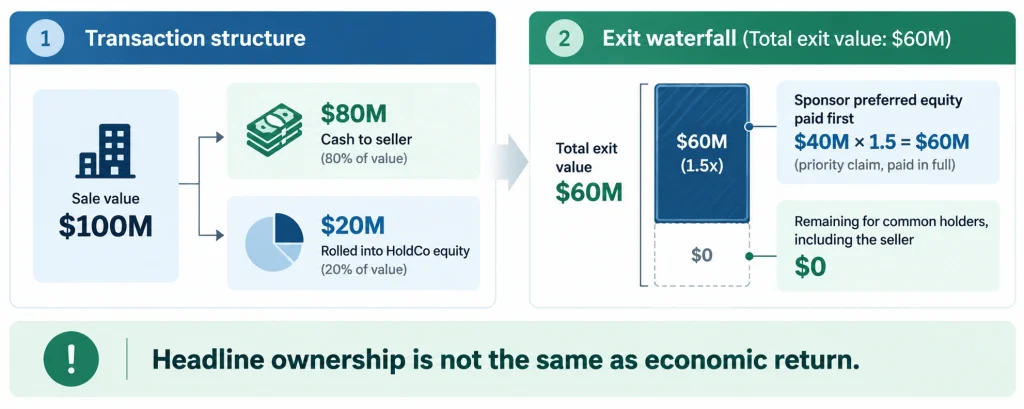
Headline ownership is not economic exposure, and sellers can reduce this risk by negotiating pari passu preferred treatment, or tag-along and catch-up provisions that share proceeds once the investor reaches a target return.
Buy-side work on an IT services acquisition, where quality-of-earnings analysis surfaced material EBITDA adjustments, showed how quickly a headline multiple can diverge from economic reality. The same discipline applies to a rollover, since the equity is only as valuable as the earnings behind the entry price.
Equity Class, Governance and Liquidity
Several structural choices decide whether the stake works as intended.
- Location in the structure, with HoldCo exposure offering platform upside and OpCo exposure offering local performance only. Hybrid designs can pair HoldCo equity with synthetic units tied to the legacy operation.
- Equity class, since sponsor preferred equity with cumulative dividends, participation rights or anti-dilution terms moves value away from common holders.
- Governance rights, which should match economic exposure through board seats, observer rights or consent rights over debt, capital raises and acquisitions.
- Liquidity rights, including tag-along, drag-along with fair market value floors, information rights and structured secondaries at future recapitalizations.
Rollover equity is illiquid until the platform is sold, recapitalized or listed, so these protections defend against trapped value. A $37M raise across equity and venture debt for a mission-driven education institution showed that the order of claims in the capital stack often tells a more honest story than ownership percentages.
Earn-Outs and Tax Treatment
An earn-out is a contingent payment, while rollover equity is ownership with all its rights and risks. Earn-outs tied to short-term performance can distort behavior, whereas rollover equity allows participation without forcing short-term decisions.
Many rollovers are structured under Section 351 for corporations or Section 721 for partnerships, which allows tax deferral on the rolled portion, although poor structuring can trigger immediate tax on paper value.
Where Rollover Equity in M&A Breaks Down
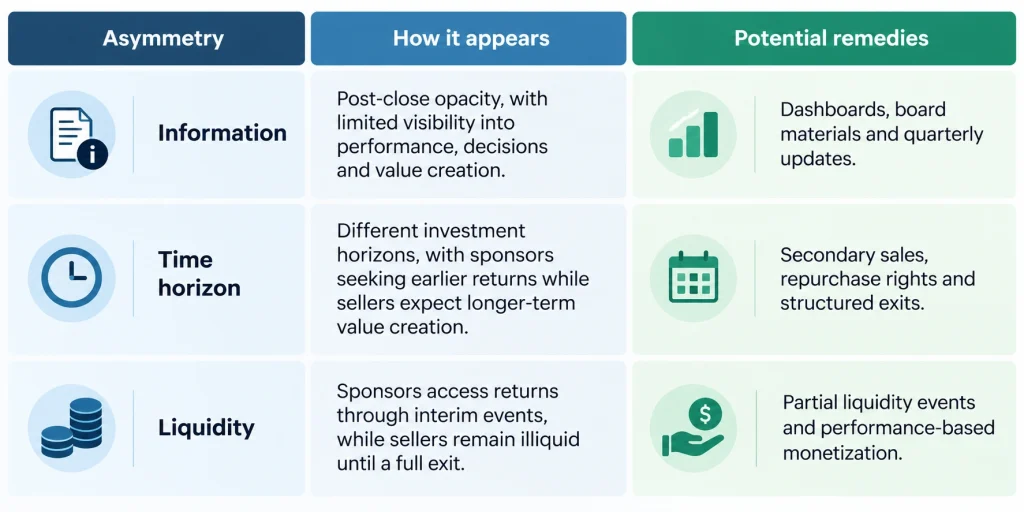
The belief that shared equity creates shared purpose is persuasive and frequently wrong, because equity sits inside a stack, a governance regime and a capital cycle. A stake beneath a 2x liquidation preference with no information access signals subordination rather than alignment. Three asymmetries explain most of the failures seen in practice.
Structural Clarity and Purposeful Governance
Surprise destroys alignment faster than any other factor, so a seller whose equity is subordinated, illiquid or non-governing needs to know it before signing. Even minority holders can be engaged as advisors or deal scouts, which preserves relevance and gives the stake a voice.
Misaligned equity usually erodes through unreturned calls and quiet attrition. In a platform that acquired six businesses in three years, each deal carried a 20% to 30% rollover with no governance rights, and the founders disengaged before the next capital raise. A platform with the same number of deals but a founder council, quarterly visibility and selective co-invest rights saw every founder reengage at exit.
Equity Rollover in Platform Roll-Ups
In a roll-up, rollover equity becomes connective tissue, provided it is designed that way. A passive HoldCo stake with no visibility is dead equity, present on the cap table and absent from the strategy. Well-designed platforms tend to rely on five mechanisms.
- Common scaffolding through a centralized HoldCo, so each stake shares in total platform return.
- Distributed voice through founder councils or operating committees.
- Co-invest and pro-rata rights, which turn former targets into partners.
- Synthetic equity tied to verticals or regions for targeted incentives.
- Temporal staging, allowing continued investment during recapitalizations and internal raises.
Experience with more than $100M in cross-border acquisitions at a publicly listed gaming company and three acquisitions at a venture-backed digital marketing company points to the same conclusion. Integration succeeds when former owners remain participants and stalls when their equity is only a receipt of past relevance.
Rollover Equity in a Changing Market
Higher debt costs, cautious strategic buyers and narrower IPO windows have stretched exits to five or seven years, which turns the promised second bite at the apple into friction. A founder who rolled 25% three years ago may now hold a stake that has grown operationally but compressed in marketable value, with no path to unlock it.
Adapting the Structure to Longer Hold Periods
Several adjustments can restore alignment when liquidity slows.
- Structured secondaries, such as allowing sellers to sell 20% to 30% of the rollover after three years at fair market price.
- Performance-based liquidity corridors tied to EBITDA, margin or integration milestones.
- Preferred equity overlays or structured earn-outs that provide interim yield alongside long-term upside.
- Expanded governance and information rights as timelines extend.
- Internal capital markets where rollover equity can be traded among insiders under valuation guardrails and sponsor buyback options.
Structure alone cannot carry the relationship, because sponsors who communicate openly and adapt terms to circumstance preserve trust, while those who hide behind legal minimums damage alignment and reputation.
Three Key Takeaways
- Rollover equity in M&A should be valued by its position in the waterfall, its governance rights and its liquidity path, because headline ownership percentages can overstate real economic exposure.
- An equity rollover works when information access, time horizons and liquidity options are designed at inception, since silent misalignment erodes engagement long before it appears in the numbers.
- In platform roll-ups and slower markets, rollover equity needs secondaries, co-invest rights and active communication so that the stake remains a living commitment rather than a deferred disappointment.
Disclaimer: This article is intended for informational purposes only and does not constitute legal, tax, or accounting advice. You should consult your own tax advisor or counsel for advice tailored to your specific situation.
Hindol Datta is a four-time CFO and senior finance executive with over 25 years of leadership experience across cybersecurity, SaaS, gaming, logistics, digital marketing, medical devices, consumer products, and nonprofit organizations. He has led more than $120M in fundraising and over $150M in M&A transactions while building the financial and operational systems that let complex businesses scale with confidence. He is the author of seven books in the Systems CFO Series and holds active CPA, CMA, and CIA credentials.
AI-assisted insights, supplemented by 25 years of finance leadership experience.