Executive Summary
An annual budget behaves like a portrait. It captures intent at a single moment and then ages as conditions change around it. A rolling forecast behaves differently. It updates as new information arrives. That makes it a better instrument for executive decisions in a year that refuses to stay predictable.
This article sets out how to turn a rolling forecast into a real decision-making framework. It covers what a rolling forecast enables that a static annual budget cannot. It covers how to tie forecast assumptions to executive decisions without losing discipline. It covers the lifecycle a rolling forecast needs to function well. And it covers where judgment and context still belong alongside the numbers.
What a Rolling Forecast Enables That an Annual Budget Cannot
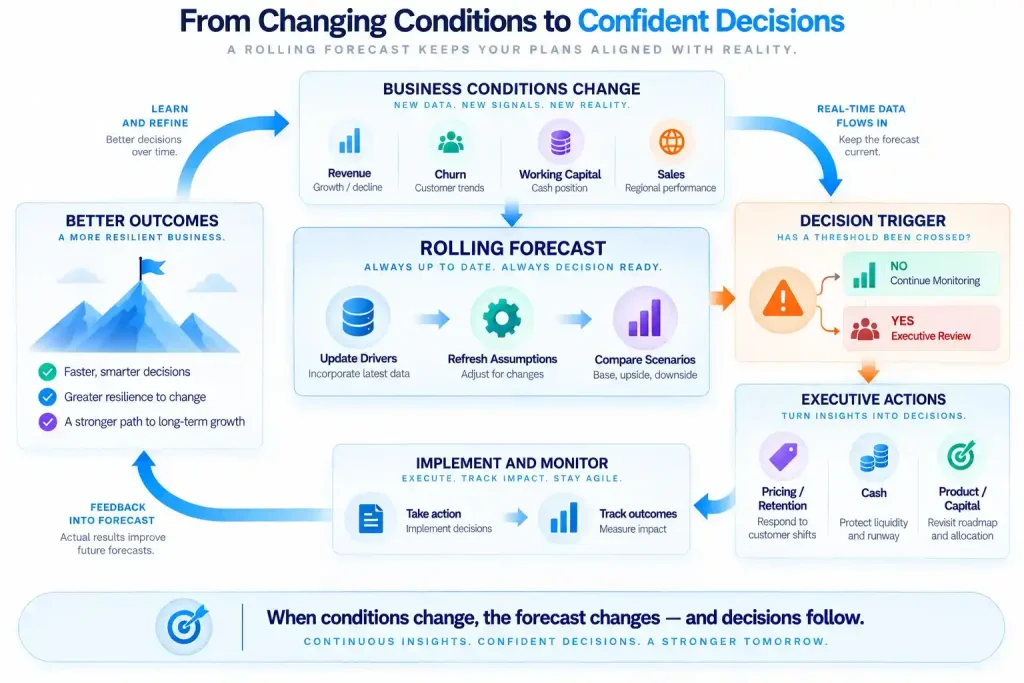
An annual budget anchors commitment to assumptions made once, months before they get tested. A rolling forecast asks a different question on a regular cadence: what has changed, and what should change with it?
That shift changes what finance actually does. Finance stops functioning as a final judge of performance. It becomes something closer to an ongoing check on what the organization currently believes, updated often enough to stay useful. A missed forecast becomes a data point instead of a failure. Each revision becomes a lesson, rather than an embarrassment to defend.
Turning Rolling Forecast Assumptions Into Decisions Without Losing Discipline
A rolling forecast can look undisciplined if every input stays open to revision. The fix is not rigidity. It is designing specific decision triggers ahead of time. A threshold, not a debate, then determines when leadership needs to step in.
A trigger works like a gate rather than an alarm. It stays open while conditions hold, and it closes to force a conversation once a defined line gets crossed.
- A churn increase past a set percentage triggers a pricing and retention review
- A working capital dip below a set threshold triggers a cash conversation before it becomes a crisis
- A cross-border sales miss of a defined size triggers a review of the product roadmap and capital allocation together
Case: Scenario Triggers at a Growth-Stage Company
A high-growth cybersecurity and identity access management company built its rolling forecast around exactly this structure. Its driver-based forecasting engine paired a matching capacity model with a disciplined reporting cadence. Together, they held actuals within five percent of forecast for eight consecutive quarters. The forecast did not just report a number each period. It flagged when a driver moved enough to warrant a real conversation about resourcing. It did not wait for the next scheduled review to notice.
Building the Rolling Forecast Lifecycle
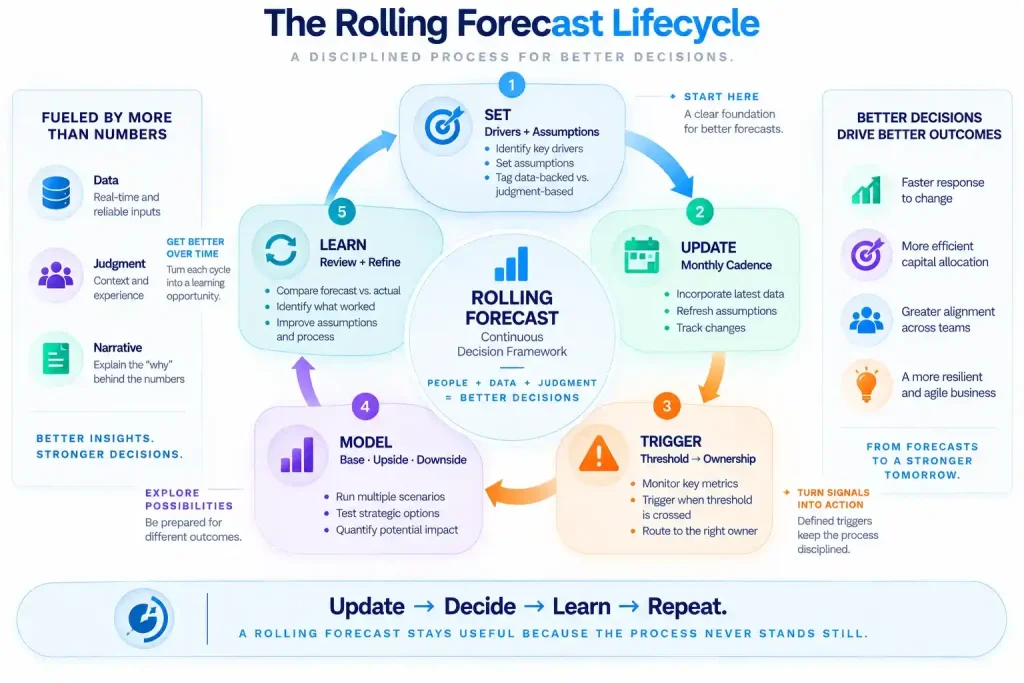
A rolling forecast needs a defined structure to stay useful. Otherwise it becomes a looser version of the old annual budget.
- Foundation setting, where finance identifies key drivers and tags each assumption as data-backed or judgment-based
- Cadence structure, with monthly updates, quarterly deep dives, and rapid escalation whenever a trigger fires
- Decision protocols, distinguishing decisions that are easy to reverse from ones that are not, and assigning clear ownership for each
- Scenario modeling, maintaining a base case alongside an upside and a downside case, each with its own narrative attached
- Reflection and refinement, through a quarterly postmortem asking whether the forecast actually improved a decision or just added noise
A mission-driven education institution applied a version of this lifecycle to a $37M capital raise. Its financial model ran multiple years of scenarios under variable funding conditions. It never had to defend a single fixed number to the board. When a specific metric moved, the institution already had a defined response ready. The forecast had done its job before the shortfall became a surprise.
Where Empathy Fits Into a Rolling Forecast
A forecast built purely on logic tends to fail once it meets the people responsible for hitting it. Assumptions carry incentive, bias, and emotion attached to them, whether the model accounts for that or not.
A short narrative memo attached to each forecast update helps close that gap. It explains what the numbers say and what sits behind them. A churn increase might trace to customer friction, pricing pressure, or delayed product work. That context does more for a leadership team than a risk score ever could.
The response to a missed forecast matters just as much as the trigger itself. A forecast greeted with inquiry teaches a team to surface problems early. A forecast greeted with blame teaches a team to hide them instead. Teams that see honest deviations met with curiosity keep surfacing problems early. That is the entire point of forecasting more than once a year.
Three Key Takeaways
- A rolling forecast beats a static annual budget because it updates on a real cadence instead of aging in place. That turns a missed number into a lesson rather than a failure to defend months later.
- Decision triggers keep a rolling forecast disciplined. A defined threshold, tied to a pre-agreed response, replaces an ad hoc debate every time a metric moves.
- A rolling forecast only earns trust when the response to a miss is inquiry, not blame. Teams that see honest deviations met with curiosity keep surfacing problems early. That is the entire point of forecasting more than once a year.
Disclaimer: This article is intended for informational purposes only and does not constitute legal, tax, or accounting advice. You should consult your own tax advisor or counsel for advice tailored to your specific situation.
Hindol Datta is a four-time CFO and senior finance executive with over 25 years of leadership experience across cybersecurity, SaaS, gaming, logistics, digital marketing, medical devices, consumer products, and nonprofit organizations. He has led more than $120M in fundraising and over $150M in M&A transactions while building the financial and operational systems that let complex businesses scale with confidence. He is the author of seven books in the Systems CFO Series and holds active CPA, CMA, and CIA credentials.
AI-assisted insights, supplemented by 25 years of finance leadership experience.