
Executive Summary
A rolling forecast replaces the fixed annual plan with a continuously updated view of the next 12 months, and it has become one of the clearest expressions of modern CFO leadership because it ties strategy to the data a business generates every month. Instead of defending a budget written in November, finance teams use a rolling forecast to test assumptions against reality and to redirect capital while decisions can still change outcomes.
This article covers the architecture of a rolling forecast, the psychology and behavior that determine whether it works, the systems that support it, and the way the CFO role evolves in response. Examples from cybersecurity SaaS, venture-backed growth companies, consumer products, and mission-driven institutions ground each section.
Why a Rolling Forecast Outperforms the Static Annual Plan
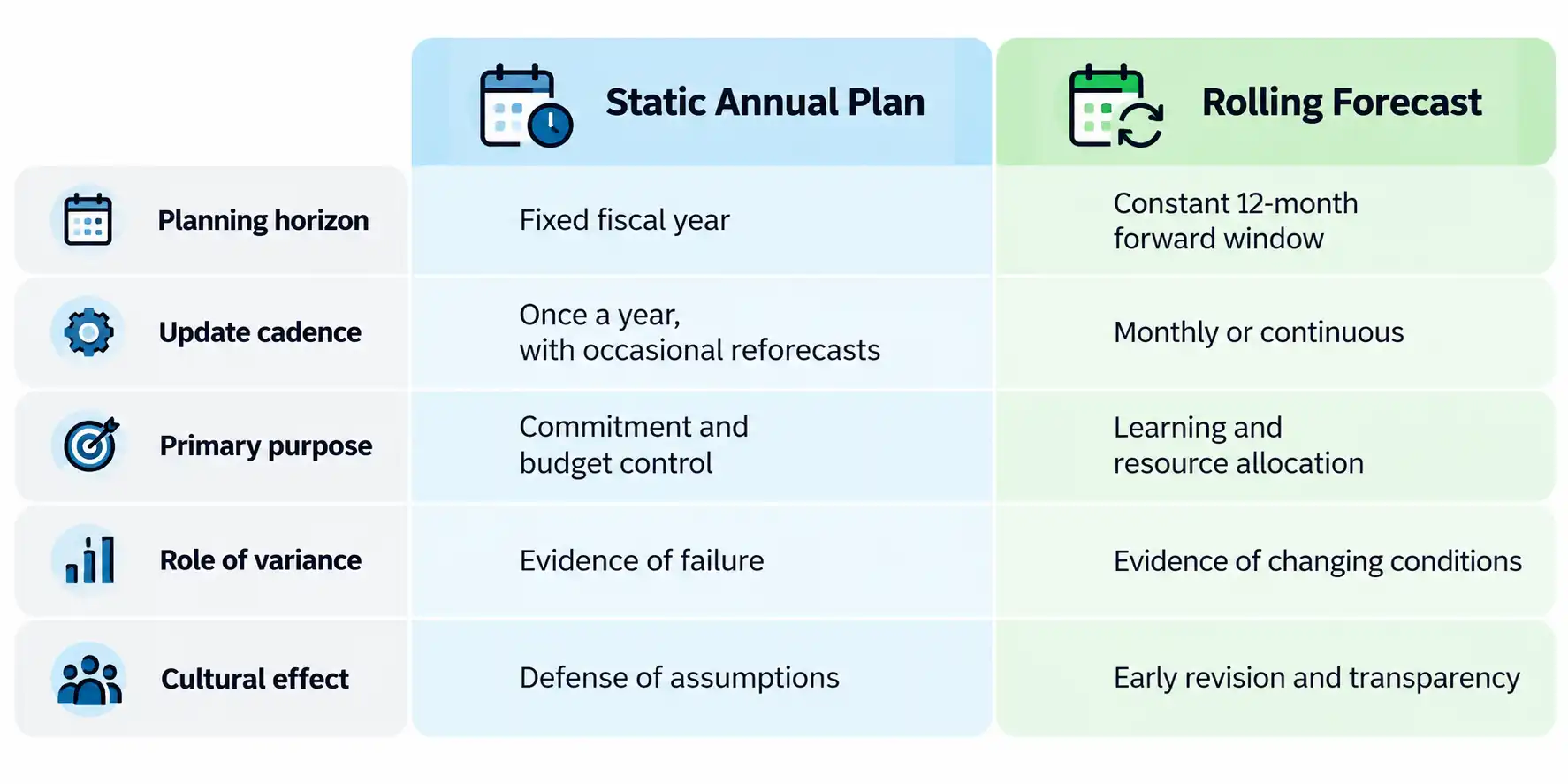
The annual operating plan offers comfort, because it gives executive calendars a shape and gives boards a number to hold. Markets, however, do not move in twelve neat columns, and a plan written in November often loses its footing by the second quarter, at which point variance analysis becomes a ritual of assigning blame rather than a source of insight.
A rolling forecast removes that ritual by extending the planning horizon each month so that the business always looks 12 months ahead, regardless of where the calendar sits. The discipline forces better questions earlier, exposes assumptions before they harden, and pulls sales, operations, and finance into one conversation while there is still time to act.
Designing a Rolling Forecast Architecture
Building the Timeline and the Data Flows
A durable rolling forecast has a timeline that advances on a regular schedule, data feeds that refresh without manual effort, and a small group responsible for deciding which movements deserve a revision. Drivers matter more than outcomes, since revenue and cost are results, while pipeline velocity, capacity, pricing, and utilization are the causes worth modeling.
In a cybersecurity and identity SaaS company with roughly $30M in ARR and teams spread across five countries, a driver-based forecasting engine and capacity model built from scratch held actuals within 5% of forecast for 8 consecutive quarters. Predictability came less from clever mathematics than from agreeing on which operational drivers deserved a place in the model.
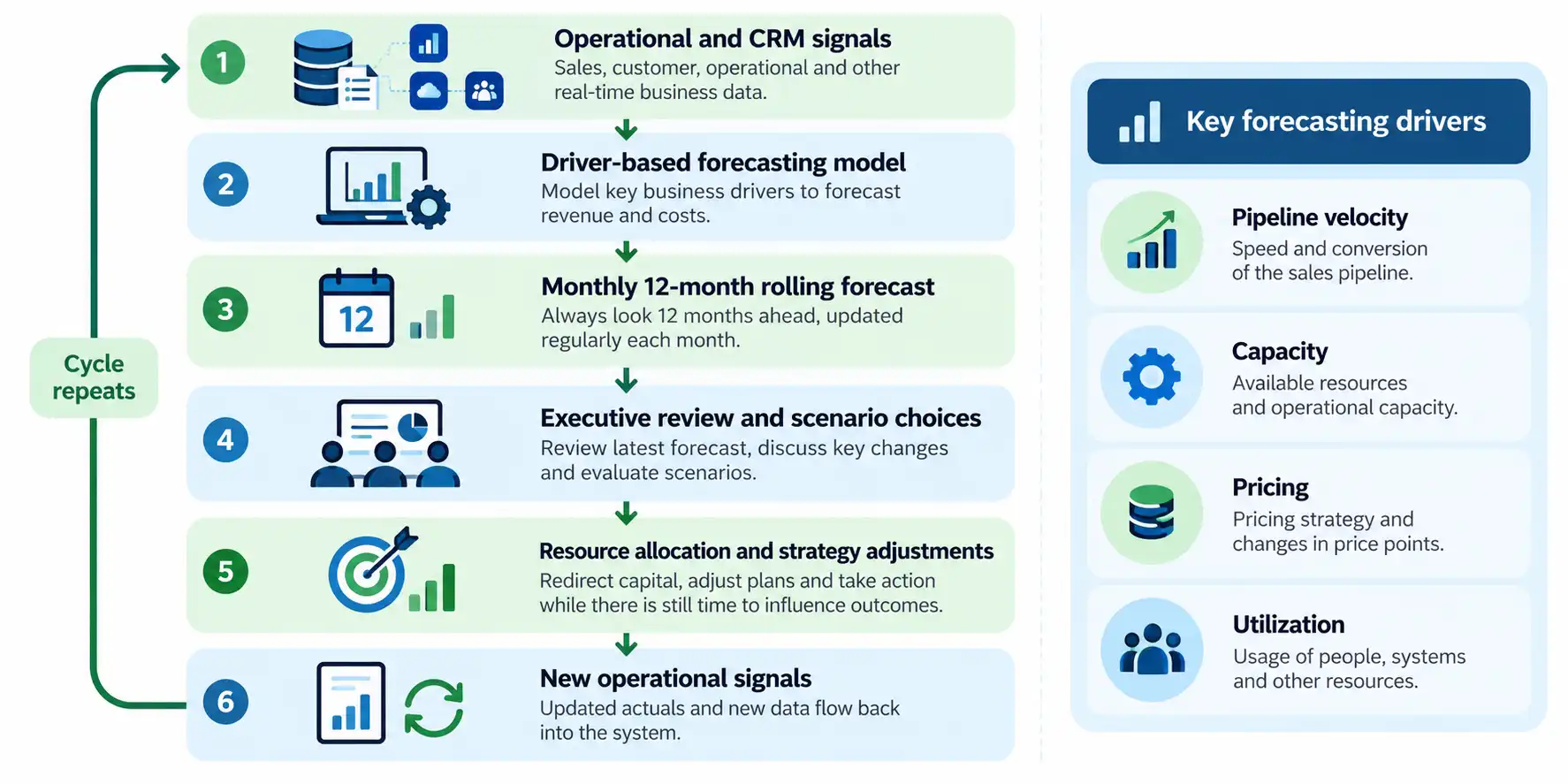
Not every movement deserves a forecast change, and a system that recalculates at every tremor produces noise rather than intelligence. The better design separates inflection points, which are small data points that hint at large direction, from anomalies that can safely wait. Typical examples include:
- A sales miss in a minor region that repeats for two consecutive months.
- Rising churn inside one customer subsegment while the overall rate looks stable.
- A regulatory change that alters the cost structure of a single product line.
Each of these deserves inquiry before it deserves a number, and the forecast should record the narrative behind a change as carefully as the figure itself.
The Psychology of Change in a Rolling Forecast Culture
The hardest part of adopting a rolling forecast is rarely technical. Leaders in a traditional planning model are rewarded for committing early and reporting variance sparingly, so the plan becomes a measure of personal credibility, and a revised forecast can feel like an admission of error.
That fear usually surfaces in small ways, such as an executive who wants quarterly numbers locked because people need stability, or a finance lead who quietly reverts to last quarter’s model to keep things consistent. These behaviors reflect identity more than competence, and they respond to leadership far better than to mandates.
Rewarding Revision Over Prediction
Finance leaders can reframe the conversation by asking whether a manager was guessing or responding to the best information available at the time. That distinction moves a revision from an indictment to a form of intelligence, and over time it produces what can be called forecast maturity, where teams explain variances less and revise earlier.
In a venture-backed digital marketing company that scaled revenue from $9M to $180M in 24 months, the pace of growth made any fixed plan obsolete within weeks. The finance function earned credibility by treating early revisions as evidence of attention, and by building customer acquisition cost, lifetime value, and contribution margin analytics that gave every revision a clear basis.
How a Rolling Forecast Shapes Behavior and Decision-Making
A rolling forecast does more than report on the business, because each update acts as a signal that something has shifted and that decisions should shift with it. Teams that forecast once a year tend to protect assumptions for months, while teams that roll their forecasts learn to accept surprise and act within it.
A product division with a reputation for unreliable numbers offers a useful pattern. Once the organization moved to a rolling model that rewarded early observation over accurate prediction, the division stopped sandbagging and stopped inflating optimism, and its forecasts became both more conservative and more precise.
The same behavioral shift appears across functions:
- Product teams size new bets through month-by-month traction rather than distant market estimates.
- Supply chain leaders manage capacity from front-line signals rather than static volume assumptions.
- HR funds headcount in response to actual demand movement rather than arbitrary annual cycles.
- Executive teams debate risk from a position of clarity rather than a defensive crouch.
In a $127M global consumer products company with direct-to-consumer, Amazon, and wholesale channels, tighter cash forecasting and demand planning helped lift inventory turns from 3x to 7x. That change released trapped working capital and showed how a forecast that updates frequently can alter operational choices well beyond the finance function.
A rolling forecast without behavioral discipline, however, becomes noise delivered at speed. Managers need coaching to read change rather than merely react to it, and meetings need to be designed so that learning outranks defense.
Technology and Systems Behind a Rolling Forecast
Organizations that forecast adaptively and those that react defensively usually differ in infrastructure rather than philosophy. Data trapped in silos, assumptions hardcoded in offline files, and shallow integrations between ERP, CRM, and FP&A platforms create a lag of weeks between reality and visibility, and in a rolling model that lag is a liability.
The infrastructure has to do three things well:
- Capture granular drivers such as pipeline, utilization, and operational signals, since these are the early tremors of change.
- Integrate continuously so that a shift in the CRM or the supply chain platform reaches the forecast without manual rework.
- Model intelligently, which means surfacing relevant patterns, flagging assumptions, and inviting scenarios instead of chasing false precision.
The same cybersecurity company that built its driver-based engine also implemented a single ERP across five country entities, and the monthly close fell from 18 days to 10. That speed mattered because a forecast built on stale actuals cannot guide anything.
Vendor demonstrations of machine learning forecasting deserve scrutiny on one question in particular, which is how the model handles human judgment layered over outliers during volatility. The CFO acts as translator between machine speed and organizational judgment, so the modeling layer should welcome human override, and the governance model should invite transparency without paralyzing iteration.
CFO Leadership in a Rolling World
Living inside a rolling forecast changes how a finance leader thinks. Planning stops being an annual summit and becomes a river to be read, and credibility shifts from stability to responsiveness with integrity, meaning the ability to explain what was believed, what changed, and why the position moved.
Strong CFO leadership in this setting depends on three habits. The first is separating personal accuracy from identity so that revision never feels like failure. The second is narrating change with coherence for boards and investors. The third is developing forecasting intuition, the pattern recognition that detects risk when every revenue assumption leans in the same direction.
At a mission-driven education and research institution in Silicon Valley, the CFO raised $37M across equity and venture debt while also running finance, HR, IT, legal, and facilities. Funding there depended on variable philanthropic and earned revenue, so multi-year scenarios had to be refreshed constantly, and the board came to trust the process because every change arrived with its reasoning attached.
The CFO who leads this way is no longer the keeper of the plan. The role becomes that of a builder of the conditions under which a company can see and respond to the truth in real time.
Three Key Takeaways
- A rolling forecast built on operational drivers, a constant 12-month window, and a clear materiality threshold turns forecasting from an annual ritual into a continuous decision tool.
- Adoption succeeds or fails on culture, so finance leaders should reward early revision, explain changes with their reasoning, and model that behavior themselves before asking it of others.
- Integrated systems and a CFO willing to translate between machine output and human judgment make a rolling forecast reliable enough to guide capital allocation and board conversations.
Disclaimer: This article is intended for informational purposes only and does not constitute legal, tax, or accounting advice. You should consult your own tax advisor or counsel for advice tailored to your specific situation.
Hindol Datta is a four-time CFO and senior finance executive with over 25 years of leadership experience across cybersecurity, SaaS, gaming, logistics, digital marketing, medical devices, consumer products, and nonprofit organizations. He has led more than $120M in fundraising and over $150M in M&A transactions while building the financial and operational systems that let complex businesses scale with confidence. He is the author of seven books in the Systems CFO Series and holds active CPA, CMA, and CIA credentials.
AI-assisted insights, supplemented by 25 years of finance leadership experience.



