
Executive Summary
The ROI of leadership development depends on whether leaders can read, defend, and act on return on investment in every capital decision. ROI is not only a calculation but the strategic expression of trade-offs, and it forces leadership to choose between initiatives, sequence capital, and accept accountability.
This article shows how CFOs can reclaim ROI as a leadership instrument and raise the ROI of leadership development. It covers a unified definition of return, a stronger business case, portfolio-level capital allocation, and the behaviors that turn ROI clarity into habit.
Reframing ROI as a Leadership Lens
From Calculation to Compass
In many organizations, ROI becomes an afterthought, a retrospective justification, or a ceremonial figure disconnected from operational truth. As companies scale, urgency, influence, and tradition replace rigor. Projects advance because they are loud and not because they are sound. Leaders should ask how a return fits within their purpose, constraints, and opportunity set, and not only what an initiative will return.
Definitions drift across functions: marketing measures lead conversion, product measures feature adoption, and technology measures efficiency. Without one enterprise definition, each team works under its own math, which misallocates resources. A unified definition does not remove nuance, and it adds coherence by including time, risk, and strategic optionality alongside financial return. A $5M initiative that opens a new market may beat a $10M initiative returning 20% over five years.
Apparent ROI Versus Real ROI
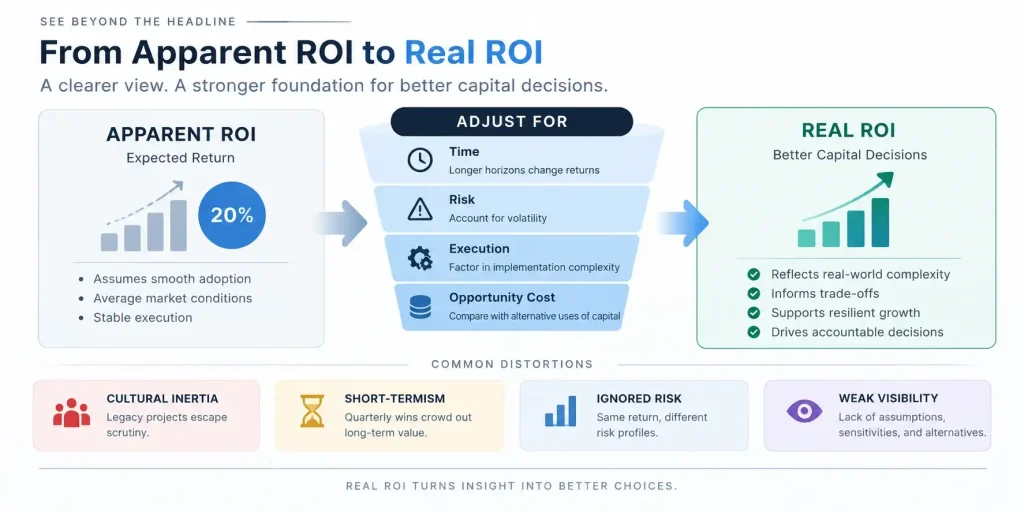
Apparent ROI lives in pitch decks and assumes smooth adoption, average markets, and stable execution. Real ROI adjusts for volatility, implementation complexity, internal trade-offs, and capital opportunity cost. On a buy-side diligence engagement for an IT services acquisition, quality-of-earnings analysis showed where reported earnings diverged from economic reality, and that gap directly informed the buyer decision.
Four distortions keep leaders from seeing real ROI:
- Cultural inertia: projects tied to legacy systems or organizational history escape scrutiny because they are familiar. Any initiative that needs capital needs a return.
- Short-termism: quarterly wins crowd out transformative investments, so leaders should defend long-horizon bets by defining intermediate milestones and not by abandoning the vision.
- Ignored risk: two initiatives can show the same expected return with sharply different distributions. Risk-adjusted return supports better diversification and scenario planning.
- Weak visibility: decisions need assumptions, sensitivities, and comparable alternatives, so leadership meetings move from intuition to model-informed debate.
Discipline at the top ties these corrections together. When executives accept vague justifications or skip post-mortems, the organization notices. Clarity begins with tone, and tone begins at the top, which is where the ROI of leadership development is won or lost.
Business Cases That Prove the ROI of Leadership Development
Value Levers, Assumptions, and Execution
The business case has often become a procedural hurdle instead of a strategic instrument. Spreadsheets cloak weak assumptions with arbitrary discount rates, compressed timelines, and inflated soft benefits. The strongest test of the ROI of leadership development is therefore the same test applied to any capital request. It must be a risk-adjusted blueprint showing what could go right and what could go wrong.
A sound case starts with strategic fit and asks why this investment is needed now. It then quantifies, sources, and benchmarks each value lever.
| Value lever | Sources of return |
| Revenue lift | Pricing, volume, new customers |
| Cost reduction | Automation, consolidation, renegotiation |
| Asset efficiency | Working capital optimization, fixed asset utilization |
| Risk mitigation | Regulatory compliance, security upgrades |
Soft benefits such as engagement or brand equity may appear, but they must be labeled as unquantified. Assumptions should be explicit and stress-tested for delayed adoption, a 15% cost overrun, or eroded pricing power. Downside, base, and upside scenarios with assigned probabilities turn a point estimate into a distribution.
At a venture-backed digital marketing company that scaled from $9M to $180M in 24 months, customer acquisition cost, lifetime value, and contribution margin discipline sustained growth. The same rigor guided a finance team that grew from one person to twelve.
Review, Tracking, and Shared Ownership
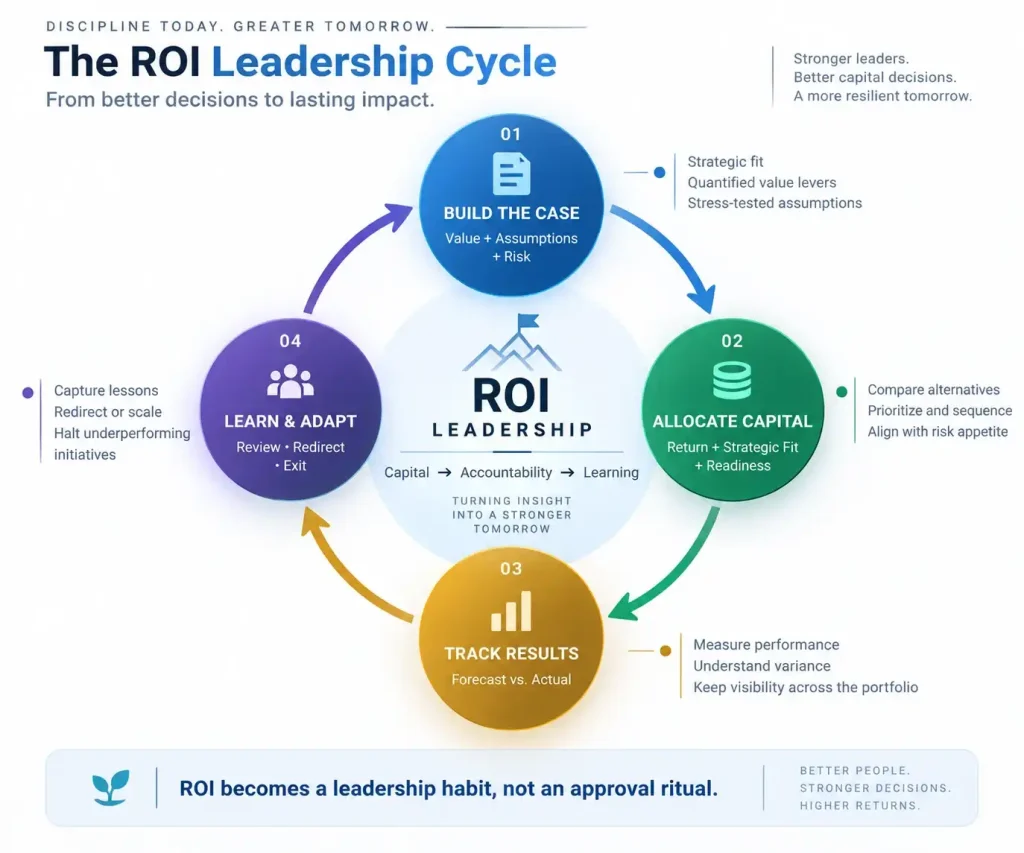
Cases must disclose execution complexity, including ownership, cross-functional dependencies, and third-party risk. A high-return project with low readiness can underperform a moderate one with mature delivery. Review should be comparative, with the investment committee ranking initiatives by return, strategic value, capital intensity, and delivery risk. The goal is to optimize enterprise return and not to approve projects.
After approval, actual performance is tracked against forecast and root causes are analyzed without blame. Digital templates and assumption libraries help, but skepticism remains a human skill. Finance and the business should co-author each case, since finance alone owns the math and the business alone owns the story. Co-authorship also raises the ROI of leadership development, because business leaders learn to defend their own assumptions.
Scaling ROI from Project Return to Portfolio Intelligence
No organization thrives on the strength of a single initiative, because strategy is expressed through portfolios. Capital allocation often stays fragmented or dependent on precedent. Every material initiative should flow through one investment review, judged on opportunity cost and strategic materiality and not on size alone.
Ranking, Buckets, and Risk
Relative ROI ranking scores initiatives on net present value, internal rate of return, payback period, strategic alignment, execution risk, and impact scale. Weights shift with priorities, so payback may dominate during a liquidity squeeze while alignment leads during expansion. Making trade-offs explicit replaces arbitrary prioritization with rational sequencing.
Capital buckets follow return and readiness and not size or hierarchy. This ends entitlement and raises the quality of business cases. At a $127M global consumer products company, inventory turns rose from 3x to 7x, which released trapped working capital for higher-return uses.
Portfolios also need risk mapping across every active initiative. Initiatives with strong individual returns may share regulatory exposure, technology dependence, or customer concentration. A balanced portfolio mixes short, medium, and long horizons so that quick wins do not crowd out transformative plays.
Governance, Capacity, and Exit Discipline
Investment committees must optimize deployment and not endorse projects, and their charters should favor challenge over consensus. Portfolio management tools visualize pipelines and simulate scenarios, though a dashboard of initiatives is a representation and not a strategy. Strategy, finance, operations, and technology must confirm that talent, systems, and vendor capacity can support the sequence, because a portfolio must match bandwidth as well as ambition.
Exit discipline matters just as much as approval discipline does. Underperforming initiatives should be halted or redirected, and regular reviews against original cases let leaders make hard calls with data. Transparent allocation also builds trust, shifting culture from protectionism to performance. Defending choices before peers is where the ROI of leadership development compounds.
Embedding the ROI of Leadership Development in Behavior and Accountability
Confidence and momentum often surround a capital request, yet few ask whether the metrics will be tracked. ROI discipline that lives only in models becomes a ritual of approval. The ROI of leadership development is realized when leaders own returns from proposal through execution.
Accountability, Memory, and Performance
Leaders are traditionally measured on revenue, margin, retention, and cost, which do not capture stewardship of capital. A leader who launches three well-projected initiatives and tracks none has consumed capital without creating value. Four practical mechanisms make accountability stick across the enterprise:
- Post-investment reviews: each major initiative is evaluated at completion or at milestones, and the goal is learning and not blame.
- ROI memory systems: repositories of assumptions, projections, actuals, and lessons reduce repeated errors and challenge future estimates.
- Transparent prioritization: communicating the ROI rationale for each approval signals fairness and shows what a strong case looks like.
- Performance management: ROI delivery enters annual goals with tracking and consequences, so executives are not rewarded for volume regardless of profitability.
At a mission-driven education institution, monthly and annual board reporting and audit committee engagement gave capital decisions the same visibility. Executive meetings should also move from status updates to value questions, such as whether the projected ROI is on track or what a new customer is worth against acquisition cost. Boards should ask whether capital deployed last year has produced returns this year.
Courage, Training, and Culture
Discipline requires courage, because leaders must sunset underperforming projects, admit forecasting errors, and challenge sacred assumptions. The CFO acts as a trusted challenger who protects capital by asking why until the answer is clear.
Leadership development closes the loop between analysis and behavior. Leaders in marketing, operations, product, and technology need the language of capital and the mechanics of risk-adjusted ROI. Finance teams become educators who test logic and co-own outcomes. ROI then stops being the domain of finance and becomes a shared expectation, making decisions more evidence-based and execution more intentional. The ROI of leadership development then shows up in decision quality, forecast accuracy, and the speed of hard calls.
Three Key Takeaways
- Define ROI once for the enterprise, include time, risk, and optionality, and separate apparent ROI from real ROI in every business case.
- Manage capital as a portfolio through relative ranking, return-based buckets, risk mapping, and firm exit discipline.
- Realize the ROI of leadership development by holding leaders accountable through post-investment reviews, ROI memory systems, and incentives tied to returns.
Disclaimer: This article is intended for informational purposes only and does not constitute legal, tax, or accounting advice. You should consult your own tax advisor or counsel for advice tailored to your specific situation.
Hindol Datta is a four-time CFO and senior finance executive with over 25 years of leadership experience across cybersecurity, SaaS, gaming, logistics, digital marketing, medical devices, consumer products, and nonprofit organizations. He has led more than $120M in fundraising and over $150M in M&A transactions while building the financial and operational systems that let complex businesses scale with confidence. He is the author of seven books in the Systems CFO Series and holds active CPA, CMA, and CIA credentials.
AI-assisted insights, supplemented by 25 years of finance leadership experience.