
Executive Summary
Many executives treat the ROI of branding as unknowable, so finance leaders either avoid brand spending or cut it first. Yet brand equity drives pricing power, lowers churn, and raises customer lifetime value. It does not appear in GAAP form, but its effects show up in conversion, retention, and margin data that finance already tracks.
The sections ahead explain how CFOs can bring rigor to brand investment without flattening it. They cover the cost of brand confusion and how to build a brand ROI model. They also examine lessons from brand successes and failures, the partnership between marketing and finance, and how brand matures into retained value. Together they show the CFO as the conscience of brand, not its opponent.
The Hidden Cost of Brand Confusion
Brand erosion seldom starts with a crisis that leaders can see. It begins with a revised slogan, a diluted positioning, or a campaign that feels slightly off-tone. Customer-facing teams start to interpret brand guidelines on their own, and the company’s story loses its edge.
How Incoherence Shows Up in the Numbers
Brand confusion does not always reduce marketing spend; it often increases it. Teams hire more agencies and produce more content, yet the campaigns stop connecting with each other. The CFO usually feels the effect first through a set of familiar signals:
- Customer acquisition costs drift upward without a clear cause
- Conversion rates flatten even as media spend holds steady
- Retention wobbles in segments that once felt secure
- Pricing power slips because customers cannot explain why the company is worth more
Consider a business whose product, pricing, and service stayed steady for five years while sales declined. Leaders blamed a new competitor and a cooling category. Churn interviews, support transcripts, and win/loss analysis told a different story: customers no longer knew what the company stood for. When brand is not a shared certainty, sales, marketing, and customers each form their own guess, and customers often choose a rival.
The lesson for finance is that incoherence is expensive. It creates redundant messaging and slows growth, because each new initiative must rebuild credibility from scratch. The answer is to clarify instead of cut. A clear brand behaves more like a fixed cost than variable spend, because once built well, it scales and compounds. The most expensive marketing says something unclear in a loud voice.
Building a Model for the ROI of Branding
Measuring the ROI of branding means tracing the financial fingerprints of trust, familiarity, and preference. A brand is the sum of the expectations a company sets and the consistency with which it meets them. That consistency creates margin that cost or utility alone cannot explain.
Start With Change, Then Trace It Back
The CFO should begin with what has changed as the brand gained coherence or reach, not with cost. Useful questions include whether lead quality improved and whether conversion rose while media spend held flat. Finance should also check whether average selling price increased without a product change. Finance then threads those effects back to the investment as a hypothesis with clear cause and effect.
Core Components of a Brand ROI Model
| Component | What It Captures | Typical Evidence |
| Willingness to pay | Price premium customers accept | Win/loss data and pricing tests |
| Acquisition efficiency | Conversion gains at steady cost per acquisition | Funnel and CAC trends |
| Customer velocity | Shorter time from awareness to purchase | Sales cycle data |
| Retention and lifetime value | Longer tenure and lower churn | Cohort analysis |
| Downstream efficiency | Fewer support calls and refunds | Service and finance data |
| Employee engagement | Lower attrition in customer-facing roles | HR data |
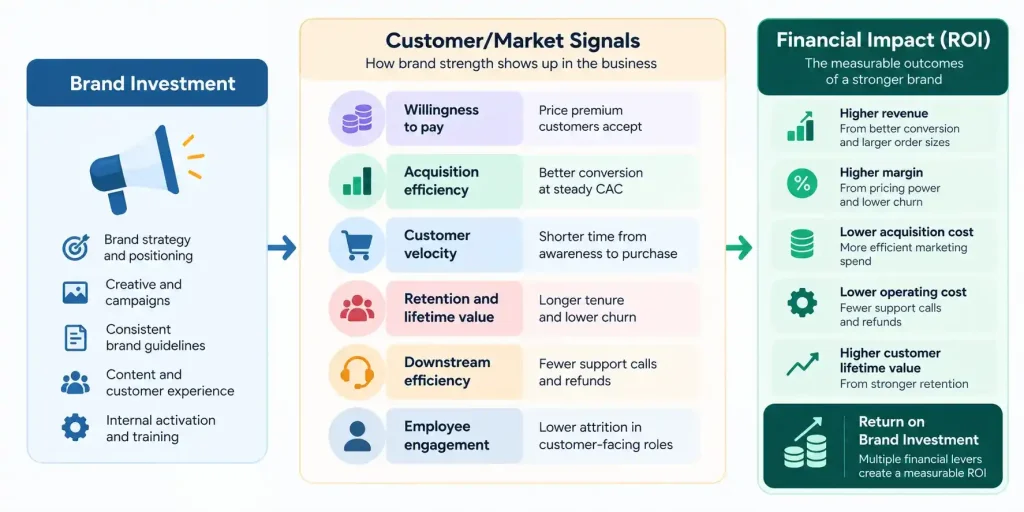
An illustrative scenario shows how these components combine. Suppose a company invests $5M in a focused brand relaunch over six months. Over the next two quarters, inbound leads rise 18%, lead conversion improves 22%, and average order size grows 12%. CAC holds steady, NPS improves, and first-year retention rises three percentage points.
Finance can model incremental revenue from higher conversion, lifetime value from longer retention, and margin uplift from lower churn. From there, an internal rate of return becomes possible, imperfect but useful. Each signal will not meet laboratory standards, yet trended carefully against the initiative, it offers enough evidence to call a return.
A venture-backed digital marketing company that grew from $9M to $180M in revenue within 24 months shows why this discipline matters. Leaders there built rigorous CAC, LTV, and contribution margin analysis to guide growth spending. That analysis gave every marketing dollar a measurable link to returns.
Lessons on the ROI of Branding From Success and Failure
Brand stories carry weight because people remember them. The companies that move markets often do so through memory and trust instead of noise. Comparing failures with successes shows that the ROI of branding depends on discipline, not design.
Theater Versus Essence
Picture a well-funded technology company that launches a lavish global campaign. The visuals impress and the spending is enormous, yet nobody can tell what the company does. Product teams joke about it, and sales reverts to old decks. The gap between CAC and LTV widens, and the CFO, consulted only after launch, cannot find a return.
Contrast that with a mid-sized B2B software company facing saturation in its core verticals. Instead of adding product lines, it spent a year learning how customers described it unprompted. Leadership distilled those insights into one honest proposition and embedded it in onboarding, investor materials, and product copy. Over time, CAC fell and renewal rates climbed, and buyers later cited brand depth as part of the valuation premium.
Theater and Essence in Brand Investment
| Dimension | Brand as Theater | Brand as Essence |
| Starting point | External campaign | Internal clarity about what is true |
| Finance role | Consulted after launch | Involved from the start with ROI gates |
| Team alignment | Sales and product disconnected | Message embedded across functions |
| Financial result | Widening CAC to LTV gap | Lower CAC, stronger renewals, valuation premium |
In each successful case, leaders discovered the brand in customer behavior and service rhythms instead of inventing it. The CFO’s role is to ask three questions in order: is it true, is it working, and is it scaling. Demanding proof before belief can miss the moment, while belief without proof mistakes noise for value.
Aligning Marketing and Finance on Brand ROI
In many companies, the CFO and CMO talk past each other. One speaks in ratios and the other in reach, so they share decks instead of decisions. Brand ROI improves when both functions learn a shared language.
Building Fluency Through Shared Questions
Fluency between the two functions begins with curiosity from both sides. The CFO should ask what a campaign is trying to achieve and how the team would know if it worked. The CMO should ask about financial thresholds, margin pressure, and which segments yield the highest return. Strong joint frameworks for the ROI of branding often include several elements:
- A clear objective, such as awareness, repositioning, or loyalty
- Few but focused KPIs, such as win rates, sales velocity, order size, and repeat purchases
- A defined tracking period, often three or four quarters
- A commitment to revise the plan if results miss agreed thresholds
When a global consumer brand enters a new market, this approach can turn an emotional narrative into a measurable plan without diluting it. Co-authored budgets build trust because both teams own the belief and the evidence.
A cybersecurity SaaS company with roughly $30M in ARR shows how pricing discipline links to perceived value. Gross margin improved by twelve percent through pricing discipline, workforce composition, and delivery cost management. Pricing power of that kind depends on customers understanding what they are paying for.
When Brand Becomes Retained Value
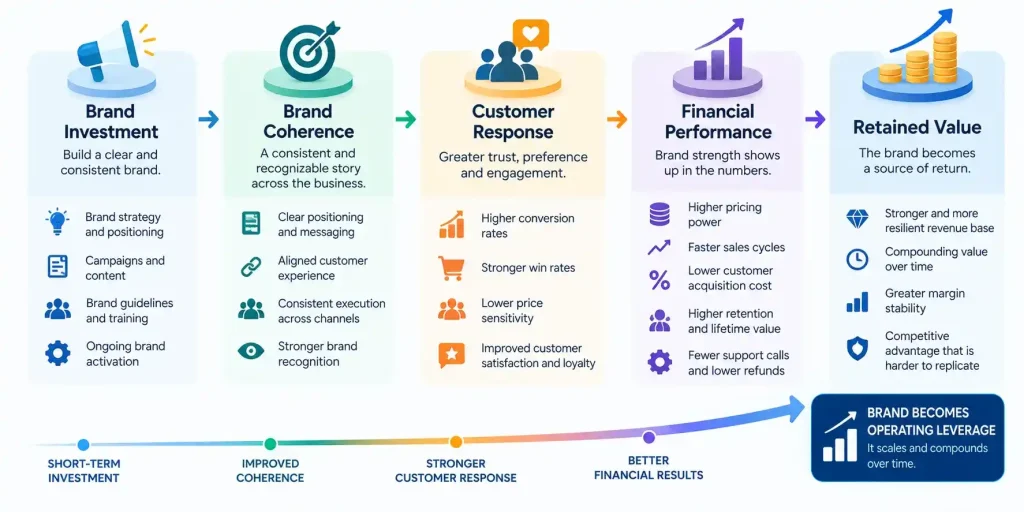
A mature brand no longer needs to introduce itself, and the ROI of branding then compounds. It supports pricing, accelerates sales, and gives the company time to recover during crises. Accountants may treat it as an intangible or a goodwill footnote, yet it operates like a permanent asset.
Signs That Brand Has Become Operating Leverage
The economic signs usually appear first in the data. CAC stabilizes even as the company scales, price sensitivity declines, and win rates improve. Analysts begin to speak of category authority and premium multiples. Internal signs follow, as recruiting becomes easier, onboarding shortens, and teams act with coherence.
Some companies with interchangeable products command brand premiums above 30%, not through cost or technology advantage but through years of reliability. Others let that equity erode by changing their story too often or by measuring brand only through media impressions. The difference lies in conviction, and finance must steward it.
A $127M global consumer products company selling through DTC, Amazon, and wholesale channels illustrates how brand and operations reinforce each other. Demand planning and SKU rationalization more than doubled inventory turns from 3x to 7x while the business grew across channels. Strong brand demand made disciplined inventory decisions easier to sustain.
The ROI of branding, in practical terms, is the ability to charge more, close faster, and survive longer. It is the part of the company that cannot be cut without consequence. When modeled carefully and funded wisely, brand becomes a source of return as well as the voice of the company.
Three Key Takeaways
- Brand confusion carries real costs in higher CAC, weaker conversion, and lost pricing power, so clarity should come before efficiency.
- The ROI of branding becomes measurable when finance traces changes in willingness to pay, conversion, retention, and service costs back to specific brand investments.
- Shared KPIs between marketing and finance turn brand from discretionary spend into a strategic asset that compounds over time.
Disclaimer: This article is intended for informational purposes only and does not constitute legal, tax, or accounting advice. You should consult your own tax advisor or counsel for advice tailored to your specific situation.
Hindol Datta is a four-time CFO and senior finance executive with over 25 years of leadership experience across cybersecurity, SaaS, gaming, logistics, digital marketing, medical devices, consumer products, and nonprofit organizations. He has led more than $120M in fundraising and over $150M in M&A transactions while building the financial and operational systems that let complex businesses scale with confidence. He is the author of seven books in the Systems CFO Series and holds active CPA, CMA, and CIA credentials.
AI-assisted insights, supplemented by 25 years of finance leadership experience.



