
Executive Summary
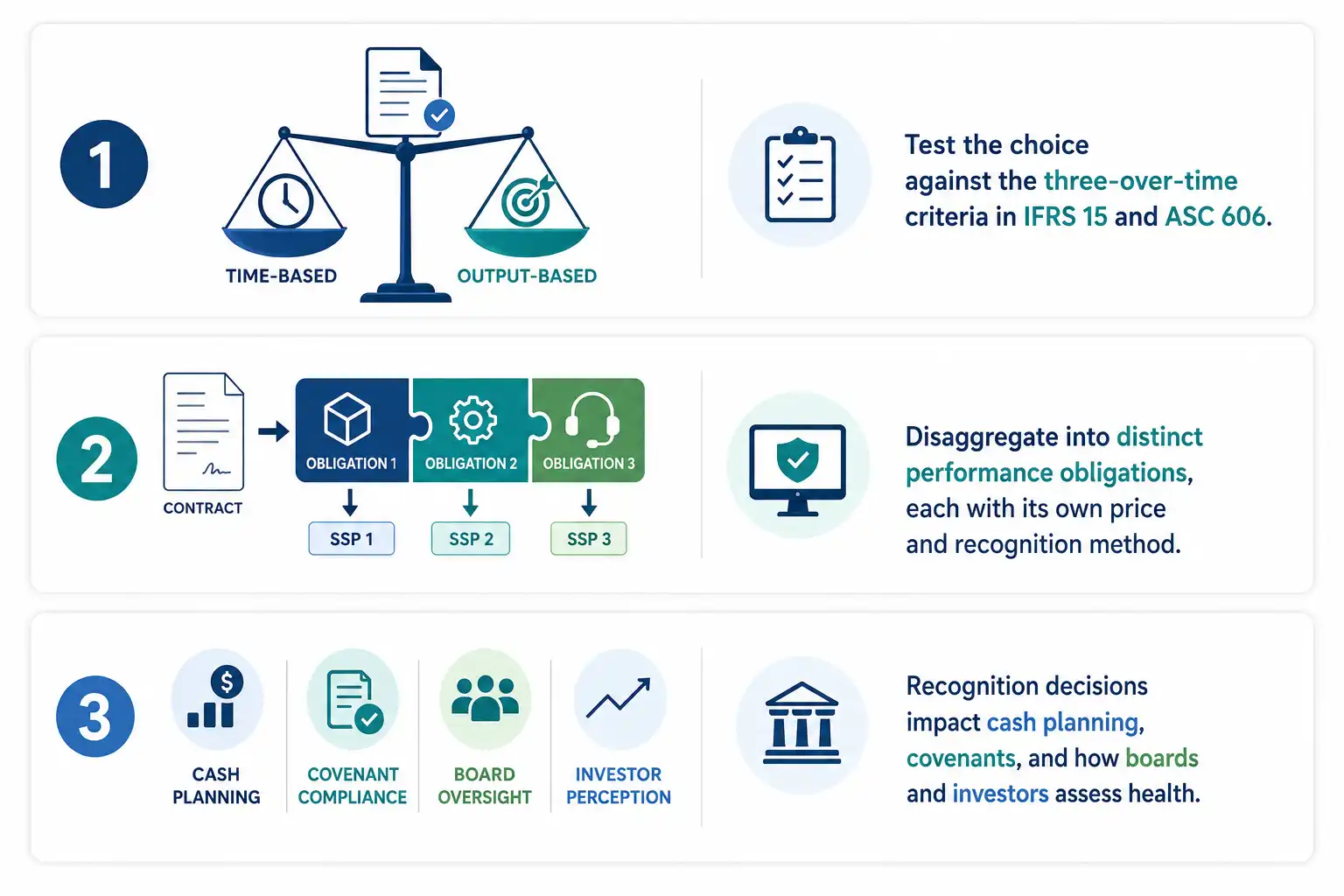
The revenue recognition principle is not merely a compliance exercise buried in the notes to the financial statements. It is a statement about how a company creates value. It must prove that value transfer with evidence a board, an auditor, or an acquirer will trust. The five-step model under IFRS 15 and ASC 606 ends with its most consequential step. That step asks a deceptively simple question. Does the customer receive value over time, or does the company deliver a specific output before revenue counts? The answer shapes everything downstream, from accounts receivable and covenant compliance to how investors read the growth story.
This article walks through when time-based recognition genuinely reflects delivery and when output-based recognition tells a more honest story. It also covers how hybrid contracts demand a level of contract disaggregation that most finance teams underbuild. It closes with the operational and system implications. Those are what separate a defensible revenue policy from a memo nobody in the business actually follows.
What the Revenue Recognition Principle Actually Requires
IFRS 15 and ASC 606 converge on a five-step model. Identify the contract, identify the performance obligations, determine the transaction price, allocate that price across obligations, and recognize revenue when or as each obligation is satisfied. The first four steps are largely mechanical once a finance team has done them a handful of times. The fifth step is where judgment lives, and where companies most often drift from economic substance toward administrative convenience.
The Three Criteria for Recognizing Revenue Over Time
Revenue may be recognized over time only if one of three conditions holds: the customer simultaneously receives and consumes the benefit as the company performs, the performance enhances an asset the customer already controls, or the company creates an asset with no alternative use while holding an enforceable right to payment for work completed to date. Absent one of these three conditions, revenue belongs at a point in time, when control transfers and the output is delivered.
| Over-Time Criterion | What It Looks Like in Practice |
| Simultaneous receipt and consumption | Managed IT services, cloud hosting, continuous access subscriptions |
| Enhancement of a customer-controlled asset | Implementation work performed directly on the customer’s system |
| No alternative use plus enforceable right to payment | Custom-built software, bespoke construction, unique R&D deliverables |
Too many finance organizations skip this analysis and default to straight-line recognition simply because the contract runs twelve months. A subscription term does not, by itself, establish uniform value transfer. That gap between contractual duration and actual delivery pattern is where auditors, and eventually investors, start asking uncomfortable questions.
Time-Based Recognition: When the Pattern Fits the Delivery
Time-based recognition earns its place when service is genuinely uniform across the contract term and effort tracks customer value in a straight line. Continuous access platforms, license-based tools with no major mid-term releases, and managed services with constant delivery cadence are the classic cases. The method is administratively attractive. It integrates cleanly with standard billing systems, supports automated deferral schedules, and gives the board a revenue line that moves predictably with churn and expansion.
The risk sits in the word “uniform.” At a high-growth cybersecurity and identity access management company generating approximately $30M in annual recurring revenue across more than 230 employees spanning five countries, the ASC 606 revenue recognition framework had to be built with enough precision to withstand acquisition diligence, not just internal reporting needs. That framework, paired with a driver-based forecasting engine and a disciplined close process that compressed reporting from eighteen days to ten, is what let the finance function hold actuals within plus or minus five percent of forecast for eight consecutive quarters. None of that precision would have mattered if the underlying recognition pattern did not reflect how customers actually consumed the product.
Time-based methods break down quickly when onboarding or implementation is front-loaded. A vertical SaaS provider selling compliance software to financial institutions may deliver the bulk of customer value in the first ninety days through automated audits, data migration, and regulatory mapping, with usage dropping by half thereafter. Recognizing that revenue straight-line overstates delivery in later months and understates it early. The fix is usually structural: split onboarding into its own performance obligation and recognize it against milestones, which also happens to give operations a clearer view of implementation effort and where margin pressure actually concentrates.
Output-Based Recognition: Matching Revenue to Value Delivered
Output-based recognition shifts the anchor from elapsed time to milestones achieved: units shipped, stages completed, hours billed, or data processed. Professional services, R&D, construction, and specialized analytics environments tend to fit this pattern more honestly than a calendar ever could.
Early-career work in financial planning and analysis for rail and transportation operations offers a useful grounding point here. Freight economics, route profitability, and capacity utilization all depend on matching cost to a specific unit of throughput rather than to a period of time, and that same logic applies directly to milestone-based service contracts. A logistics organization running systems integration engagements under milestone contracts, for example, benefits from tracking deliverables against billing stages rather than booking on total contract value alone. Each completed deliverable triggers partial billing and partial recognition, which synchronizes finance with delivery operations, improves cash flow predictability, and gives the board a forecast it can actually trust.
Output-based recognition is operationally heavier. It demands precise definitions of what counts as a completed milestone and documented evidence that the milestone occurred, since that same rigor invites closer audit scrutiny. That trade-off is worth making whenever the alternative is a revenue line that misrepresents how the business earns its money.
Hybrid Contracts and the Discipline of Disaggregation
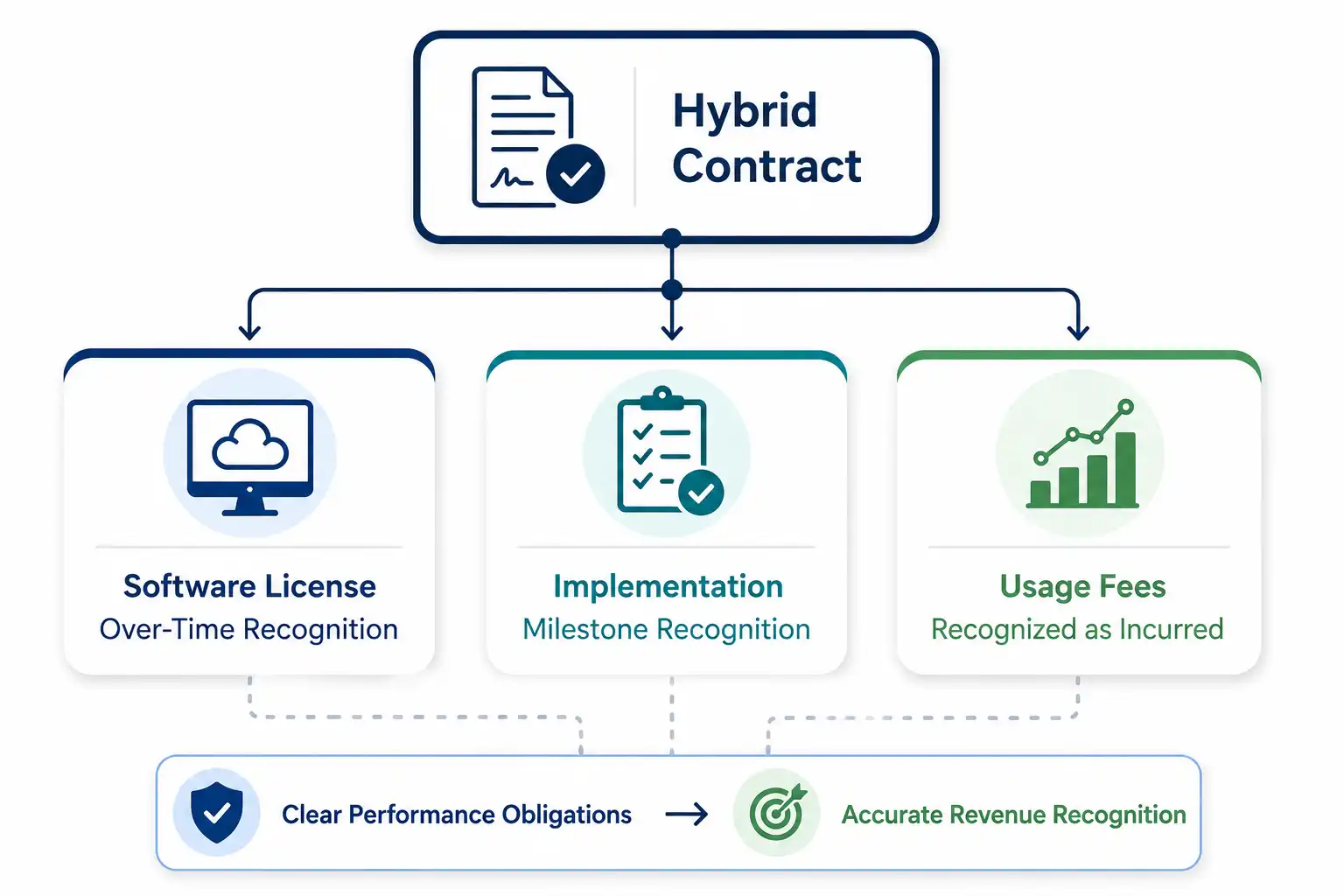
Most real contracts do not sit neatly in one category. They blend software licenses recognized over time, implementation recognized by milestone, and usage-based fees recognized as incurred. The task for finance leadership is not to force a single method onto a blended contract but to disaggregate it into distinct performance obligations, each with its own standalone selling price allocation and its own recognition pattern.
Getting this right requires systems that can hold the complexity. A Euronext Paris-listed gaming and digital entertainment company operating across the United States, France, the United Kingdom, Singapore, and South Korea faced exactly this challenge at scale: creating one unified definition of revenue across every subsidiary while reporting under both IFRS and US GAAP simultaneously. Rolling out Oracle Financials and MicroStrategy firmwide was what made that unified definition operational rather than aspirational, materially cutting statutory reporting cycles in the process.
Hybrid recognition breaks in three predictable places, and each is worth naming explicitly:
Undefined deliverables
If a performance obligation cannot be described precisely enough to prove completion, it cannot be recognized against a milestone with any confidence.
Disconnected systems
Revenue rules that live in a policy memo but not in the CRM, billing, or ERP configuration will not survive contact with a growing transaction volume.
Missing evidence trails
Auditors, and increasingly acquirers during diligence, expect documented proof of completion, not a finance team’s word for it.
Communicating Recognition Decisions to Boards and Investors
A revenue policy is only as strong as the confidence it generates in the room where capital decisions get made. Boards rarely need every footnote, but they do need to understand why a given pattern reflects delivery and how it connects to the metrics they actually track: ARR, backlog, gross margin, and cash conversion.
At a mission-driven education and research institution that raised $37M across equity and venture debt, board and audit committee engagement was not a quarterly formality; it was the mechanism through which recognition judgments, funding scenarios, and long-term sustainability decisions were tested and defended. That same discipline applies whenever a company changes its recognition pattern. The conversation goes better when the rationale is framed as strategic alignment between delivery and reporting, not as a defensive reaction to an audit finding.
What the Recognition Pattern Reveals
Revenue recognition is not only an accounting outcome. A time-based pattern signals steady, continuous service. An output-based pattern signals performance tied to discrete deliverables. A hybrid pattern signals complexity that, if well managed, reads as sophistication rather than confusion. Investors read these signals whether or not management intends them to. A recognition pattern that drifts from the operating model will surface eventually, and it is far better for finance to identify that gap internally than to have an auditor or an acquirer surface it during diligence.
Three Key Takeaways
Disclaimer: This article is intended for informational purposes only and does not constitute legal, tax, or accounting advice. You should consult your own tax advisor or counsel for advice tailored to your specific situation.
Hindol Datta is a four-time CFO and senior finance executive with over 25 years of leadership experience across cybersecurity, SaaS, gaming, logistics, digital marketing, medical devices, consumer products, and nonprofit organizations. He has led more than $120M in fundraising and over $150M in M&A transactions while building the financial and operational systems that let complex businesses scale with confidence. He is the author of seven books in the Systems CFO Series and holds active CPA, CMA, and CIA credentials.
AI-assisted insights, supplemented by 25 years of finance leadership experience.