
Executive Summary
Revenue forecasting has moved from a quarterly clerical exercise to a consequential finance discipline. Forecast quality now determines how well a company allocates capital, hires ahead of demand, and absorbs shocks. Strategic forecasting extends the practice by linking revenue to the operational drivers that produce it. It refreshes the view monthly and assigns each assumption to the function that controls it.
This article explains how the shift works in practice. It compares traditional and strategic forecasts and outlines the data, models, and accountability the discipline requires. It also shows how mature organizations use forecasting to shape growth rather than merely predict it.
Why Traditional Revenue Forecasting Falls Short
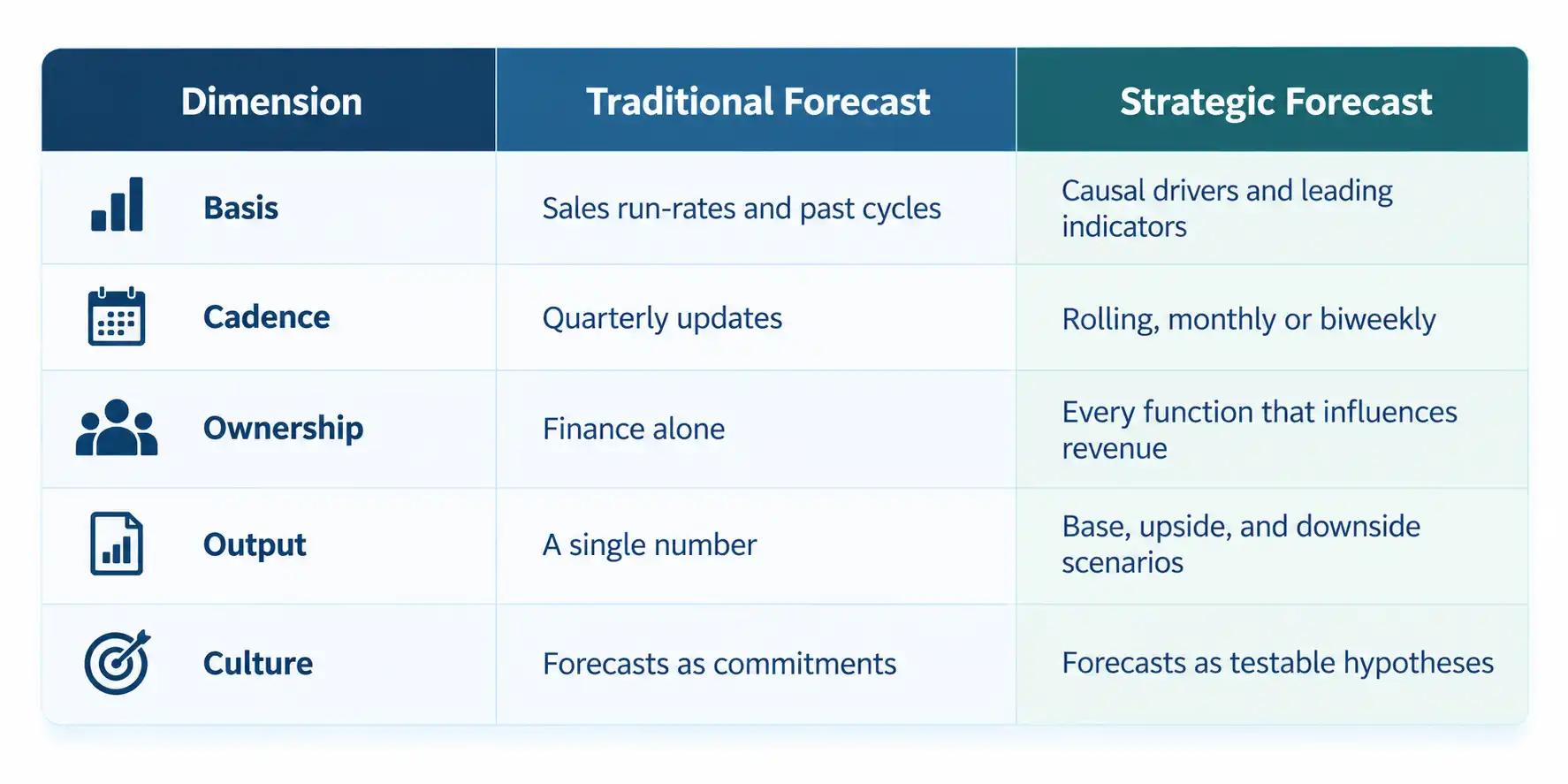
For decades, revenue forecasting was treated as an exercise in extrapolation. Sales submitted numbers, finance stress tested them against budget, and leadership braced for variance at quarter end. That approach made sense in stable markets. Volatile macroeconomic conditions, shifting customer expectations, and competitive saturation have since made static planning obsolete.
The weaknesses of traditional revenue forecasting are structural rather than technical. Inputs tend to be subjective, shaped by optimism or sandbagging depending on incentive design. The resulting number arrives with a confidence interval wider than anyone admits. Such forecasts may satisfy reporting requirements, yet they fail to inform strategy.
What Strategic Forecasting Changes
Causal, Driver-Based Models
Strategic forecasting rests on causal thinking about how revenue is actually produced. Revenue is the emergent result of interdependent drivers such as macroeconomic indicators, demand signals, competitor behavior, digital engagement, and pricing. Identifying the leading indicators among them reveals which levers sit within management’s control.
The difference shows up in the language of the forecast itself. A traditional statement reads, “Q4 revenue is expected to reach $100M based on 10% quarter-over-quarter growth.” A strategic statement reads, “Assuming a 5% lift in digital traffic, a 12% gain in sales productivity, and stable renewals, Q4 revenue reaches $100M; if renewal rates fall below 85% or ad spend underperforms by 10%, the outcome is closer to $94M.” The second version prepares the organization as well as predicting.
In a cybersecurity and identity access management company with roughly $30M in ARR, a driver-based forecasting engine and capacity model built from scratch held actuals within plus or minus 5% of forecast for 8 consecutive quarters.
Rolling Forecasts and Scenario Planning
Cadence changes as well, since leading companies replace quarterly updates with rolling forecasts refreshed monthly or biweekly, each carrying upside, base, and downside cases built on current data. Assumptions get tested earlier and resources move before the window closes, so the forecast functions as a steering wheel instead of a scoreboard.
Treating Forecasts as Hypotheses
In many organizations forecasts are feared as commitments and misses are punished, which produces cautious optimism or numerical theater. Strategic forecasting treats a forecast as a hypothesis, so a miss becomes a source of insight and a beat becomes a test of assumptions.
Building the Operational Backbone of Revenue Forecasting
Strategic forecasting lives in systems, conversations, assumptions, and incentives rather than in spreadsheets. Three foundations carry the load: high-integrity data, scalable models, and cross-functional accountability.
High-Integrity Data
Every forecast is capped by the quality of its information. One department may define a qualified lead differently from another, and finance may model churn from contracts while customer success tracks it from user activity; that misalignment creates noise that quickly becomes strategic fog. The remedy is governance, with finance, sales, operations, and IT agreeing on shared definitions and reconciling CRM, ERP, and marketing automation data into a single forecasting environment.
Model Design That Explains the Business
A good model interprets the present instead of overfitting the past. Rather than extrapolating historical growth, a strategic model decomposes revenue into volume, price, product mix, customer segment, and region, then forecasts each component from leading indicators such as pipeline velocity, competitive pricing pressure, and marketing conversion rates. Data scientists and operators should build these models together so that outputs remain explainable.
In a professional services firm that scaled from $12M to $63M in revenue within 8 months, engagement-level profitability, utilization, and pipeline reporting across five business units gave leadership its first clear view of where margin was created and where it quietly leaked.
Cross-Functional Accountability
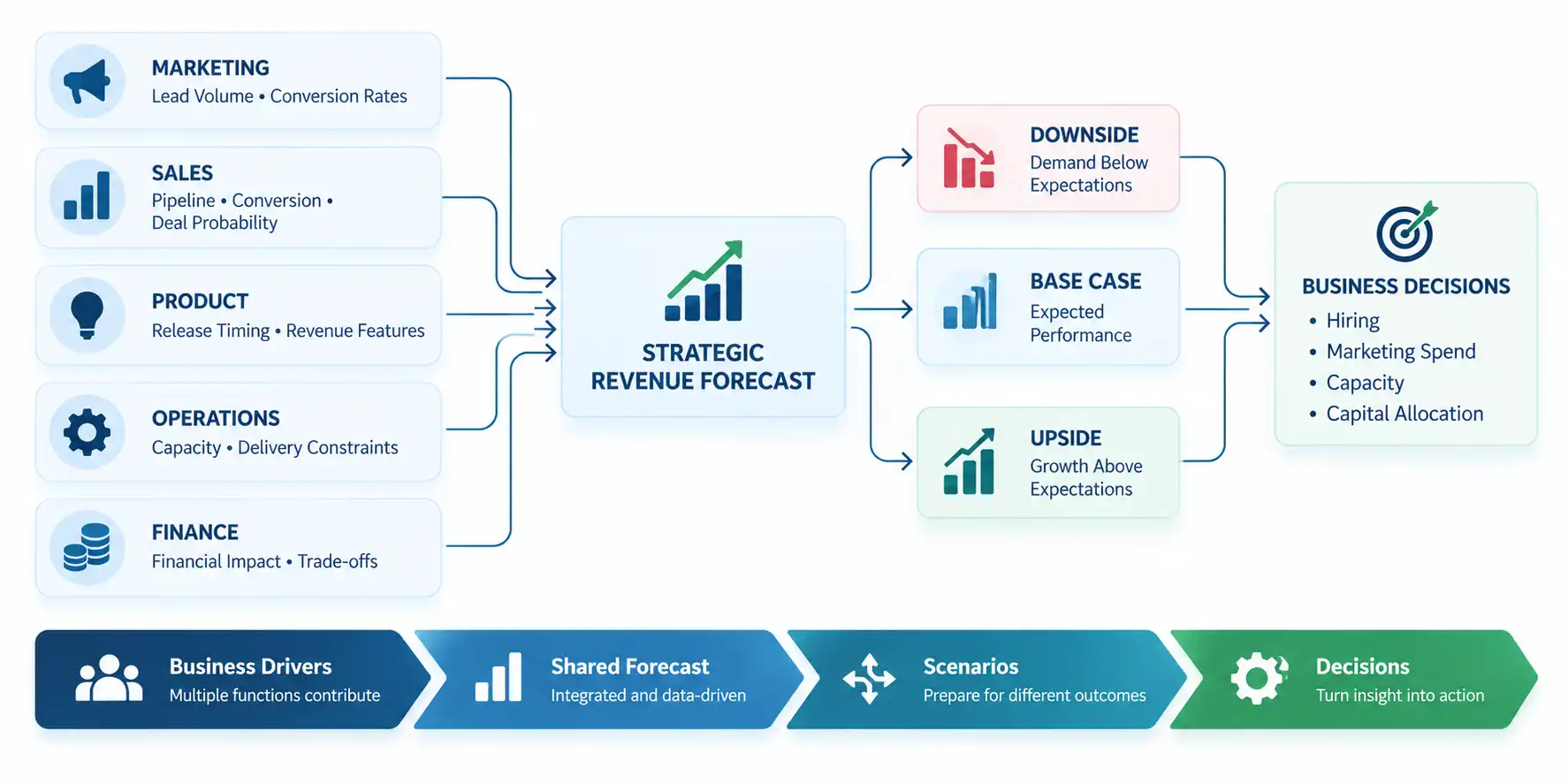
Revenue forecasting stops being a finance-only task when each function owns the inputs it controls:
- Marketing owns top-of-funnel assumptions such as qualified lead volume and conversion rates.
- Sales owns conversion, pipeline calibration, and the response when assumptions break.
- Product owns release timing and the roadmap features that unlock revenue in target segments.
- Operations owns fulfillment capacity and the bottlenecks that limit delivery.
- Finance owns integration, translating forecast movements into financial impact and trade-offs.
Forecast councils or growth operating committees institutionalize this ownership. In these working sessions a sales shortfall might prompt marketing to adjust spend, finance to revisit incentive accruals, or product to accelerate roadmap features. Planning platforms should surface the drivers, the deltas, and the confidence intervals, while a 12 to 36 month horizon makes capacity constraints and capital needs visible early.
Embedding Strategic Forecasting into Growth Operations
A forecast that sits in a board deck is a missed opportunity, so integration begins with rhythm. Forecast reviews belong in weekly pipeline calls and executive standups, where a change in the forecast forces a change in plans. Each department needs to know how it will respond when assumptions break: if marketing forecasts a 20% increase in inbound qualified leads, sales requires a plan to absorb that volume and a second plan for the case where only half materializes.
Sales, Finance, and Product Alignment
Sales-led revenue forecasting works best as a probability-weighted signal that incorporates pipeline stages, conversion rates, customer health, and rep-level trends, with sales leadership accountable for transparent calibration rather than perfect prediction. Finance then translates movement into consequence, since a 5% revenue shortfall may produce a 10% reduction in EBITDA depending on cost structure, and a delayed launch may require rescheduled hiring or revised pricing. Product and engineering use the same signals to prioritize roadmap features and time market entries.
Decision Windows
Decision windows are defined moments in the operating calendar when forecast insights convert into choices, such as whether to add headcount, accelerate a campaign, or renegotiate vendor contracts. Customer experience benefits as well, because a forecast churn risk in a cohort lets customer success intervene early.
The same principle applies to supply chains: in a $127M global consumer products company, demand planning and SKU rationalization tied to the forecast lifted inventory turns from 3x to 7x, releasing working capital that had been trapped in stock.
Strategic Forecasting as a Source of Competitive Advantage
Mature organizations treat forecasting as a strategic capability rather than a technical function, embedding it in hiring, capital expenditure, pricing, market entry, and M&A decisions.
The Learning Loop and Investment Discipline
These organizations measure how quickly forecasts improve with each cycle, treating every variance as a data point and every surprise as a signal.
Investment decisions benefit from the same discipline, because a company that can simulate how growth levers translate into financial outcomes can decide with confidence whether to add sales coverage in one region, invest in digital acquisition in another, or favor enterprise accounts over SMB volume. In a venture-backed digital marketing company that grew from $9M to $180M in 24 months, customer acquisition cost, lifetime value, and contribution margin analytics supplied the scenario logic that decided which channels earned additional capital.
Agility Corridors and External Credibility
Agility corridors set bounds within which teams may act without waiting for top-down direction. If revenue stays within a 5% band of forecast, business units execute pre-approved spending or hiring plans, and if performance deviates beyond that band, leadership intervenes, which replaces rigidity with responsiveness while keeping governance intact.
Consistent delivery within forecast ranges also builds external credibility, because investors reward predictability with premium valuations. Sustaining the capability depends on three long-term assets:
- Talent: analytical thinkers embedded in every function who translate data into action.
- Tooling: predictive platforms, scenario engines, and dashboards that make forecasts accessible.
- Trust: a culture in which people believe in the forecast, act on it, and learn from it.
Three Key Takeaways
- Strategic forecasting replaces extrapolation with driver-based models, so every revenue assumption has an owner and a lever that management can actually pull.
- Rolling forecasts, scenario ranges, and decision windows convert revenue forecasting from a reporting scoreboard into a steering mechanism that reallocates capital before opportunities close.
- Forecast quality compounds through feedback, which means the organizations that learn fastest from variance gain both internal alignment and external credibility.
Disclaimer: This article is intended for informational purposes only and does not constitute legal, tax, or accounting advice. You should consult your own tax advisor or counsel for advice tailored to your specific situation.
Hindol Datta is a four-time CFO and senior finance executive with over 25 years of leadership experience across cybersecurity, SaaS, gaming, logistics, digital marketing, medical devices, consumer products, and nonprofit organizations. He has led more than $120M in fundraising and over $150M in M&A transactions while building the financial and operational systems that let complex businesses scale with confidence. He is the author of seven books in the Systems CFO Series and holds active CPA, CMA, and CIA credentials.
AI-assisted insights, supplemented by 25 years of finance leadership experience.