
Executive Summary
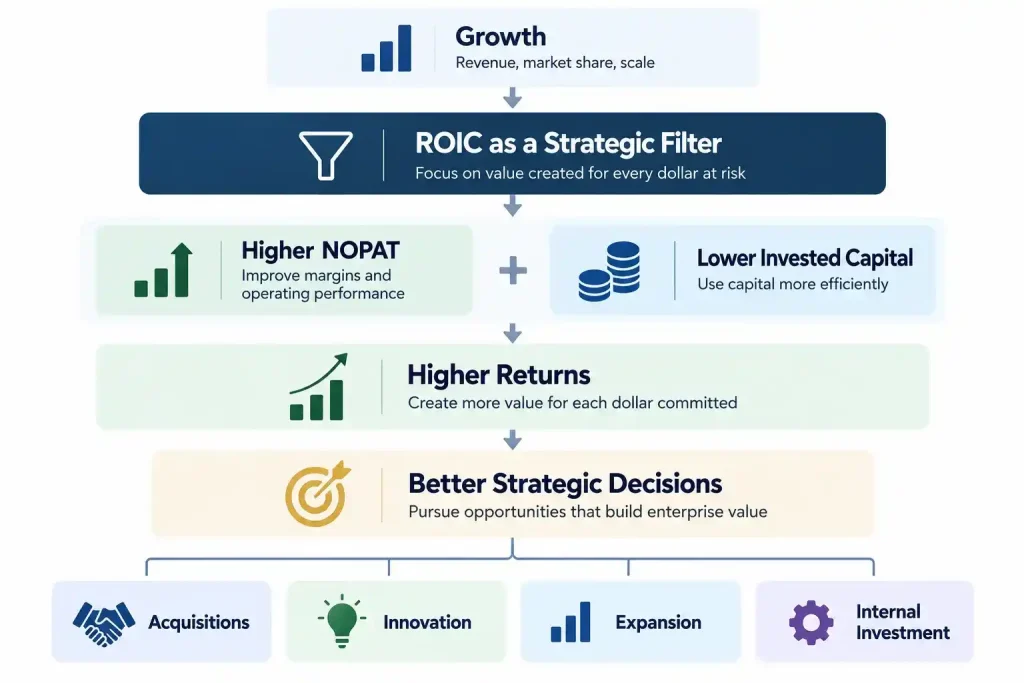
Return on invested capital changes how leaders see growth. The question shifts from how much a company can expand to how much value it creates for every dollar at risk. Revenue can surge while returns fall, and only a capital lens reveals whether growth builds enterprise value or quietly destroys it. For finance leaders, ROIC works best as a strategic filter, not a quarterly footnote.
The sections ahead explain why growth without return is a mirage and how the ROIC formula works as an operating system. They also apply return discipline to major strategic choices and show why the CFO must teach it as a shared language across the company.
Why Growth Without Return on Invested Capital Is a Mirage
Some success feels good but does not last. Revenue climbs, headcount expands, and market share grows, yet the underlying economics weaken until capital tightens or debt costs rise. Growth that fails to earn its cost of capital looks like progress while it erodes value underneath.
Return as a Filter, Not a Brake
Return on invested capital asks a simple question: how much value does the company create for each dollar entrusted to it? The measure carries the weight of every prior decision, from factories built to teams scaled and technologies acquired. If the engine converts capital into lasting surplus, it compounds; if not, no amount of revenue will redeem it.
Many companies double revenue while halving their ROIC, or close acquisitions that flatter the top line but dilute value. Such outcomes reflect failures of discipline, not failures of ambition. Capital discipline means saying no to deals that fail on return and pruning low-performing products. It also means resisting new capacity built only to fill a five-year plan. None of this calls for austerity, only alignment between effort and outcome and between scale and sense.
How the ROIC Formula Works as an Operating System
Return on invested capital rests on disciplined math that reveals more than most metrics. Too often, companies treat it as a quarterly footnote instead of a tool for daily decisions. Used well, ROIC brings gravity to every executive conversation about trade-offs.
The Two Components of ROIC
| Component | Definition | What It Reveals |
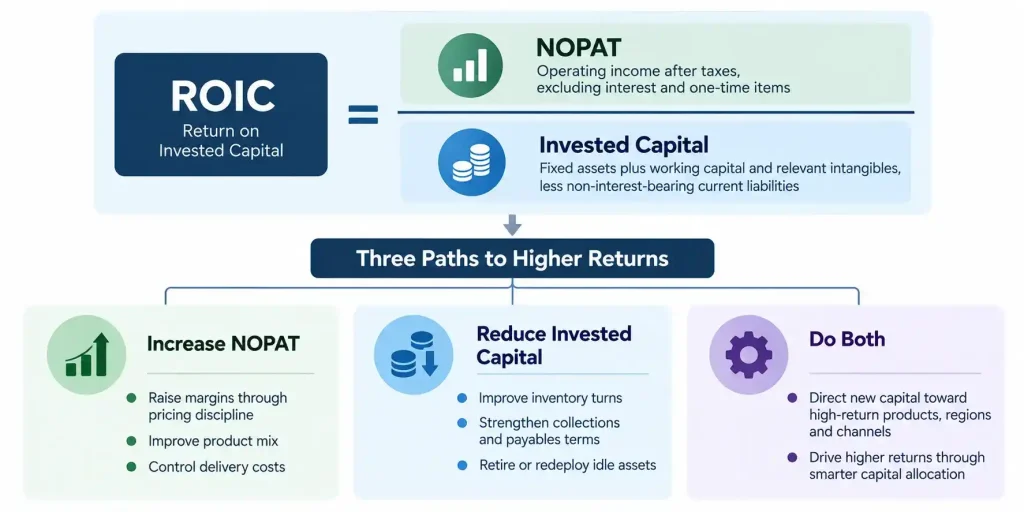
| NOPAT (numerator) | Operating income after taxes, excluding interest and one-time items | How well the business turns its operations into economic profit |
| Invested capital (denominator) | Fixed assets plus working capital and relevant intangibles, less non-interest-bearing current liabilities | How much capital the business still needs to run |
| ROIC | NOPAT divided by invested capital | Value created for each dollar committed to the business |
NOPAT removes financing decisions from the picture, so it measures pure operating effectiveness. Invested capital reflects what the business is still using, not simply what it once spent. Together they punish idle assets, expose bloated balance sheets, and highlight the cost of sprawling global footprints.
Three Paths to Higher Returns
Every effort to raise return on invested capital follows one of three paths: increase NOPAT, reduce invested capital, or do both. Each path rests on many smaller decisions across the business:
- Raise margins through pricing discipline, product mix, and delivery cost control
- Release working capital by improving inventory turns, collections, and payables terms
- Retire or redeploy idle assets that no longer earn their keep
- Direct new capital toward products, regions, and channels with proven returns
A $127M global consumer products company shows how powerful the capital side can be. Inventory turns more than doubled, from 3x to 7x, through demand planning and SKU rationalization. That improvement released trapped working capital and transformed cash conversion, which shrinks invested capital while supporting growth.
A cybersecurity SaaS company with roughly $30M in ARR shows the profit side at work. Gross margin improved by twelve percent through pricing discipline, workforce composition, and delivery cost management. Higher margin on the same capital base lifts returns directly.
Teaching ROIC Across the Business
Every unit leader should know the ROIC, asset intensity, and cost of capital for their own area. Taking more capital is not a sign of trust; it is a commitment to earn more than that capital costs. Accounting choices also deserve scrutiny, including how companies capitalize software, treat goodwill, and allocate overhead to high-return divisions.
Applying Return on Invested Capital to Strategic Decisions
A capital lens proves its worth in moments when the urge to act outruns the discipline to evaluate. The CFO serves as a lens of rigor in these moments, not a brake on ambition.
Mergers and Acquisitions
Few events are as tempting or as risky as acquisitions. Return discipline asks whether a deal will earn more than it costs in cash, not just on paper. It also asks whether the acquisition lifts blended ROIC or dilutes it below the cost of capital. Leaders should ask whether integration will create value or simply add complexity.
Buy-side due diligence on an IT services acquisition illustrates this rigor. Quality-of-earnings analysis surfaced material EBITDA adjustments where reported earnings diverged from economic reality. That kind of analysis protects returns by revealing what a buyer is truly paying for.
Innovation, Expansion, and Internal Investment
Product innovation does not need to be incremental to pass a return test. Ambitious projects simply need a clear capital path, a credible payback slope, and an honest view of interim burn. Geographic expansion deserves the same treatment, since new leases, headcount, compliance, and slow ramps all add capital drag.
A return corridor helps leaders evaluate these choices before they commit. If entry costs are too high or breakeven too distant, the company can pause, pivot, or pilot small. Even internal projects such as automation or a new ERP system must do more than tidy processes. They should raise asset velocity, cut operating cost, or unlock scale.
Return Discipline Across Strategic Choices
| Decision | Key Return Question | Warning Sign |
| Acquisition | Will it lift blended ROIC after integration? | Accretion on paper but returns below the cost of capital |
| New product | Is there a credible payback path? | Long burn with no clear capital milestones |
| Market entry | Does the return corridor justify the capital? | Slow ramp, high fixed cost, and unclear breakeven |
| Internal systems | Will it raise asset velocity or cut cost? | Benefits limited to process tidiness |
The CFO as Steward of Capital Discipline
The CFO acts as the conscience of capital. Return on invested capital is more than a measure of past efficiency; it declares that the company does not take resources for granted. Even when capital feels cheap, every dollar deployed absorbs attention, reduces optionality, and shapes the future in ways that are hard to reverse.
Making Return a Shared Language
ROIC must be taught as well as calculated. When it shrinks into a finance KPI, it loses its cultural power. When leadership, the board, and the CEO share it as a common language, it strengthens every conversation about products, pricing, hiring, and acquisitions.
The real value of return on invested capital lies in clarity. It shows which bets generate value and exposes assets that no longer serve the model. It also signals to investors that the company grows well, not just fast, and a company that lives by return compounds quietly over time.
Three Key Takeaways
- Growth that fails to earn its cost of capital erodes value, so return on invested capital should filter which ambitions a company pursues.
- ROIC improves through higher NOPAT, lower invested capital, or both. Margins, working capital, asset use, and smarter allocation are the main levers.
- Return discipline works best as a shared language across leadership, applied consistently to acquisitions, innovation, expansion, and internal investment.
Disclaimer: This article is intended for informational purposes only and does not constitute legal, tax, or accounting advice. You should consult your own tax advisor or counsel for advice tailored to your specific situation.
Hindol Datta is a four-time CFO and senior finance executive with over 25 years of leadership experience across cybersecurity, SaaS, gaming, logistics, digital marketing, medical devices, consumer products, and nonprofit organizations. He has led more than $120M in fundraising and over $150M in M&A transactions while building the financial and operational systems that let complex businesses scale with confidence. He is the author of seven books in the Systems CFO Series and holds active CPA, CMA, and CIA credentials.
AI-assisted insights, supplemented by 25 years of finance leadership experience.