
Executive Summary
“Every finance organization with a foreign subsidiary eventually confronts the same question. It arrives disguised as a technical accounting matter, when it is in fact a governance decision about economic substance. Is this entity a standalone operation, earning and spending in its own currency? Or is it an extension of the parent? One conducting business in the parent’s currency, while its books happen to sit somewhere else. That single determination decides which of two methods applies. Remeasurement vs translation is not a matter of accounting preference. It is a matter of correctly describing how a business actually functions. Getting it wrong distorts earnings and unsettles investors. It also invites the kind of audit scrutiny that no finance leader wants to explain to a board.
This article walks through both methods under ASC 830. It covers the judgment required to determine functional currency, and the operational discipline that keeps the determination defensible over time. It also addresses the related question of foreign currency transaction vs translation accounting. Finance teams frequently confuse the two concepts, even though they solve different problems within the same standard.
Two Currency Frameworks, One Critical Choice
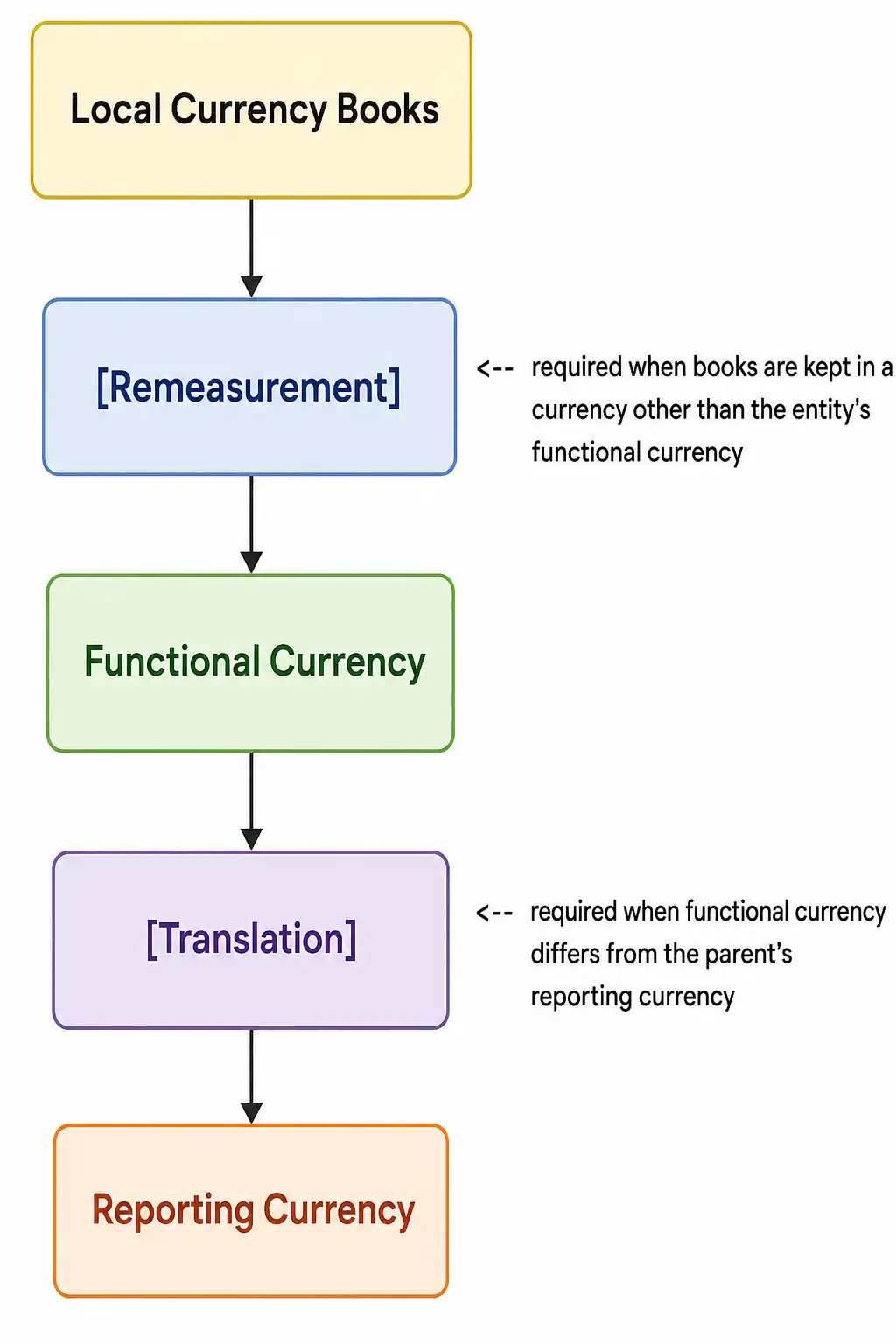
ASC 830 provides two primary mechanisms for converting foreign currency financial statements into a parent’s reporting currency. Translation applies when a foreign operation maintains a functional currency different from the parent’s reporting currency. Remeasurement applies when an entity keeps its books in a currency other than its functional currency. This holds true regardless of where those books physically sit. The distinction sounds narrow on paper, and yet it governs where currency volatility lands. Translation adjustments accumulate quietly in equity through other comprehensive income. Remeasurement gains and losses flow directly into net income. There, they can swing a quarter’s results in ways that have nothing to do with operating performance.
The decision hinges entirely on functional currency. This is the currency of the primary economic environment in which the entity operates. Not the currency of incorporation. Not the currency of the local bank account. The functional currency is the currency in which the entity earns revenue, pays its people, and commits its capital.
Functional Currency: The Foundation of Every ASC 830 Determination
Where Judgment Lives
ASC 830 offers a list of indicators for functional currency determination, including the currency that denominates sales prices, the currency of the country whose competitive forces and regulations most affect pricing, the currency that governs financing arrangements, and the currency in which the entity incurs labor, materials, and other costs. None of these indicators is dispositive on its own and weighing them against one another is where experienced judgment separates a defensible position from a convenient one.
A recurring pattern shows up in software and subscription businesses with local sales entities. Many default to the parent’s reporting currency as the functional currency, even when local customers pay in local currency, the entity pays its staff in local currency, and local receivables and tax obligations sit entirely within the local economy. That default is often wrong. A multi-entity cybersecurity and identity access management organization operating across the United States, Canada, Mexico, India, and Nepal illustrates the point well: five distinct economic environments, each requiring its own functional currency evaluation rather than a default tied to the parent’s currency for administrative convenience.
The opposite pattern appears in hardware and consumer products businesses, where procurement, pricing, and contracting often flow through a centralized entity even though manufacturing occurs abroad. A global consumer products company with more than $127M in revenue, operating direct-to-consumer, Amazon, and wholesale channels with a supply chain spanning China and Vietnam, illustrates this structure well. The company centralized sourcing and pricing strategy in a way that supported a functional currency determination tied to the parent’s currency, even though physical operations sat overseas.
Translation vs Remeasurement: How the Current Rate and Temporal Methods Differ
When translation applies, ASC 830 requires the current rate method, which works as follows:
- Assets and liabilities are translated at the end-of-period spot rate.
- Revenues and expenses are translated at average rates for the period.
- Equity components are translated at historical rates.
- The resulting currency translation adjustment flows to other comprehensive income, not the income statement.
This approach isolates operating performance from currency movement. Foreign exchange fluctuation does not touch the income statement until the entity repatriates earnings or sells the underlying assets, which allows management and the board to evaluate the business on its operating merits rather than on the noise of exchange rate swings.
When remeasurement applies, ASC 830 requires the temporal method, which works differently:
- Monetary assets and liabilities, including cash, receivables, and payables, are remeasured at the current rate.
- Non-monetary assets, including inventory and fixed assets, are remeasured at historical rates.
- Revenue and expense items tied to non-monetary accounts, such as depreciation and cost of goods sold, use historical rates.
- The resulting remeasurement gain or loss flows directly to the income statement.
The practical consequence is volatility. Remeasurement introduces currency movement directly into reported net income, and in inflationary or high-devaluation environments that volatility can be pronounced enough to distort the headline numbers a board or investor sees.
Foreign Currency Transaction vs Translation: Why the Distinction Matters for Reported Earnings
A foreign currency transaction vs translation distinction trips up finance teams almost as often as the functional currency determination itself. A foreign currency transaction is a single event, such as a sale, purchase, or loan denominated in a currency other than the entity’s functional currency; it is remeasured at the transaction date and again at each reporting date until settlement, with the resulting gain or loss recognized in earnings. Translation, by contrast, is a financial statement-level process applied to an entire set of books once functional currency has been established. Confusing the two leads teams to misclassify what should be a transactional gain or loss as a translation adjustment sitting in equity, understating the earnings volatility a board should actually see.
What Remeasurement vs Translation Means for Consolidated Reporting
The choice between these two methods carries consequences well beyond the accounting entries themselves.
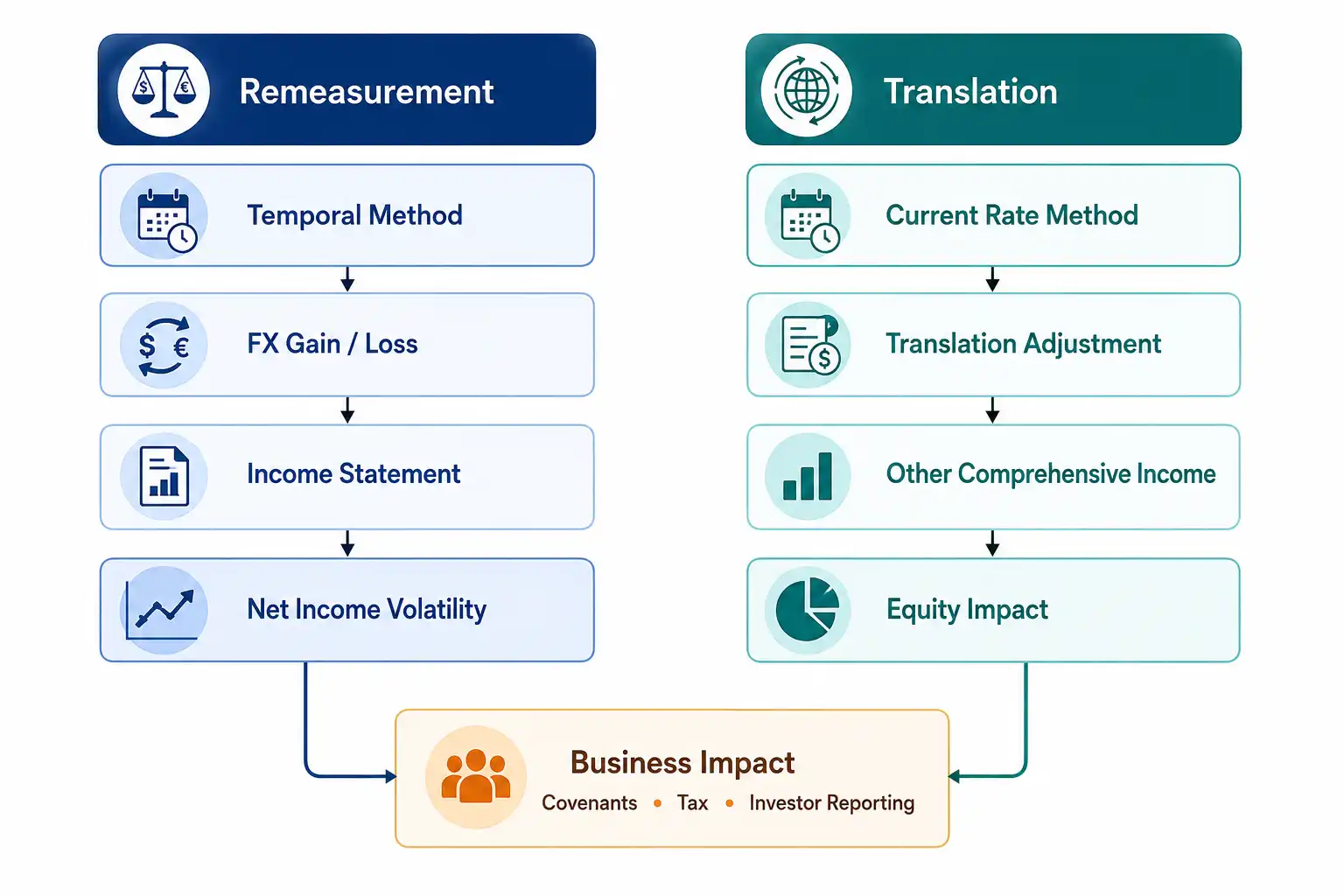
Net income volatility
Remeasurement gains and losses hit the income statement directly, while translation effects sit in other comprehensive income and rarely draw the same scrutiny.
Equity fluctuation
Cumulative translation adjustments can grow substantial over time, particularly for long-standing subsidiaries operating in volatile currency environments.
Covenant compliance
Remeasurement-driven swings in net income can affect interest coverage ratios and EBITDA-linked covenants in ways that have nothing to do with underlying business performance.
Tax treatment
Many jurisdictions tax foreign exchange gains and losses differently depending on whether they are realized or unrealized, adding another layer of consequence to the functional currency call.
A global gaming and digital entertainment company listed on Euronext Paris, with operations spanning the United States, France, the United Kingdom, Singapore, and South Korea, illustrates what happens when this determination is wrong. In a period of currency devaluation, a Latin American subsidiary remeasured in US dollars generated $4.5M of foreign exchange losses that hit reported net income and surprised investors who had not been briefed on the exposure. A reassessment concluded the functional currency should have been local, and a restatement followed. The change carried no cash impact, yet it cost the organization credibility with its investor base, a far more expensive currency to rebuild than the dollar or the euro.
Building Systems and Processes That Can Support the Determination
Foreign currency accounting under ASC 830 is not solely a policy question; it depends on the underlying finance infrastructure. Rate sourcing must be accurate and consistently applied across spot and average rates. Systems must track layered historical costs for fixed assets and equity contributions across multiple currencies. Documentation supporting the functional currency determination must be thorough enough to withstand audit inquiry years after the original decision was made.
A global gaming company’s rollout of a unified enterprise resource planning and reporting platform across five countries under both IFRS and US GAAP demonstrated how much of this determination lives in systems architecture rather than accounting policy alone. A single, consistent definition of revenue across every subsidiary made the functional currency determinations auditable in a way that spreadsheets and manual processes rarely achieve.
A Playbook for Finance Leaders
- Review every foreign entity annually and document the functional currency rationale in writing, not as an afterthought during audit season.
- Confirm the enterprise resource planning system supports both translation and remeasurement mechanics with correct rate application at the transaction and consolidation level.
- Brief FP&A and investor relations teams on where currency volatility will surface, since a surprise in net income lands very differently with investors than a movement buried in equity.
- Analyze cumulative translation adjustment balances and their potential effect if a subsidiary is divested or its earnings repatriated.
- Bring foreign exchange impact into board narratives proactively, particularly in periods when currency movement materially affects reported results.
Three Key Takeaways
- Translation vs remeasurement is not an accounting technicality; it is a determination about whether a foreign operation functions as an independent economic unit or as an extension of the parent, and that determination decides whether currency volatility shows up in equity or in earnings.
- Functional currency judgment requires weighing pricing, cost, financing, and regulatory factors together rather than defaulting to the parent’s reporting currency for convenience, a mistake that shows up repeatedly in software and consumer products businesses with international operations.
- The infrastructure behind the determination, including rate sourcing, documentation, and consolidated reporting systems, matters as much as the policy itself, since a technically correct method applied on unreliable systems will still produce results that do not withstand audit or investor scrutiny.
Disclaimer: This article is intended for informational purposes only and does not constitute legal, tax, or accounting advice. You should consult your own tax advisor or counsel for advice tailored to your specific situation.
Hindol Datta is a four-time CFO and senior finance executive with over 25 years of leadership experience across cybersecurity, SaaS, gaming, logistics, digital marketing, medical devices, consumer products, and nonprofit organizations. He has led more than $120M in fundraising and over $150M in M&A transactions while building the financial and operational systems that let complex businesses scale with confidence. He is the author of seven books in the Systems CFO Series and holds active CPA, CMA, and CIA credentials.
AI-assisted insights, supplemented by 25 years of finance leadership experience.