Executive Summary
Real-time risk analytics changes risk management from a backward-looking report into a forward-looking discipline. Quarterly reviews and month-end reports were built for a slower world, and modern exposures move faster than those cycles can capture. This article explains how finance leaders can close that gap without drowning the organization in noise.
The sections ahead examine the lag built into legacy systems and the role of analytics as a sensory layer for finance. They also cover how governance must change to absorb live signals and how culture turns detection into disciplined reflex.
Why Legacy Risk Management Falls Behind Real-Time Risk Analytics
Most risk frameworks took shape when data moved at the speed of paperwork. The annual audit set the standard for certainty, the monthly close served as gospel, and the quarterly forecast peered through the fog. Beneath that structure, a quiet fragility always lingered, because precise processes were also slow ones.
The Illusion of Periodic Control
Legacy systems lag in insight as much as in data capture. They rely on reconciliations instead of streams and on human review instead of algorithmic detection. A margin shortfall appears weeks after the promotion failed, and a liquidity gap emerges once collections have already slipped. In each case the numbers tell the truth, but they tell it too late to matter.
Periodic control assumes that risk behaves politely and waits for the reporting cycle. In practice, a market moves on Sunday night, a cyber breach starts at 2:14 a.m., and a supplier defaults mid-production. None of these events respect fiscal calendars, so legacy systems offer the comfort of completeness at the cost of timeliness.
How Strong Performance Masks Fragility
The mirage deepens further when results look strong on paper. Revenue masks inefficiency, valuations outpace risk, and confidence dulls vigilance. Teams document policies and reaffirm thresholds, yet the underlying responsiveness is missing. When volatility returns, the lag becomes visible, often after the window to maneuver has closed.
Periodic Control Versus Continuous Awareness
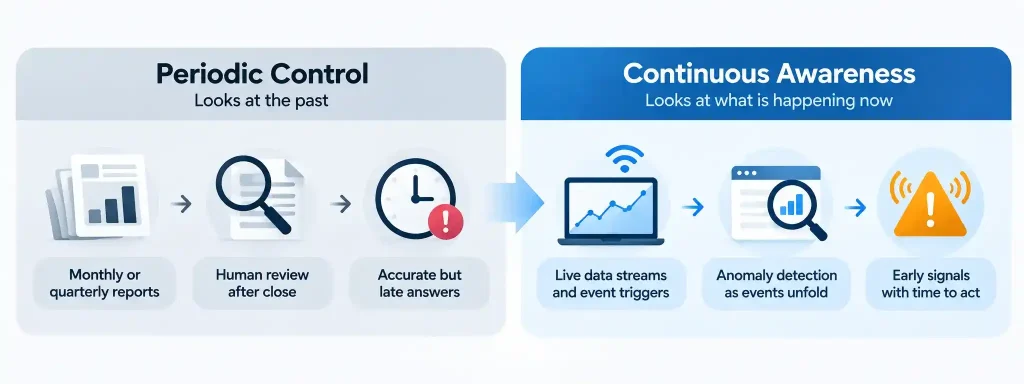
| Dimension | Periodic Control | Continuous Awareness |
| Data cadence | Monthly or quarterly batches | Live streams and event triggers |
| Detection method | Human review after close | Anomaly detection as events unfold |
| Core question | What happened? | What is starting to happen? |
| Typical outcome | Accurate but late answers | Early signals with time to act |
Real-Time Risk Analytics as the Nervous System of Finance
A nervous system exists to interpret stimuli and trigger a response before harm spreads. Finance needs the same capability, because an enterprise without live perception will eventually misprice risk and misallocate attention. Real-time risk analytics provides that sensory layer, turning risk from a category in a report into a pattern in motion.
Reading Streams Instead of Reports
Traditional analytics answers questions leaders already know to ask. Real-time risk monitoring works differently, since it watches for divergence, velocity, and deviation from the norm across many data streams. Early signals often look small and easy to dismiss at first:
- A spike in late payments from one region may point to local economic tightening
- A drop in basket size within one customer cohort may signal product fatigue
- Frequent requests for expedited shipping may reveal an upstream inventory constraint
These signals are tremors that hint at change, not conclusions. Read early, they create options; read late, they become losses. A $127M global consumer products company with a supply chain spanning China and Vietnam shows the value of this kind of reading. Inventory turns more than doubled, from 3x to 7x, through demand planning and SKU rationalization. That result depended on seeing demand and supply signals early enough to act on them.
Designing Thresholds and Response Paths
Building this capability is an architectural task as well as a technical one. It requires integrated data sources, streaming pipelines, models that understand seasonality, and alerts that favor signal over noise. Without governance, real-time risk analytics becomes a noise generator; with it, the same tools become instruments of precision.
Thresholds should flex with context instead of sitting fixed on a spreadsheet. Risk appetite must translate into sensitivity bands that catch real exposure without triggering alarm fatigue. Response design matters just as much, because analytics alone does not manage risk. Every alert needs an owner, a playbook, and a clear decision path.
Embedding Real-Time Risk Analytics into Governance
Insight without consequence changes nothing inside an organization. Executives rarely lack access to data; the problem is that data seldom rises with urgency or descends with accountability. Governance at its best is the systematic allocation of attention to where risk lives, and every signal from real-time risk analytics needs a home.
Reimagining the Risk Committee
A quarterly committee reviewing historical breaches cannot keep pace with the live exposure that real-time risk analytics reveals. The committee must become a standing structure that assesses anomalies and triggers containment in the moment. Its membership should blend finance, operations, cybersecurity, compliance, and supply chain, and its job is to prepare the board, not just report to it.
Capital planning must adapt to live signals as well. A demand volatility signal can make an approved capital outlay obsolete, and a supplier alert can demand sudden rerouting of resources. Contingency reserves, scenario-based pivots, and rolling reforecasts let budget discipline coexist with adaptive intent. Consolidated reporting across five countries under both IFRS and US GAAP at a public gaming company shows why this matters. When boards and audit committees span several jurisdictions, early and consistent risk signals become a governance requirement.
Tiered Escalation That Matches Signal to Authority
Not every signal requires a committee, but every signal must know its path. The CFO calibrates the tiers so that neither overreaction nor underreaction becomes the default.
Tiered Escalation Framework
| Tier | Example Signal | Response Owner |
| Local | An operational anomaly within one function | Functional leader |
| Cross-functional | Revenue softness across several regions | Office of the CFO |
| Systemic | A threat to liquidity, reputation, or strategy | CEO and board |
Institutional Memory and Healthy Skepticism
Risk events and near-misses deserve careful study, since insight fades unless someone records it. A risk intelligence repository captures anomalies, tracks outcomes, and refines thresholds over time. Frontline observations belong there too, from the manager who notices a returns pattern to the salesperson who hears client hesitation.
Speed still needs skepticism, because not every fluctuation signals exposure. Finance leaders must avoid the trap of false precision and keep asking what matters and why now.
Building a Culture of Vigilance and Financial Reflex
Even the most elegant real-time risk analytics platform will rust if the organization does not know how to listen to it. Vigilance is a discipline, not a dashboard, and financial reflex grows the way muscle memory does. Leaders set the tone by modeling curiosity over certainty and readiness over bravado.
Rewarding Early Signals and Practicing Response
A team that flags an unexplained pattern deserves recognition, even when the signal turns out to be a false positive. Incentives shape this behavior, since managers rewarded only against plan tend to hide variance. Reflex also comes from repetition, which the following practices build over time:
- Tabletop scenarios that walk teams through a liquidity or supply shock
- Live alert drills that test escalation paths and response speed
- Crisis simulations that connect finance, operations, and cybersecurity
- Performance reviews that credit early flagging and fast course correction
A cybersecurity SaaS company with roughly $30M in ARR held actuals within plus or minus five percent of forecast for 8 consecutive quarters. That consistency came from a driver-based forecasting engine and a steady reporting cadence, which gave leaders early sight of variance. Predictability of that kind is what financial reflex looks like in practice.
Vigilance Without Paranoia
A culture of responsiveness must rest on disciplined calm. The goal is not to react to every twitch in the data, but to recognize when a twitch marks the start of a pattern. Cross-functional fluency helps here, since a supply chain event can quickly become a liquidity event.
The Real-Time Risk Analytics Cycle
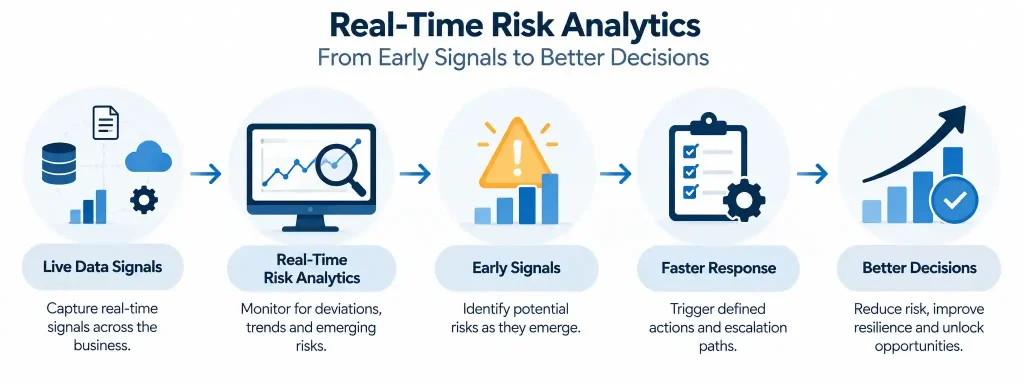
| Detect | Interpret | Escalate | Respond | Learn |
| Streams flag anomalies | Context separates signal from noise | Tiers route the alert | Playbooks guide action | Repositories refine thresholds |
Awareness as a Competitive Advantage
The same systems that detect fraud can also reveal opportunity, and the analytics that flag supply risk can surface pricing power. Real-time risk analytics does not replace judgment; it prepares it and gives it time. The CFO shifts from narrator of past performance to guardian of emerging exposure. In an age of continuous risk, the enterprises that perceive earliest are the ones that shape their future instead of simply surviving it.
Three Key Takeaways
- Legacy reporting cycles offer completeness at the cost of timeliness. Real-time risk analytics must complement the monthly close with live signals and dynamic thresholds.
- Detection only creates value when governance absorbs it. That requires a standing risk committee, tiered escalation, and a repository that turns near-misses into better thresholds.
- Culture sustains what technology starts, so leaders should reward early signals, rehearse responses through drills, and keep vigilance anchored in calm judgment.
Disclaimer: This article is intended for informational purposes only and does not constitute legal, tax, or accounting advice. You should consult your own tax advisor or counsel for advice tailored to your specific situation.
Hindol Datta is a four-time CFO and senior finance executive with over 25 years of leadership experience across cybersecurity, SaaS, gaming, logistics, digital marketing, medical devices, consumer products, and nonprofit organizations. He has led more than $120M in fundraising and over $150M in M&A transactions while building the financial and operational systems that let complex businesses scale with confidence. He is the author of seven books in the Systems CFO Series and holds active CPA, CMA, and CIA credentials.
AI-assisted insights, supplemented by 25 years of finance leadership experience.