
Executive Summary
Private equity fundraising has never been only about capital, because limited partners underwrite a thesis, a team, and a decade of decisions not yet made. Capital still chases performance, yet trust now chases discipline, and that shift is rewriting how general partners raise.
This article traces the PE fundraising trends reshaping the cycle, the narrative that persuades a skeptical LP, and the operating discipline a raise demands. It ends with the ethical covenant that begins once capital crosses the threshold.
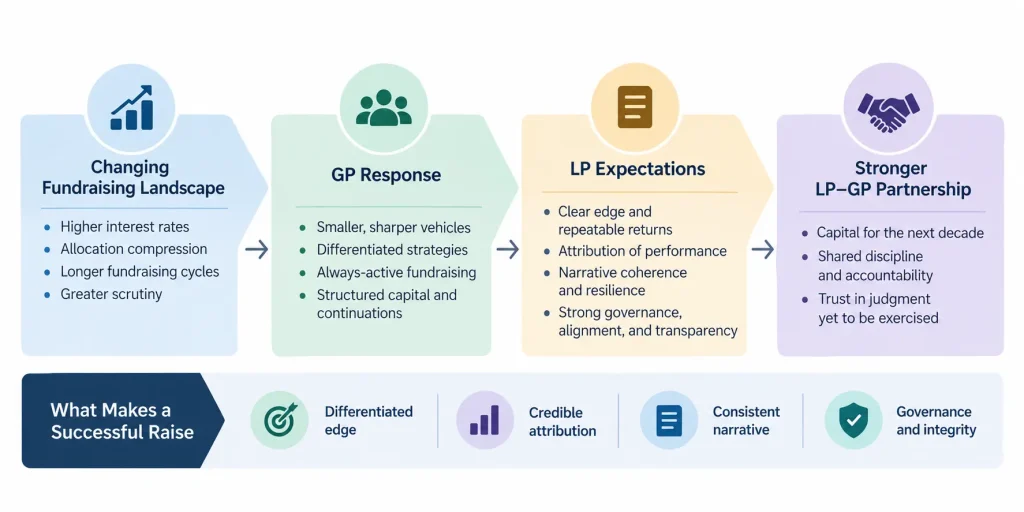
Why Private Equity Fundraising Tests Institutional Clarity
The old heuristics of a three-year track record, 2-and-20 economics, and a five-point deck are fading. In their place, LPs ask whether a manager understands why returns occurred and whether they can recur under different conditions. They also want to know what the firm will refuse to do. Today’s GP must act as part operator, part historian, and part ethicist.
Strong managers do not pitch so much as articulate a worldview, revealing the logic behind their choices instead of only showcasing deals. Yet the underlying task of private equity fundraising remains unchanged: forging a partnership between strangers, bound by contract and by belief in judgment yet to be exercised. For that reason, the clarity a firm brings to the raise mirrors the clarity it brings to the firm itself.
PE Fundraising Trends Reshaping the Cycle
Private equity fundraising once followed a natural rhythm, with raises every three to four years and LPs eager to redeploy distributions. That equilibrium has fractured, and GPs and LPs are now renegotiating their compact.
Macro Headwinds and Allocation Compression
Rising base rates have reversed a decade of cheap money, buoyant multiples, and strong distributions. Pensions, endowments, and sovereign funds now face denominator effects, allocation caps, and liquidity pressure. Appetite for private equity remains high on paper, but dollars for new managers or larger vehicles have become scarce and political. Re-ups with legacy relationships absorb most of the capital, so emerging managers compete against structural incumbency, not performance alone.
Private equity fundraising cycles have lengthened as a result. Strong managers once closed in six to nine months, while even well-regarded firms now report timelines of 15 months or longer. LPs need more time because vintage dispersion has widened and past returns look like artifacts of a vanished macro regime. Governance rights, key-person clauses, carry waterfalls, and reporting infrastructure, once table stakes, are now under the microscope.
What These Trends Demand From General Partners
Every raise must now contend with four realities. Each one shifts the burden of proof onto the manager:
- LPs are over-allocated to the familiar, so novel strategies need differentiated access or a provable edge.
- Performance alone does not persuade, because LPs want attribution that separates skill from what the market provided.
- Narrative coherence matters more than ever, since resilience now outranks raw return.
- Capital formation is no longer GP-led, as LPs syndicate, run back-channel references, and decide before the first meeting.
GPs have responded to these PE fundraising trends in several ways. Some raise smaller vehicles with sharper mandates to protect their edge, while others treat fundraising as a rolling, always-active process. Still others turn to structured capital and continuation vehicles for liquidity. Across all of these responses, power has shifted toward allocators who now shape funds instead of merely choosing them. Fundraising can no longer sit with investor relations alone, because LPs are underwriting judgment and expect to hear it from the CIO and managing partners.
The Narrative Behind Successful Private Equity Fundraising
Spreadsheets prove what has happened, but allocators invest in what has not. A raise therefore becomes a test of credibility that binds outcomes to intent.
From Charts to Pre-Committed Philosophy
The quality of a raise often shows in how it opens. The flow below captures the progression from ordinary to exceptional.
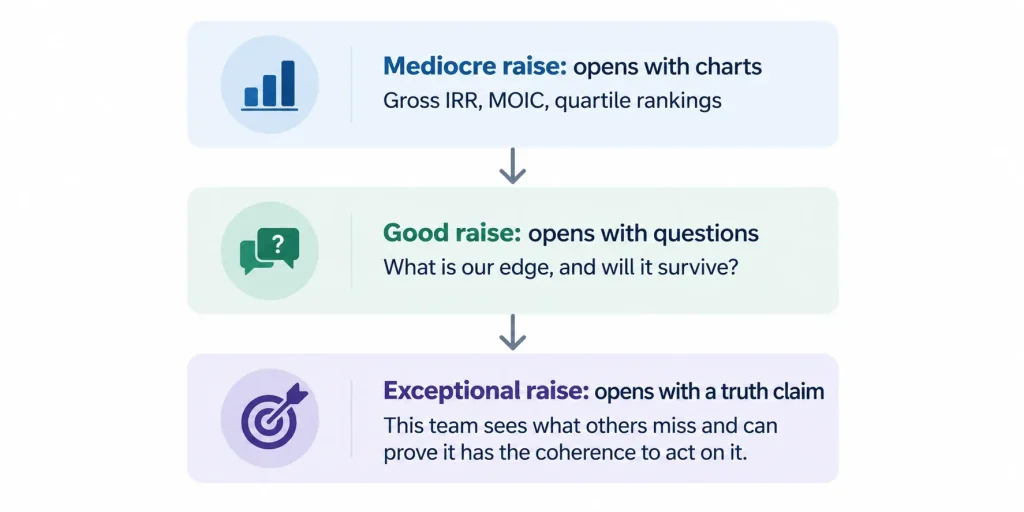
LPs are not backing the last deal but the next ten, so the core question shifts from what a manager earned to what it understands. Post hoc rationalization fills decks with flattering attribution and glossed-over mistakes. Pre-committed philosophy is rarer and more durable, because it shows deals passed on, mistakes made, and what changed afterward. A $20M Series B raise for a marketplace SaaS company showed the same dynamic, as its cohort and unit economics models held up in diligence by explaining causes, not just outcomes.
Managing LP Expectations With Integrity
Overpromising has long been the historical sin of private equity fundraising. Guiding to a 20% IRR now invites questions about fees, leverage costs, and exit multiple compression. A manager who defends every assumption signals insecurity, while one who owns the ambiguity earns trust.
Emotional expectations matter as well, because LPs overweight recency and crave steadiness. A recent underperformer with clarity can outperform a recent winner who cannot explain its edge. Owning the investor narrative and audit committee relationships through a $37M equity and venture debt raise at a mission-driven education institution reinforced that same lesson. Authentic managers admit errors, set boundaries, and accept short-term rejection in service of long-term trust.
Five Threads of a Credible Fundraising Narrative
A narrative built this way becomes a strategic invitation instead of a marketing exercise. Five threads hold that narrative together in practice:
- Origin story: the founding idea and the problem the firm was built to solve.
- Investment thesis: what the team understands better than the market, and why it matters now.
- Process discipline: how the firm sources, underwrites, and governs deals, and what protects against drift.
- Track record forensics: what past results taught the team, and what it will not repeat.
- Cultural fidelity: which decisions the firm rewards and how it stays consistent when tempted.
Operationalizing Private Equity Fundraising Without Losing Strategic Soul
Early fundraising is artisanal, built on founder pitches and personal relationships. Scale demands a platform that can withstand scrutiny from many institutions at once.
The Data Room as an Index of Readiness
LPs enter the data room seeking reassurance that processes exist and oversight is real. A curated room signals foresight, while a messy one suggests a team still improvising. A strong room now holds five categories of evidence:
- Track record attribution by deal, team member, and strategy, both gross and net.
- Investment committee materials that show deals were interrogated, not rubber-stamped.
- Portfolio monitoring templates for tracking KPIs and triggering interventions.
- ESG policies framed as risk management, not virtue signaling.
- Valuation memos and audits that show how marks are derived and defended.
Three Operational Disciplines
Fundraising at scale runs as a parallel operating system alongside deal flow, and partner fatigue is where most firms falter. Three operational disciplines protect the firm’s hard-won edge:
- Delegation without abdication: investor relations owns logistics, but deal partners stay at the table.
- Systematized customization: modular messaging lets a sovereign fund hear about downside resilience and an endowment about time-weighted exposure.
- Governance signaling: real committees, conflict protocols, and succession planning show fiduciary behavior before funding.
Polish carries its own risk, since a corporate voice and generic thesis erase the edge that made a firm investable. Living documentation helps, including memos that record real debate and post-mortems that track reasoning. A venture-backed performance marketing company that raised $36.5M across three rounds built its first external audit along the way, turning governance into evidence investors could trust.
The Covenant of Capital in Private Equity Fundraising
Every raise is persuasion, but every close is trust. Once capital is wired, the LP cedes control, and the GP holds agency over how that capital is governed and explained. Behind every commitment stand pensioners, university endowments, and hospital operating margins, so capital is consequence, not commodity.
Honoring that asymmetry in private equity fundraising takes four forms. Intellectual honesty means explaining underperformance plainly, without smoothing variance or deferring bad news. Strategic discipline means resisting fashionable sectors and inflated fund sizes, since style drift breaks the covenant set out in the PPM. Governance courage means surfacing internal tensions and planning succession early. Temporal empathy means designing around each LP’s liquidity needs and reporting expectations.
LPs carry responsibility too, including avoiding trend-driven mandates and contradictory liquidity demands. When both sides honor their roles, compounded trust becomes the hidden asset on every GP’s balance sheet. As denominator pressure and constrained exits persist, the winners will show three traits:
- Transparency without fragility: willing to show flaws as evidence of learning.
- Growth without drift: able to scale capital without abandoning the edge.
- Conviction without arrogance: clear about beliefs and humble about what they cannot control.
Three Key Takeaways
- PE fundraising trends now favor managers who can attribute returns to repeatable skill. Longer cycles and allocation compression reward clarity over pedigree.
- Persuasion in private equity fundraising comes from pre-committed philosophy and honest expectation management. Owning ambiguity earns more trust than defending every assumption.
- Treat the raise as a covenant, not a campaign. Clean data rooms, real governance, and candid reporting turn capital into compounded trust.
Disclaimer: This article is intended for informational purposes only and does not constitute legal, tax, or accounting advice. You should consult your own tax advisor or counsel for advice tailored to your specific situation.
Hindol Datta is a four-time CFO and senior finance executive with over 25 years of leadership experience across cybersecurity, SaaS, gaming, logistics, digital marketing, medical devices, consumer products, and nonprofit organizations. He has led more than $120M in fundraising and over $150M in M&A transactions while building the financial and operational systems that let complex businesses scale with confidence. He is the author of seven books in the Systems CFO Series and holds active CPA, CMA, and CIA credentials.
AI-assisted insights, supplemented by 25 years of finance leadership experience.