
Executive Summary
Every growing company eventually faces a version of the same question: gross revenue or net revenue? Gross means reporting the full amount billed to the customer. Net means reporting only the margin retained after paying a partner. That choice sits inside one of the more consequential judgments calls in ASC 606, the principal vs agent revenue recognition determination. It shapes how investors read growth. It shapes how boards evaluate strategy. And it shapes how auditors sign off on the numbers a company puts in front of the market.
This article works through the control indicators that separate principal from agent status. It looks at the industries where the distinction gets genuinely difficult. It also covers the downstream effects on KPIs, tax exposure, and investor narrative. The analysis plays out inside real marketplace, SaaS, and logistics businesses, where the right answer often runs against what the growth story wants to say.
Principal vs Agent: Defining the Distinction That Drives Revenue Recognition
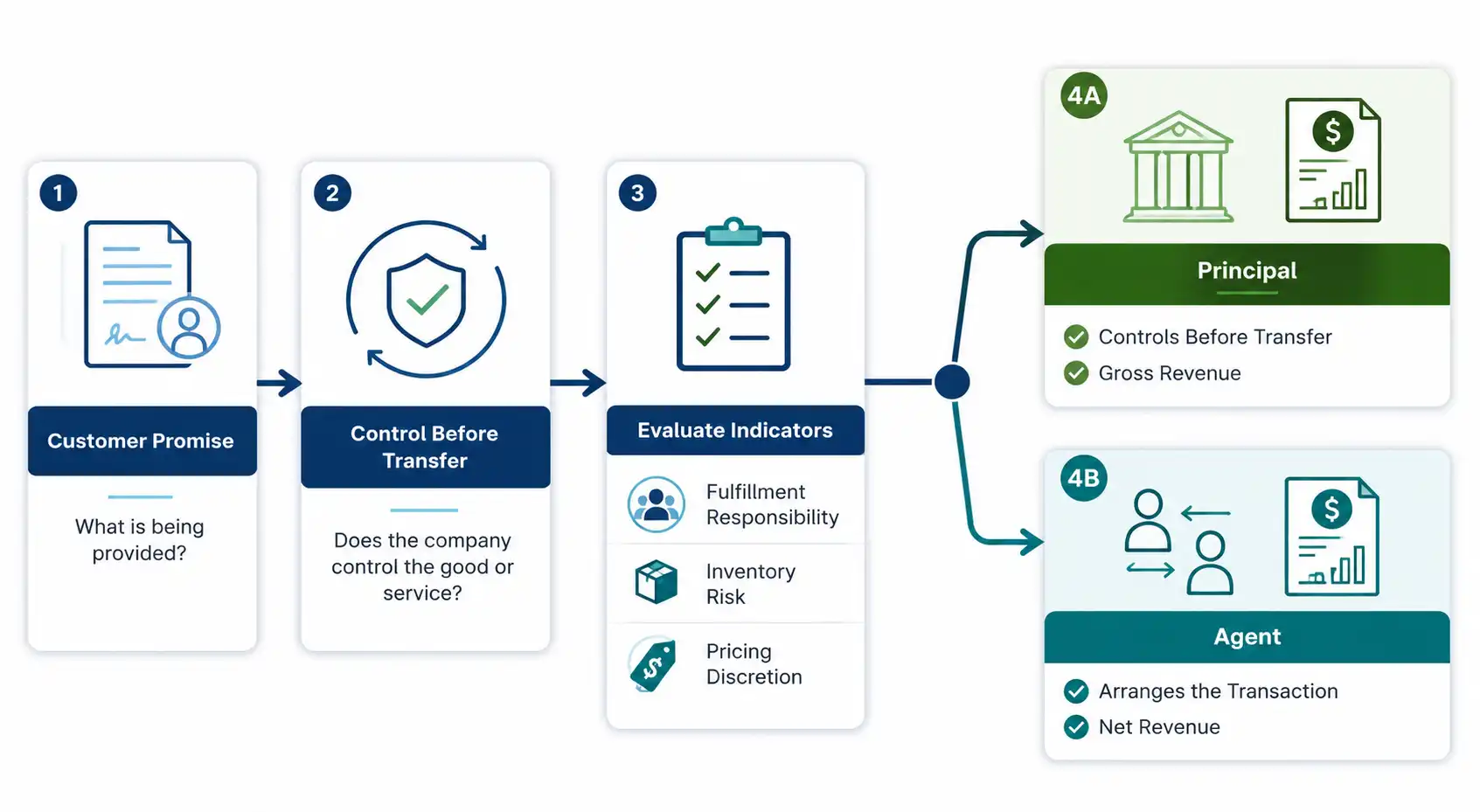
The mechanics are simple to state and harder to apply. A principal controls the good or service before it transfers to the customer. It carries the risk if something goes wrong. It recognizes revenue gross, meaning the full amount billed. An agent arranges for someone else to provide the good or service and never takes control of it. It recognizes revenue net, meaning the fee or commission earned for making the connection.
That framing sounds tidy in a textbook. It becomes considerably messier once real contracts, pricing authority, and customer relationships enter the picture, which is why ASC 606 devotes an entire evaluation framework to a question a founder might otherwise answer in a sentence.
Why the Principal vs Agent Call Changes the Story a Company Tells
Gross revenue makes the top line look larger, and it flatters growth-rate metrics that investors watch closely. Net revenue produces a leaner top line, but one that more honestly reflects the economics underneath it. Founders tend to prefer gross because it feels bigger on a slide, yet auditors, acquirers, and later-stage investors will ask, directly, whether the company actually holds the economic rights that gross presentation implies.
At a high-growth cybersecurity and identity access management company carrying roughly $30M in annual recurring revenue, the finance team built the ASC 606 revenue recognition framework and the controls environment behind it from scratch. This was not a compliance exercise tucked into a footnote. It became the piece of board-grade reporting that carried the business cleanly through acquisition diligence, because every recognized dollar traced back to a defensible control judgment.
The Control Indicators That Decide Principal vs Agent Status
ASC 606 lists several indicators for assessing control before transfer, and no single one is determinative on its own. Together, though, they form a pattern that a practiced eye can read quickly:
- Primary responsibility. Who is on the hook for fulfilling the promise made to the customer, including delivery schedules, defect resolution, and the overall customer relationship.
- Inventory risk. Who holds the product or service before transfer, and who absorbs the loss if it is returned or defective.
- Pricing discretion. Who sets the price the customer actually pays, as opposed to simply accepting a price set by someone else.
- Customer perception. Who the customer believes is standing behind the service, since accountability in the customer’s mind often tracks the accounting answer.
- Ability to direct use. Who controls how and when the service is delivered, versus who is merely matching demand with a third party’s supply.
Each is facts-and-circumstances driven, and applying them early, before audit season begins, sets expectations rather than producing surprises.
Marketplace Models: Where Principal vs Agent Revenue Recognition Gets Complicated
The marketplace business is the classic proving ground for this analysis. It connects buyers and sellers, often facilitates payment, and sometimes provides support, but the underlying question never changes: who actually controls the product or service being exchanged.
A travel booking platform that simply connects a traveler to a hotel and collects a fee is an agent. One that negotiates bulk inventory, sets the price the traveler pays, and owns the refund process is behaving as a principal, regardless of how the deck describes it.
In a marketplace SaaS engagement heading into a $20M Series B raise, the cohort analysis and unit economics models built for investor diligence told a story that gross GMV never could. Early decks in similar businesses often present gross merchandise value as though it were revenue. Analyzing the underlying contracts made clear that the platform matched supply and demand without ever controlling delivery, earning a fee of roughly 12 percent. When the presentation shifted from GMV to net revenue, the top line dropped sharply, yet margin held steady, and the narrative moved from top-line growth to unit economics strength.
SaaS Platforms with Embedded Third-Party Services
The question resurfaces in a different form inside SaaS, particularly with white-labeled or embedded offerings. A software company that bundles a third-party payments, mapping, or AI service into a single customer invoice needs to determine whether it holds discretion over pricing, support, and delivery. Where it does, principal treatment is likely appropriate. Where it does not, agent treatment usually follows.
Documentation carries more weight here than most teams expect. Reseller agreements, service-level commitments, support obligations, and pricing control clauses all factor into the analysis. A SaaS analytics business bundling third-party data services with genuine pricing control and indemnification rights in its contracts was ultimately treated as principal by its auditors, adding several million dollars to reported revenue. Absent that contract language, the conclusion could easily have run the other way.
Third-Party Logistics and the Line Between Owning and Facilitating
In third-party logistics and e-commerce, control is frequently shared rather than exclusive. A company that owns inventory but outsources delivery generally remains a principal, since it still owns the product and fulfills the promise made to the customer. A company that never touches the product and simply routes orders is functioning as an agent.
Early-career work in rail and transportation FP&A, focused on freight economics, route profitability, and capacity utilization, builds a durable instinct for how physical supply chains create or destroy margin at the unit level, and that instinct carries directly into this determination. A recurring cautionary pattern involves e-commerce companies that book all revenue gross, including for drop-shipped products they never physically hold; when auditors establish that the company bore neither inventory nor shipping risk, the resulting restatement can reach back several years and delay a planned IPO by months.
Beyond the Income Statement: KPIs, Tax, and Investor Perception
The principal vs agent revenue recognition determination reaches well past the revenue line. A shift from gross to net can push a company’s CAC-to-revenue ratio higher even though nothing about customer acquisition actually changed, while a shift toward gross can compress a reported gross margin percentage. Valuation multiples often move in response, since investors price growth-stage businesses differently depending on whether they are looking at scaled transaction volume or scaled economic ownership.
At a Euronext Paris-listed gaming and digital entertainment company operating across five countries, building one consistent definition of revenue across every subsidiary under both IFRS and US GAAP was a prerequisite for credible consolidated reporting, not an afterthought layered on at close. Presenting gross transaction value and net revenue side by side, with the reasoning made explicit, tends to build more durable trust than optimizing for a single flattering number.
Tax exposure follows the same pattern. Sales tax and VAT obligations differ depending on principal or agent status, and many jurisdictions apply comparable frameworks, so a misclassification can leave a company underpaying or overpaying tax authorities for years.
A Quick Reference: Gross vs Net Revenue at a Glance
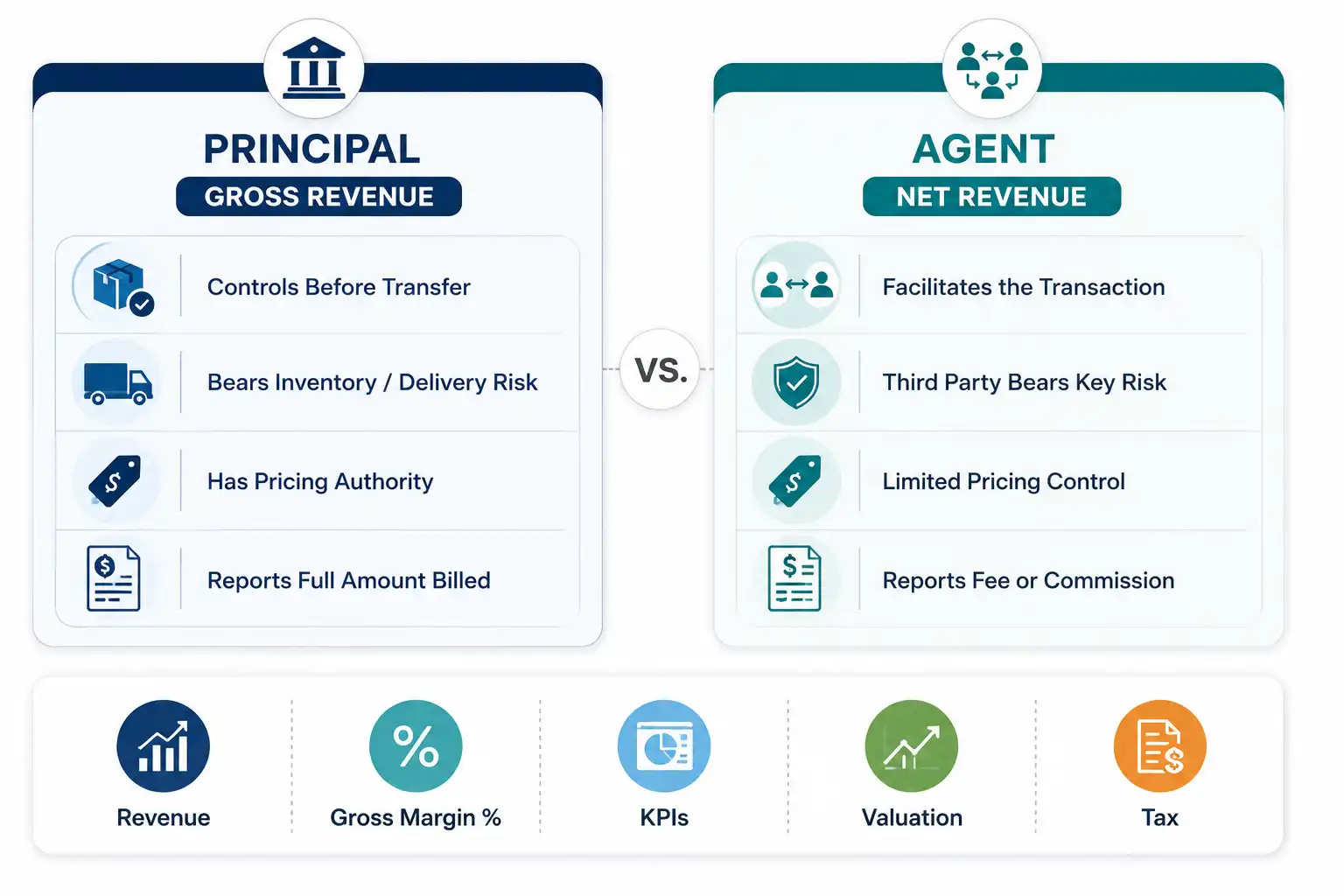
| Factor | Principal (Gross Revenue) | Agent (Net Revenue) |
| Control before transfer | Yes | No |
| Inventory or delivery risk | Held by the company | Held by the third party |
| Pricing authority | Company sets the price | Price set by another party |
| Customer accountability | Company is seen as the provider | Third party is seen as the provider |
| Revenue recognized | Full amount billed | Fee or commission earned |
Managing the Principal vs Agent Determination Proactively
The finance leaders who avoid painful restatements treat this as a recurring discipline rather than a once-and-done conclusion: documenting the principal-agent analysis annually, revisiting it whenever the business model or contract terms change, briefing auditors on the reasoning before fieldwork begins, and aligning legal and tax advisors early enough to catch blind spots before they become findings.
None of this is purely an accounting exercise. It is a board-level conversation, a messaging decision, and a credibility signal that follows the company into every later fundraising or M&A process.
Three Key Takeaways
- The principal vs agent revenue recognition determination is a control test, not a preference, and the answer should be built from documented contract rights over pricing, fulfillment responsibility, and inventory risk rather than from which figure looks more impressive on a slide.
- Marketplace, SaaS reseller, and logistics businesses face this judgment most often, and the companies that get it right treat gross transaction value and net revenue as complementary metrics to present together, not as a single number to optimize.
- Because the classification touches KPIs, valuation multiples, and tax obligations across jurisdictions, the analysis holds up best when it is documented annually, revisited as the business evolves, and shared with auditors and advisors well ahead of any transaction that will put the numbers under scrutiny.
Disclaimer: This article is intended for informational purposes only and does not constitute legal, tax, or accounting advice. You should consult your own tax advisor or counsel for advice tailored to your specific situation.
Hindol Datta is a four-time CFO and senior finance executive with over 25 years of leadership experience across cybersecurity, SaaS, gaming, logistics, digital marketing, medical devices, consumer products, and nonprofit organizations. He has led more than $120M in fundraising and over $150M in M&A transactions while building the financial and operational systems that let complex businesses scale with confidence. He is the author of seven books in the Systems CFO Series and holds active CPA, CMA, and CIA credentials.
AI-assisted insights, supplemented by 25 years of finance leadership experience.