Executive Summary
Predictive signals in reporting help finance teams see what is forming before the quarter closes, not just what already happened. Traditional quarter-end reporting chronicles the past with precision, yet it often fails to show the shape of what lies ahead. For finance leaders steering through volatility, that gap between hindsight and foresight has become costly.
The sections ahead explain why quarter-end still produces surprises and how to build a signal-aware financial system. They also cover how early signals fit into governance and investor narratives, and how the finance function builds the habits that sustain foresight.
Why Quarter-End Reporting Still Needs Predictive Signals
Modern finance holds more data than ever, yet quarter-end still delivers unwelcome surprises. Revenue shifts appear late, margins compress without warning, and costs spike in the final weeks. These variances rarely come from nowhere, since they unfold gradually through the month and sometimes through the day. The cadence of traditional reporting does not let teams see them in time, which is the gap that predictive signals in reporting close.
The Compression Trap
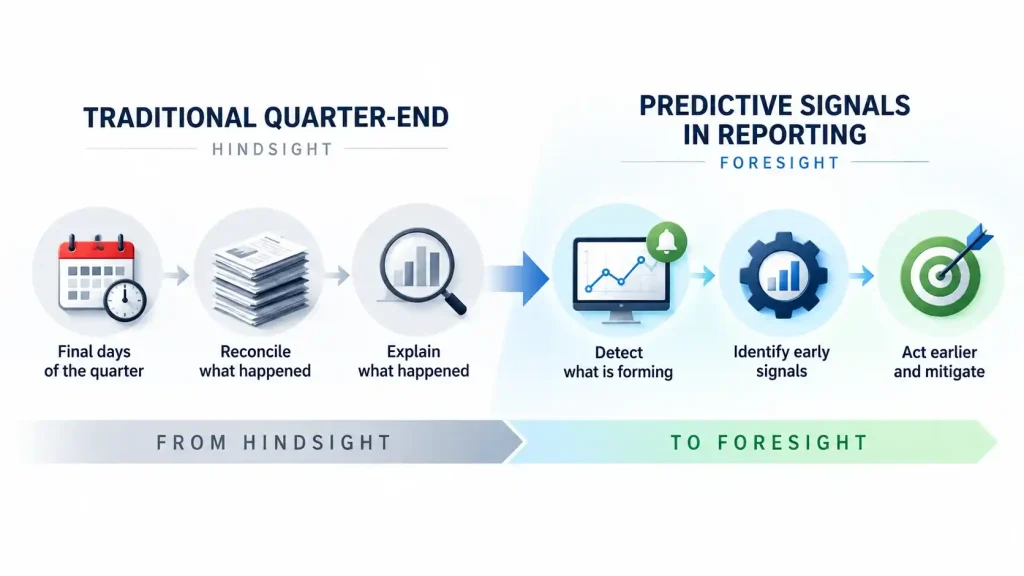
Quarter-end in its classic form is a race against the calendar. The final days go to closing books, reconciling ledgers, and stitching a story together from functions that each run on their own timing. Most of the effort goes into reconciling instead of revealing, so little bandwidth remains to ask what the numbers mean.
Finance teams know this pattern as the compression trap, because it pushes all discovery into the last possible moment. By then, the team can only explain the result, not change it. Leaders can mitigate or even reverse a missed target they spot a month early. The same miss found in the final hour becomes a narrative liability instead.
Why the Trap Persists
Part of the cause is cultural, rooted in a belief that no one should draw conclusions until the books are final. That instinct protects control, but it also creates paralysis around early interpretation. Misinterpretation is the real danger, not interpretation itself.
The other cause is structural and often harder to fix. Data sits in silos, and the forecasting model often runs separately from operational flows. As a result, teams assemble the quarter in a hurry through last-minute calls and patchwork reconciliations. Many burn out chasing numbers that always arrive late.
Traditional Close Versus Signal-Aware Reporting
| Dimension | Traditional Quarter-End | Signal-Aware Reporting |
| Timing of discovery | Final days of the quarter | Weeks before the close |
| Primary effort | Reconciling what happened | Detecting what is forming |
| Variance commentary | Reactive explanation | Early mitigation options |
| Team experience | Late-stage firefighting | Steady, anticipatory rhythm |
Building a Signal-Aware System for Predictive Signals in Reporting
Every enterprise produces a continuous stream of data from order logs, procurement schedules, product usage, and invoice timing. Most quarter-end processes ignore that stream until it becomes final figures. A system built around predictive signals in reporting listens as the quarter unfolds and asks where friction is beginning to emerge.
Identifying Leading Indicators
The first step is to find the precursors that tend to appear before material change. Leading indicators differ by domain, but motion always comes before the outcome:
- Revenue: slower quote activity, more late-stage customer questions, or a dip in product usage
- Cost: rising delivery exceptions, unplanned labor scheduling, or shifts in purchase order cadence
- Working capital: lengthening days sales outstanding or a rise in partial payments
Finance should work across functions to learn which anomalies have historically predicted surprise. Variance then becomes a pattern to detect instead of an outcome to explain.
Calibrating Models and Moving Signals into the Workflow
Building these models is part art and part engineering. A revenue model trained on prior years must also account for interest rates, inflation, and policy shifts. A margin model must separate cyclical drivers from structural ones, and finance should partner with data science to deepen perception instead of automating decisions.
Detection alone achieves little unless the signal reaches the people who can act. When a usage decline points to revenue softness, the CRO needs that signal before the forecast slips. Executives also need each signal framed as a short narrative. That narrative covers what the team sees, why it matters, how confident the model is, and what to do next.
One cybersecurity and identity SaaS company with roughly $30M in ARR shows what this discipline can deliver. A driver-based forecasting engine held actuals within plus or minus five percent of forecast for 8 consecutive quarters. A NetSuite implementation across five country entities also compressed the monthly close from 18 days to 10, freeing time for analysis.
Integrating Predictive Signals into Governance and External Narratives
Predictive signals in reporting reshape how an enterprise governs itself and speaks to the market. Traditional governance moves information upward in a tight sequence, from operating forecasts to finance validation to leadership review. Early signals arrive outside that sequence and carry varying levels of certainty, so they need their own home.
Creating an Early-Signal Council
A small cross-functional group can review predictive inputs every week and guide management attention ahead of formal variances. Finance alone cannot interpret a change in churn velocity without context from customer success, product, and marketing. The council treats early signals as alerts, not forecasts, which builds a culture of early discussion instead of late justification.
Communicating with Boards and Investors
External use of predictive signals in reporting requires care, because investors value foresight yet punish error. The CFO must separate what is informative from what is committal. The goal is to convey awareness of an inflection point without pre-announcing results.
Signal-Informed Communication Examples
| Instead of Committing To | Communicate Awareness Of |
| Revised revenue numbers | Emerging demand softness |
| Hard churn forecasts | Shifts in customer behavior |
| Fixed margin guidance | Input cost volatility within scenario ranges |
| Static variance tables | Rolling signal maps and forward risks |
Boards must grow comfortable with partial information and probability-based discussion. Board materials can shift from static variance tables toward rolling signal maps that show emerging risks. A Euronext Paris-listed gaming company with operations across five countries offers relevant context. Reporting under both IFRS and US GAAP, alongside board and audit oversight, showed how much credibility depends on consistent and timely signals.
Risk management benefits from the same forward-looking discipline as well. Predictive models can inform scenario trees, early warning thresholds, and hedging choices before a quarter is lost. Quarter-end becomes a punctuation mark instead of a singular peak, and the CFO becomes the first interpreter instead of the final narrator.
The CFO as Signal Architect
The finance function must grow into an early-warning organ, and the CFO leads that shift as a signal architect. This fluency does not come from tools alone, since it depends on training, design, and a culture of inquiry. Three design principles shape how a finance team builds predictive signals in reporting into daily work.
Three Principles for a Signal-Aware Finance Team
| Principle | What It Means in Practice |
| Curiosity over compliance | Ask what the team learned too late last quarter and which signals could have helped |
| Constructive skepticism | Question every model and anomaly, but default to inquiry over dismissal |
| Narrative competence | Translate a metric into meaning, such as login trends as a proxy for engagement |
Weekly signal briefings, cross-functional huddles, and clear escalation paths turn these principles into habits that keep predictive signals in reporting alive. Finance also becomes a partner to executive intuition, confirming a hunch with data or flagging a warning sign that instinct missed.
The Predictive Reporting Cycle
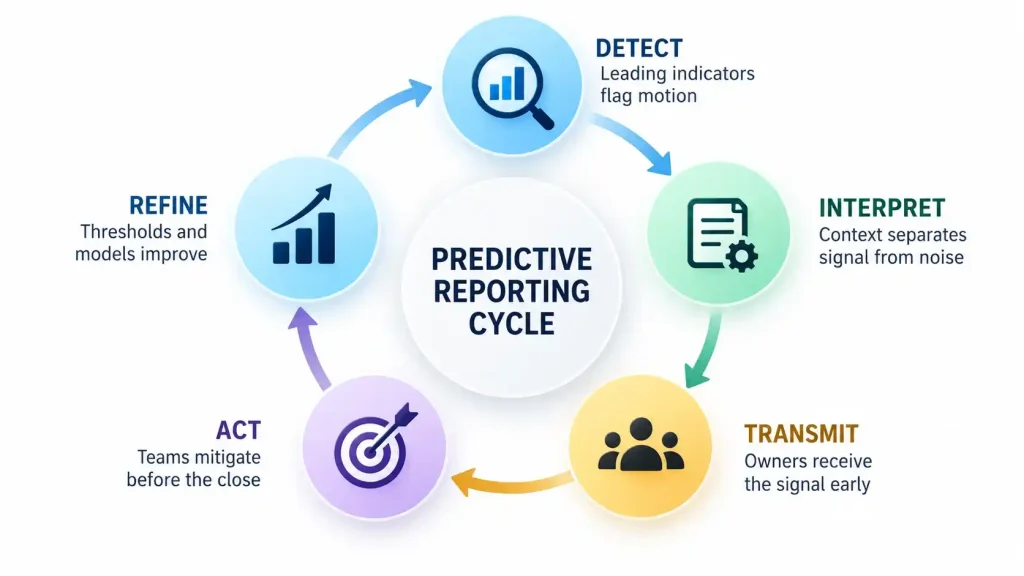
| Detect | Interpret | Transmit | Act | Refine |
| Leading indicators flag motion | Context separates signal from noise | Owners receive the signal early | Teams mitigate before the close | Thresholds and models improve |
Over time, this capability changes the relationship between a company and surprise. Variances lose their sting, forecasts gain credibility, and the quarter becomes a choreography instead of a scramble. Predictive signals in reporting do not eliminate uncertainty, but they reveal its shape early enough for leaders to act with purpose.
Three Key Takeaways
- The compression trap defers discovery to the final days of the quarter. Predictive signals in reporting move that discovery forward by weeks, turning reactive explanation into proactive mitigation.
- Predictive signals in reporting depend on the right leading indicators and calibrated models. Clear paths must also carry each signal to the owner who can act on it.
- Governance and culture sustain foresight, so finance teams need an early-signal council, careful external messaging, and habits of curiosity and constructive skepticism.
Disclaimer: This article is intended for informational purposes only and does not constitute legal, tax, or accounting advice. You should consult your own tax advisor or counsel for advice tailored to your specific situation.
Hindol Datta is a four-time CFO and senior finance executive with over 25 years of leadership experience across cybersecurity, SaaS, gaming, logistics, digital marketing, medical devices, consumer products, and nonprofit organizations. He has led more than $120M in fundraising and over $150M in M&A transactions while building the financial and operational systems that let complex businesses scale with confidence. He is the author of seven books in the Systems CFO Series and holds active CPA, CMA, and CIA credentials.
AI-assisted insights, supplemented by 25 years of finance leadership experience.