
Executive Summary
Portfolio monitoring in private equity rarely earns headlines, yet it often separates repeatable returns from lucky ones. Firms operate without daily marks or liquid prices, so the scarcest resource is signal, not capital. Firms that read emerging truth before it hardens into hindsight hold a structural edge.
This article treats monitoring as a performance discipline, not an administrative chore. It covers signal design, feedback loops, trust with management teams, and the way disciplined monitoring pulls DPI forward and sharpens capital allocation.
Why Portfolio Monitoring in Private Equity Is a Performance Discipline
Most firms already run check-ins, board packs and scorecards. These tend to be retrospective compilations that record the past without predicting the future. A board pack reports last quarter’s EBITDA, but it seldom shows where margin pressure will strike next.
The gap resembles the difference between a thermometer and an early warning system. Poor monitoring produces late action, not just late data. Weekly sales soften, churn hides beneath pricing gains, and a key executive leaves for “work-life balance.” By the time the dashboard turns red, the problem has already embedded itself in the business.
Three Tests of Effective Private Equity Portfolio Monitoring
Board packs describe outcomes, while strong private equity portfolio monitoring explains them. To do that, it must pass three tests:
- Granular: value is created by SKU, region or cohort, so early aggregation hides the signal.
- Dynamic: budget comparisons miss direction, so systems need rolling baselines and peer benchmarks.
- Diagnostic: data must explain whether margin compression stems from pricing, mix or input costs.
A company that beats its revenue plan while LTV/CAC declines is quietly losing value. Monitoring of this quality requires deliberate design, aligned deal teams, standardized data and a willingness to challenge assumptions.
Signal Compression: Monitoring Portfolio Companies in a Noisy World
The monthly check-in follows a familiar and comforting ritual. Revenue is up, EBITDA sits slightly ahead of plan, and the partner nods along with the CFO. The danger lies in assuming the presentation reflects what is happening inside the business.
Claude Shannon showed that messages sent through noisy channels must be encoded to survive distortion. In this analogy, the portfolio is the message and operational complexity is the channel. Presentation spin and managerial bias form the noise, so monitoring portfolio companies means decoding, not collecting.
Designing a Minimum Set of Decision-Relevant Metrics
Great systems capture the smallest set of metrics that reduces uncertainty on the variables that matter most. A dashboard of 50 metrics that prompts no action is worse than three numbers that capture real tension.
In a subscription business, cohort retention, LTV/CAC and net expansion say far more than MRR growth alone. In manufacturing, gross profit per hour of capacity shows whether throughput scales with pricing. One $30M ARR cybersecurity SaaS business built a driver-based forecasting engine and capacity model. Actuals then held within plus or minus 5% of forecast for 8 consecutive quarters.
Five Principles of Signal Design
- Compression: select the few leading variables that best predict long-term value.
- Adaptive baselining: use moving averages and z-scores to detect inflection, not just variance.
- Causal mapping: write down, debate and update a model of what drives what.
- Entropy scanning: direct scrutiny toward volatile signals, even when results meet plan.
- Meta-signals: track report timeliness, data lag and how often managers contest figures.
A system that misses second-derivative change becomes a factory for lagging indicators. Causal mapping turns each metric into a node in a belief network that updates as new data arrives. Portfolio monitoring in private equity then becomes forecasting under uncertainty, not a review of history.
Feedback Loops That Turn Portfolio Monitoring Into Action
A system that observes but never responds is performative data science. Firms need feedback loops that compare signals with expectations and trigger adjustment at the company, fund or firm level. John Boyd’s OODA cycle offers a practical template for portfolio monitoring in private equity.
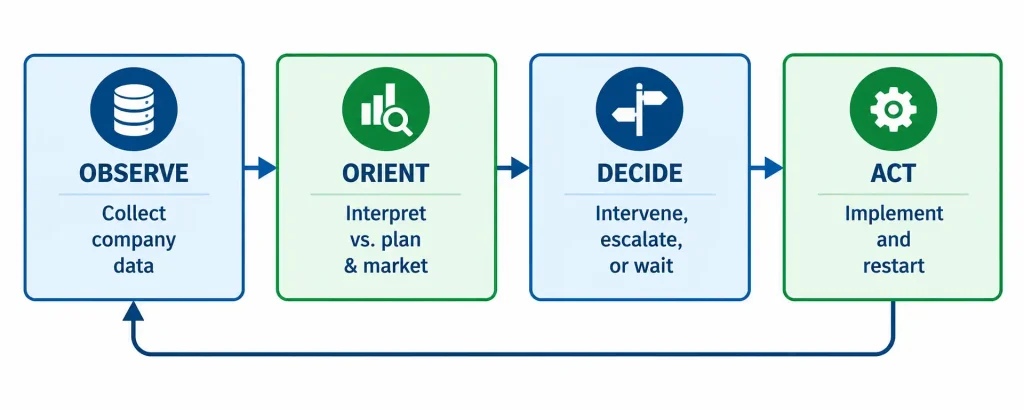
A Working Capital Example
A growing portfolio company may see its days sales outstanding creep up each month. In a weak loop, the team logs the change and assumes seasonality. Three months later, working capital tightens, vendor payments slip and morale softens.
A strong loop reads the same uptick as customer pressure or invoicing lag. The CFO reaches out, and a temporary AR specialist may join the effort. Both scenarios start with identical data, yet decision velocity separates contained risk from lasting damage.
Nested Loops and Low-Latency Response
Response speed depends on structure as much as data. Leading firms build three tiers of loops, each with clear owners and triggers:
- Tactical: weekly sales, site traffic and NPS shifts guide management adjustments.
- Operational: margin shifts, churn and rep productivity trigger operating partner engagement.
- Strategic: return velocity, capital at risk and sector exposure inform follow-ons and reserves.
Every lag between signal and action carries a cost, and delay compounds against IRR. Predefined if-then thresholds and distributed authority keep latency low. A record of which signals led to which outcomes builds institutional reflexes. Speed should also favor the downside, because a 50% loss requires a 100% gain to recover.
Monitoring Without Mistrust: Transparency as a Strategic Asset
Monitoring is a relationship as much as a system, because measurement changes behavior. When management experiences metrics as oversight, they hide variance. When metrics serve as shared insight, managers surface the underlying drivers. Several principles keep that relationship healthy:
- Intentional framing: present monitoring as support for the business, not closer surveillance.
- Co-authorship: build KPIs, thresholds and reporting cadence together with management.
- Contextual interpretation: ask what drives the variance and what comes next.
- Transparent protocols: define which signals prompt discussion and which prompt decisions.
- Psychological safety: reward early warnings and honest self-diagnosis over blame.
Co-authorship pays off in diligence as well as governance. A Series B marketplace SaaS company built its cohort and unit economics models alongside leadership. Those numbers withstood investor scrutiny during a $20M raise, because management trusted and could defend them.
Some critical signals never reach a dashboard, such as a trusted lieutenant’s resignation or a fatigued CEO. Site visits, off-cycle conversations and dinners without slides keep this qualitative layer alive. Spreadsheets often lag, while the team usually knows first.
How Private Equity Portfolio Monitoring Drives DPI and Capital Allocation
DPI, TVPI and reserve ratios rest on one foundation: how well the firm knows what it owns, and when. Disciplined portfolio monitoring in private equity connects operating performance to financial realization.
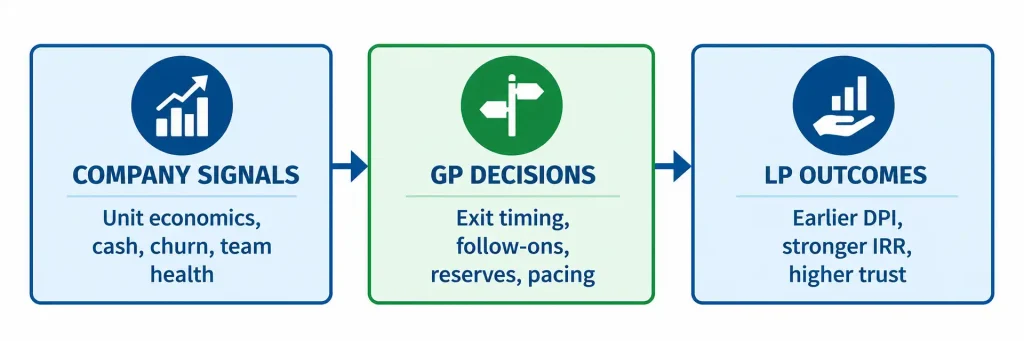
Exit Readiness and Earlier Distributions
The most reliable path to faster DPI runs through continuous exit readiness. Strong monitoring helps firms spot inflection points, gauge buyer appetite and prepare data rooms in advance. Distributions can then begin around year four instead of bunching near fund end. A public gaming company preparing for an S-1 shows the value of this posture. A single revenue definition across every subsidiary shortened reporting cycles and made diligence cleaner.
Follow-Ons, Reserves and Portfolio-Wide Patterns
Live IRR glidepaths let investment committees test whether the marginal dollar belongs in an existing asset. Tracking volatility in cash flow and working capital helps firms size reserves with precision. In one $127M consumer products business, demand planning and SKU rationalization lifted inventory turns from 3x to 7x. That shift released trapped working capital, the kind of change that good monitoring detects early.
Monitoring portfolio performance across assets also reveals cross-company patterns. Pricing pressure in one holding often appears in another. Shifts in unit economics can warn of wage inflation or demand compression and inform deployment pace.
The Compounding Payoff of Portfolio Monitoring in Private Equity
Firms that monitor poorly face a late-stage scramble, with exits crowded near fund end. Firms with mature private equity portfolio monitoring enjoy compounding benefits across the portfolio:
- Faster exits, because exit readiness is continuous.
- Better follow-on decisions, because glidepaths stay current.
- Smarter reserve allocation, because risk is calibrated.
- Fewer write-downs, because drift gets caught early.
- Higher LP trust, because reality is confronted jointly.
The deepest payoff of this discipline is cultural. Variance stops being punished, candor gains value, and learning becomes institutional memory. Capital is abundant and strategy is portable, so early and structured perception remains a defining edge in private equity.
Three Key Takeaways
- Effective portfolio monitoring in private equity compresses noise into a few leading, causally mapped metrics. These metrics predict value instead of merely recording it.
- Monitoring creates value only through feedback loops with clear thresholds and distributed authority. Those loops should respond faster to downside risk than to upside opportunity.
- Trust turns data into shared perception between the GP and management. That shared view pulls DPI forward, sharpens reserve decisions and builds lasting credibility with LPs.
Disclaimer: This article is intended for informational purposes only and does not constitute legal, tax, or accounting advice. You should consult your own tax advisor or counsel for advice tailored to your specific situation.
Hindol Datta is a four-time CFO and senior finance executive with over 25 years of leadership experience across cybersecurity, SaaS, gaming, logistics, digital marketing, medical devices, consumer products, and nonprofit organizations. He has led more than $120M in fundraising and over $150M in M&A transactions while building the financial and operational systems that let complex businesses scale with confidence. He is the author of seven books in the Systems CFO Series and holds active CPA, CMA, and CIA credentials.
AI-assisted insights, supplemented by 25 years of finance leadership experience.