
Executive Summary
Portfolio company value creation rarely follows the logic of a standalone business. A private equity sponsor acquires a company to test a thesis, and the hold period sets its deadline. Every operating choice therefore carries two burdens, improving the business and strengthening the exit story. Companies that manage both build value that a future buyer will pay a premium to own.
Four forces shape the outcome: the company’s design as an engineered asset, the value creation plan that drives results, its role inside a wider fund, and the human side of leading under sponsor ownership. Each force offers practical guidance for CFOs, operating partners, and management teams.
Why Portfolio Company Value Creation Begins with Design
Conventional accounting treats each company as a self-contained organism, but private equity dissolves that assumption. A portfolio company is a component within a larger financial system, selected with intent, not grown from entrepreneurial impulse. Its mandate is a return measured in calendar terms, not in open-ended ambition.
The Hold Period as a Source of Discipline
Most sponsors hold an asset for five to seven years, a cadence that reflects how long real transformation takes. A shorter window produces cosmetic change, while a longer one traps capital that could earn returns elsewhere. Within that arc, the company must become measurably more valuable, or the sponsor must exit on weaker terms.
This constraint gives portfolio company value creation a clarity that founder-led and public firms often lack. Plans become contractual, not aspirational, and governance stays engaged every quarter. Leaders surface trade-offs, allocate resources with finality, and move with an urgency that open-ended institutions struggle to match.
The Dual Accountability of an Engineered Asset
After acquisition, the company lives in two worlds at once. It still serves customers, competes for share, and manages people. It also reports upward to a fund, its limited partners, and a return model built at underwriting. Performance becomes a narrative that must show trajectory, unlock multiples, and build confidence in the exit.
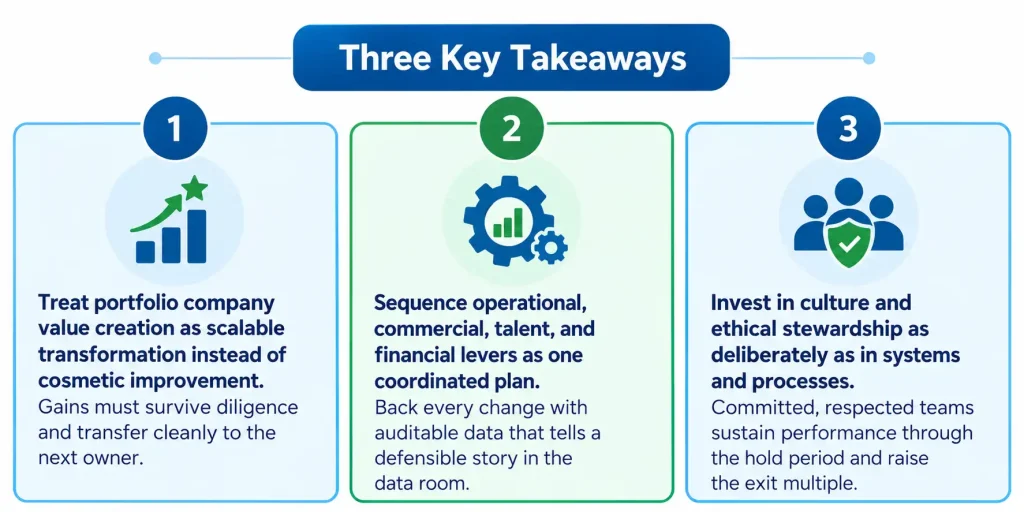
That dual role creates a paradox at the heart of portfolio company value creation. The company is transitory by design, yet the value it creates must endure. Cosmetic gains will not survive diligence, and idiosyncratic gains will draw a buyer’s discount. The real task is scalable transformation of systems, capabilities, and economics that a new owner can see and inherit.
Building the Value Creation Plan: Operational, Commercial, and Financial Levers
The term sheet defines ownership, but the value creation plan defines destiny. Sponsors tailor the playbook to the sector and thesis, then execute it against a time-bound model. The levers vary by industry and maturity, yet their logic stays consistent. Each lever aims to compress time-to-value, remove inefficiency, and prepare a compelling exit narrative.
How the Value Creation Levers Connect
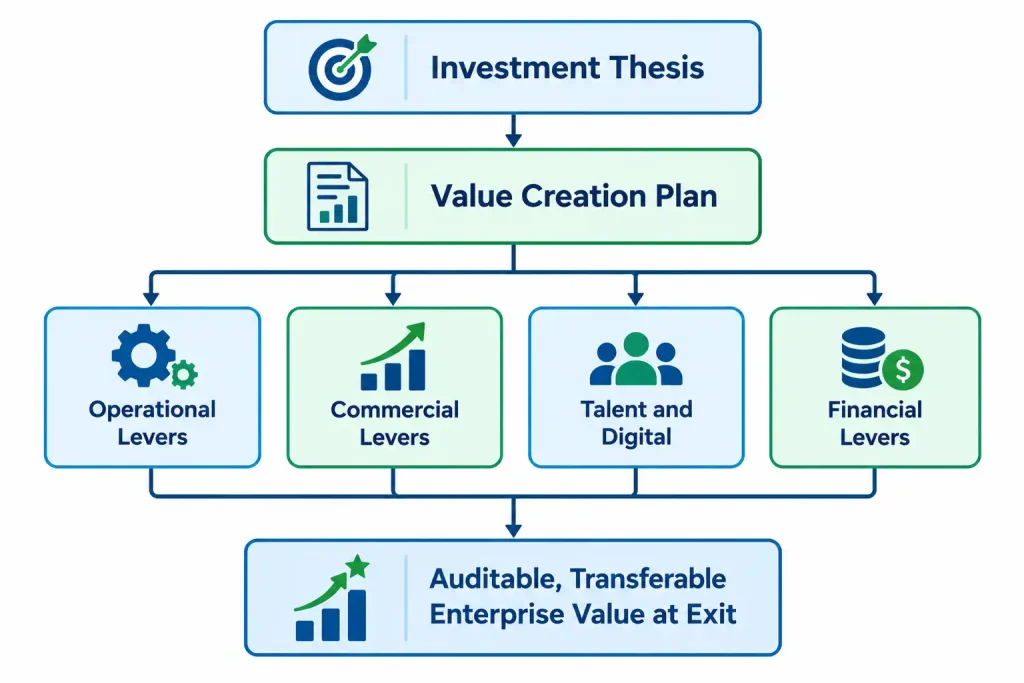
Operational Levers: Simplification and Process Discipline
Complexity built up over years of ad hoc decisions quietly erodes throughput. For that reason, the first operational mandate in portfolio company value creation is usually simplification:
- Rationalizing product lines and pruning low-margin SKUs
- Streamlining the supply chain and consolidating indirect procurement
- Testing SG&A for coherence with strategy instead of habit
- Reengineering order-to-cash, procure-to-pay, and hire-to-retire cycles
- Replacing anecdote with dashboards, benchmarks, and a regular operating cadence
A $127M global consumer products company illustrates the payoff. Through demand planning, SKU rationalization, and logistics optimization, its inventory turns more than doubled from 3x to 7x. That shift released trapped working capital and transformed cash conversion, an improvement any acquirer could verify in the numbers.
Commercial Levers: Pricing, Go-to-Market, and Demand
Commercial value creation faces outward, and pricing deserves early scrutiny, from value-based models and bundling to discount discipline. Sales incentives should reward margin, not volume alone. Leaders refine segmentation and weigh customer acquisition cost against lifetime value. Marketing evolves from scattered campaigns into a demand engine that teams measure, test, and refine.
At one venture-backed performance marketing company, CAC, LTV, and contribution margin analytics sustained growth from $9M to $180M within 24 months. In private equity, a clear commercial story serves customers and future acquirers alike, because a credible narrative supports multiple expansion.
Talent and Digital Enablement
Talent strategy often begins with a management reshuffle, but the deeper work reshapes the whole organization. Incentives tie directly to the value creation plan. High performers earn retention and stretch assignments, while persistent underperformance leads to exits. Culture becomes a deliberate force multiplier, not an accident of history.
Digital enablement has moved from option to necessity. ERP modernization, data governance, and targeted automation buy time, reduce error, and reveal signal. The goal is transactional readiness, not transformation for its own sake.
Financial Levers and Capital Structure
Financial levers work in concert with the operational ones:
- Optimizing the capital structure and restructuring debt to create optionality
- Freeing working capital through receivables discipline and faster inventory turns
- Divesting non-core assets that dilute management focus
- Pursuing tuck-in acquisitions to add capabilities or consolidate market share
Each dollar carries two readings in this model, its immediate return and its contribution to terminal value.
Sequencing, Narrative, and Exit Readiness
Mechanics alone do not produce outperformance, because value creation is a choreography, not a checklist. Leaders must sequence, resource, and manage the levers through deliberate change management. The CEO carries the belief, while the CFO translates between plan and pulse.
The transformation must also remain auditable, so the data room can explain what changed, why, and with what effect. One cybersecurity and identity access management company with about $30M in ARR shows the standard. Its finance team held actuals within plus or minus five percent of forecast for 8 consecutive quarters. A NetSuite rollout across 5 country entities cut the monthly close from 18 days to 10. Board-grade reporting and an ASC 606 framework then carried the business through acquisition diligence.
Buy-side quality-of-earnings work reveals the opposite case, where reported earnings diverge from economic reality and EBITDA adjustments erode the asking price. That contrast exposes the central paradox of portfolio company value creation. The company is built to be sold, yet it must transform as if held forever to earn a premium.
Portfolio Company Value Creation Across the Wider Fund
A portfolio company operates within two systems: the market it shares with every enterprise, and the fund that owns it. Its greatest contribution is sometimes relational, and that relational value takes several distinct forms:
- Synergy: In a platform roll-up, consolidated procurement, unified IT, and harmonized pricing create value in the connective tissue between assets.
- Knowledge sharing: A SaaS CFO’s insight on churn can help a sibling company improve renewals.
- Risk balance: A consumer downturn may hurt one holding while accelerating another, giving the fund a convex profile.
- Signal: A disciplined exit strengthens the sponsor’s reputation and eases future fundraising with limited partners.
- Liquidity orchestration: One exit may fund a new platform, while another provides ballast during a difficult fund cycle.
Synergy has limits, however, since forced integration can distract or dilute a healthy business. The optimal design favors complementarity over uniformity, and some companies add the most value by remaining independent. Leaders who understand their fit within the fund develop situational fluency, which reflects system awareness, not subservience.
Leading Through the Human Side of Portfolio Company Value Creation
Capital models do not execute transformation; people do. Managers, operators, and workers absorb the pressure of temporary stewardship, and three conditions shape that experience:
- Compression: The clock starts at acquisition, so decision cycles shorten and tolerance for ambiguity falls.
- Identity dislocation: New positioning, new executives, and a new strategy force teams to question who they are.
- Asymmetry of information and power: Metrics flow upward to investment committees, and capital decisions follow models operators rarely see.
The result blends agency with constraint, since leaders can restructure quickly and hire decisively within firm limits. Hold periods, debt covenants, and exit narratives bound that autonomy, so leaders act as principal and agent at once.
Stewardship as an Exit Multiplier
Done well, the structure produces a high-performance culture with clear expectations, focused strategy, and resources tied to outcomes. Done poorly, it breeds brittleness: compliance replaces learning, managers game KPIs, turnover rises, and cynicism spreads. Employees then start to see themselves as passengers on a transactional journey.
Stewardship, not structure, makes the difference between those outcomes. Strong leaders translate the financial mandate into a human story about customer impact and enduring capability. They do not hide the exit, but they elevate the journey toward it. The CFO also serves as a moral compass, defending the integrity of the numbers and the dignity of effort.
Ethics is good economics, because durable capability depends on committed and respected people. At its best, portfolio company value creation leaves behind more than returned capital. It embeds discipline, accelerates maturity, and hands the next owner a better business, a wiser team, and a clearer model.
Disclaimer: This article is intended for informational purposes only and does not constitute legal, tax, or accounting advice. You should consult your own tax advisor or counsel for advice tailored to your specific situation.
Hindol Datta is a four-time CFO and senior finance executive with over 25 years of leadership experience across cybersecurity, SaaS, gaming, logistics, digital marketing, medical devices, consumer products, and nonprofit organizations. He has led more than $120M in fundraising and over $150M in M&A transactions while building the financial and operational systems that let complex businesses scale with confidence. He is the author of seven books in the Systems CFO Series and holds active CPA, CMA, and CIA credentials.
AI-assisted insights, supplemented by 25 years of finance leadership experience.