
Executive Summary
Portfolio company reporting decides whether an investor partnership stays aligned or slowly drifts apart. Capital moves fast at the start, yet later quarters can leave one side chasing numbers and the other chasing narrative. That drift rarely stems from bad faith; it comes from weak signals, and disciplined portfolio monitoring is how those signals grow stronger.
This article sets out a practical framework for reporting that serves both the board and the operating team. It covers purpose, a three-layer architecture, cadence, transparency, and the role of the CFO. Six principles for the next board package close the piece.
Why Portfolio Company Reporting Should Deliver Signal, Not Surveillance
Many partnerships begin with conviction and then drift into opacity. The answer is not surveillance, a spreadsheet deluge, or a dashboard built for its own sake. A sound portfolio company reporting system balances control with autonomy and visibility with operational flow.
Compliance is the usual answer to why companies report at all. Limited partners expect updates, auditors need support, and exits require a clean history, yet that standard sets the bar too low. The real purpose of portfolio company reporting is to align belief with behavior across every steward of capital.
What gets reported becomes what gets measured, and what gets measured shapes how people behave. In that sense, reporting helps build the business it claims to describe.
Fidelity Matters More Than Frequency
High-frequency reporting that lacks interpretation does more harm than good, while low-frequency reporting rich in context can work as a compass. The question is not how often a company reports, but how well it signals.
Consider a single revenue growth figure, which tells a board almost nothing on its own. Broken down by channel, customer cohort, and pricing tier, the same figure reveals far more:
- Whether growth is systemic or opportunistic
- If it adds to margin or dilutes it
- How likely it is to repeat at scale, or whether it was a one-time anomaly
In a funding round, cohort and unit economics models often anchor investor diligence better than any topline chart. Investors do not need omniscience; they need orientation on which levers management is pulling, which assumptions still hold, and where variance is emerging. When portfolio monitoring fails here, trust erodes through signal failure instead of malfeasance.
Designing a Portfolio Monitoring Framework Across Three Layers
Effective reporting starts from a shared theory of the business instead of a template. That theory defines what drives value, what creates risk, and what constrains growth. From that theory, a diagnostic framework takes shape across three connected layers.
How the Three Reporting Layers Connect
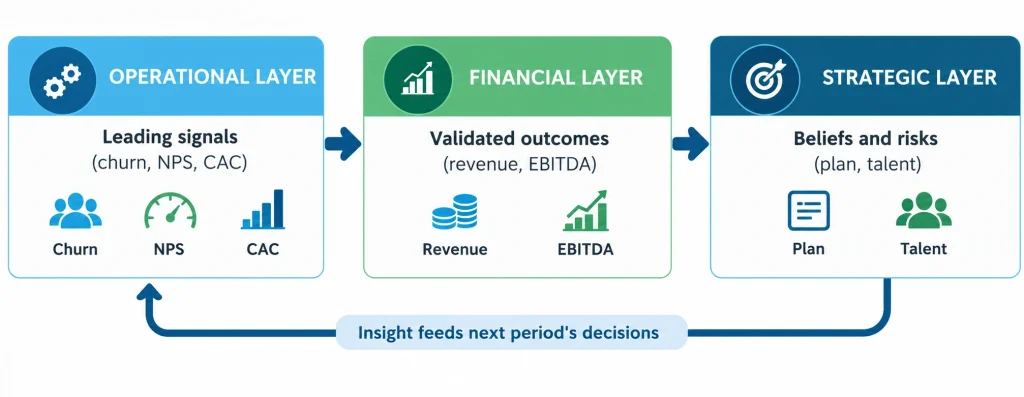
The Operational Layer: Leading Indicators
The operational layer captures the heartbeat of the business through customer acquisition, churn, product velocity, sales cycles, and inventory turns. A rise in support tickets may precede gross margin pressure, and a falling NPS may foreshadow retention erosion. Teams should choose these metrics for relevance to system behavior, not for ease of collection.
The Financial Layer: Validating the Mechanism
The financial layer translates activity into revenue, gross profit, EBITDA, working capital, and capex, each compared against budget, prior year, and model. A margin increase without explanation is noise, while one explained by mix shift and pricing power is a signal. For multi-country groups, one unified definition of revenue across subsidiaries makes every financial signal trustworthy.
The Strategic Layer: Reporting What Management Believes
The strategic layer is the rarest part of portfolio company reporting and the most essential. It covers progress on key initiatives, risks to the plan, talent pipeline depth, market dynamics, and regulatory exposure. Boards measure these items through judgment instead of numbers, and without them even the best dashboards turn sterile.
All three layers need integration, with FP&A working closely alongside product, sales, and HR. The CFO curates both the data and the narrative. In turn, the board packet becomes a map of where the company stands and what lies ahead.
Setting the Cadence of Portfolio Company Reporting
Reporting cadence should follow system velocity instead of tradition, so the rhythm matches the pulse of each business model.
Matching Cadence to Business Velocity
| Business Model | Operational Reporting | Financial Reporting |
| Consumer subscription with high daily volume | Weekly dashboards | Monthly P&L |
| Capital-intensive manufacturing | Monthly operational reports | Quarterly financials |
Controlling Friction and Building Flow
Reporting also creates friction, since duplicative, high-frequency reporting exhausts the team while sparse reporting invites drift. Every reporting motion should create internal value before it meets an external need. A metric that informs no internal decision does not belong in external reports.
Flow matters as much as frequency, and the best investor reporting moves through a natural pipeline of judgment:
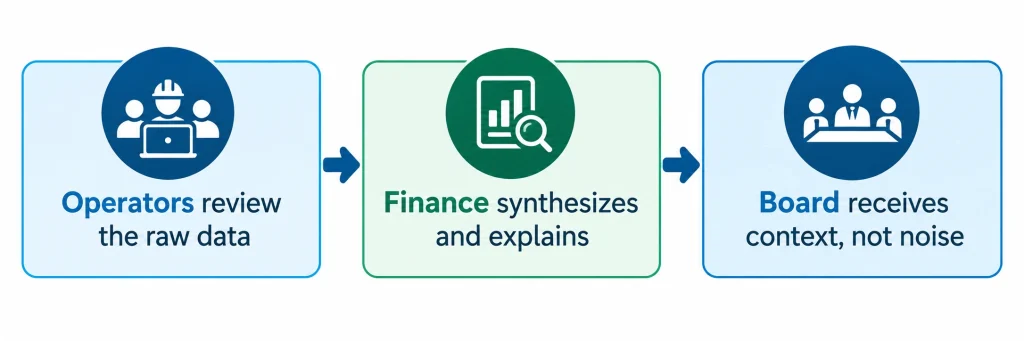
A driver-based forecasting engine paired with a steady reporting cadence keeps actuals close to forecast quarter after quarter. A faster monthly close means board numbers arrive while they still matter. Finance answers questions before anyone asks them, and surprises become rare.
Transparency in Portfolio Company Reporting as a Covenant
Transparency is less a management virtue than a structural design choice. Candor is easy in good quarters, and the real test arrives during volatility. High burn, mounting forecast misses, and executive churn reveal whether reporting acts as a mirror or a mask.
Honest portfolio company reporting reads as narrative truth instead of marketing, because the goal is to preserve trust, not image. In practice, that discipline looks like this:
- A missed plan comes with a clear account of why it happened
- Any new risk arrives with its scope quantified in the report
- Each broken assumption triggers a revised model for the board
Investors seldom punish bad news; they punish surprise. Early disclosure gives the board time to act and turns a crisis into a course correction. In a turnaround, candid monthly reporting gives investors the confidence to stay patient while burn comes down.
Candor also builds a feedback loop over time. Investors trust the signals, ask sharper questions, and engage more deeply, so board meetings shift from interrogation to partnership. Here lies the paradox of transparency: clear visibility lets the investor step back and the team move forward.
The CFO as Architect, Interpreter, and Steward of Investor Reporting
No one is more central to portfolio company reporting than the CFO, who owns the translation more than the numbers. The job is to elevate the signal by curating what matters, explaining what is changing, and revealing what is not yet visible.
That work demands judgment in both content and framing. Every variance has a context, every miss has a cause, and every plan rests on an assumption. A good CFO weaves these threads with epistemic humility, accepting that no one foresees every risk while insisting that each one gets explained.
The CFO also builds the data systems, reporting templates, and analytical workflows, training the team to think in mechanisms as well as metrics. Internal reporting should feed external reporting, so nothing reaches investors that was not first useful to the business.
Finally, the CFO holds the narrative line across board packets, monthly calls, and budget reviews. Steady reporting to the finance and audit committees also builds the investor confidence that a capital raise depends on. The story told to the board has to match the story the organization lives.
Six Principles for High-Fidelity Portfolio Company Reporting
These principles form a framework, not a template, for transparent reporting that preserves control:
- Build on a shared model of value, because no volume of data creates alignment without a common view of what drives the business.
- Layer the reporting across operational, financial, and strategic dimensions, since silence in one layer distorts the others.
- Calibrate cadence, friction, and audience so reporting moves at the speed of the business without exhausting the team.
- Keep the narrative coherent, telling a story that evolves over time instead of a series of disconnected snapshots.
- Stay honest in a quiet, consistent, and respectful way, without theatrics.
- Serve both sides of the table, empowering the operator while informing the investor, so reporting becomes a capability instead of a chore.
Conclusion: From Portfolio Monitoring to Readiness
In the end, portfolio company reporting is about meaning more than metrics. A strong system aligns everyone on where the business stands, why it is moving, and which forces will shape its path. Done well, portfolio monitoring converts capital into conviction and conviction into control through clarity instead of force.
Three Key Takeaways
- Portfolio company reporting should explain the mechanism behind results, giving investors orientation instead of a pile of data.
- A three-layer portfolio monitoring framework, reported at a cadence that matches business velocity, catches drift before it reaches the financials.
- Transparency during volatile quarters builds trust, and that trust earns management more autonomy from the board, not less.
Disclaimer: This article is intended for informational purposes only and does not constitute legal, tax, or accounting advice. You should consult your own tax advisor or counsel for advice tailored to your specific situation.
Hindol Datta is a four-time CFO and senior finance executive with over 25 years of leadership experience across cybersecurity, SaaS, gaming, logistics, digital marketing, medical devices, consumer products, and nonprofit organizations. He has led more than $120M in fundraising and over $150M in M&A transactions while building the financial and operational systems that let complex businesses scale with confidence. He is the author of seven books in the Systems CFO Series and holds active CPA, CMA, and CIA credentials.
AI-assisted insights, supplemented by 25 years of finance leadership experience.