
Executive Summary
A platform investment is the architecture that decides whether an industry roll-up compounds or collapses. Many sponsors reduce the strategy to multiple arbitrage: buy at 5x EBITDA, integrate, and re-rate at 10x. That arithmetic ignores the coherence, feedback, and learning that a well-designed platform supplies.
This article examines the anatomy of a platform investment, the economics that make aggregation work, the failure modes that limit every roll-up model, and how AI is reshaping the platform of the future. Finance leaders will find a practical lens for judging whether a roll-up is built to learn or merely built to buy.
Why Platform Investment Defines the Industry Roll-Up
A portfolio acquires companies, while a platform assembles capabilities. That distinction separates a roll-up that gambles on momentum from one that runs as a hypothesis with a feedback loop. The power of a platform lies less in its scale than in its ability to scale decision-making.
In a typical industry roll-up, each acquisition adds revenue along with operational noise. Fragmented systems, cultural misalignment, uneven talent, and disjointed customer experiences pile up. A strong platform investment works as an anti-entropic force, channeling that complexity into coherence through common systems, unified data, shared services, and repeatable onboarding playbooks.
The best platforms are neither fully centralized nor fully federated. They stay centralized in principle and decentralized in execution. Each acquisition becomes a data point, and each integration updates the platform’s beliefs about integration risk, customer retention, and synergy.
Incentives complete the picture of a sound platform investment. Without alignment, even an elegant design degrades into bureaucracy. Shared services, performance benchmarking, variable compensation, and equity participation must make collaboration the dominant strategy for every acquired team.
The Architecture of a Platform Investment
A platform investment is an investment in coherence, not control. It functions as the operating system that lets a roll-up shift from serial consolidation to emergent advantage. Its strength shows up in speed of integration, modularity, adaptability to variance, and decision velocity.
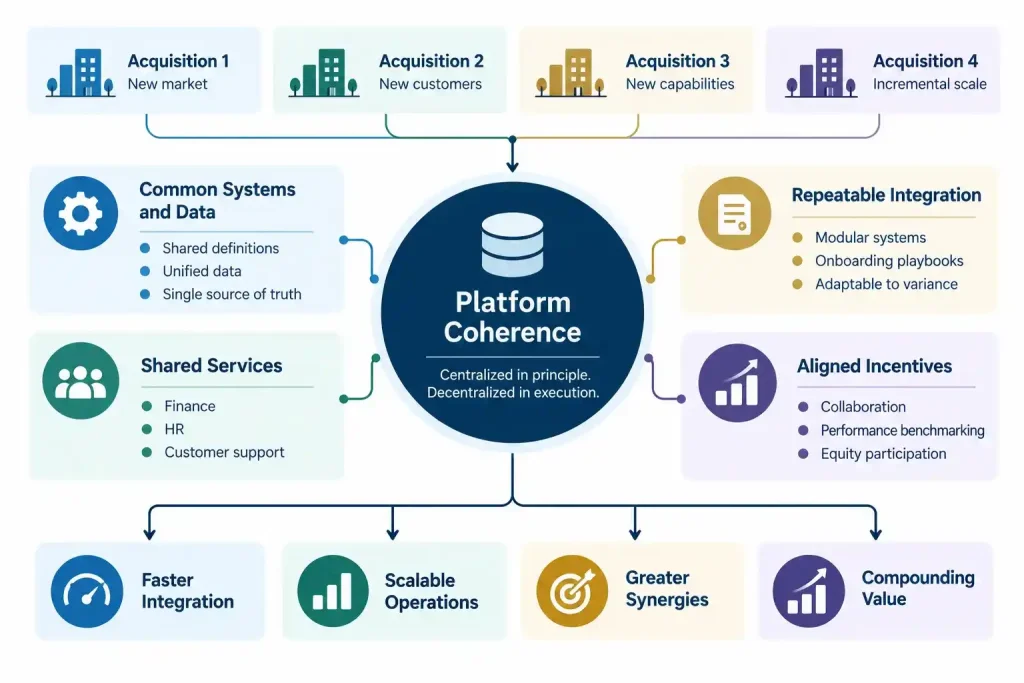
Shared Language Before Shared Tools
Platform investment design begins with semantics, not software. Without a common definition of a customer, of revenue recognition, or of net retention, every future acquisition starts misaligned. At a cybersecurity and identity access management company operating across five country entities, a single ERP implementation built on shared definitions cut the monthly close from 18 days to 10.
Modularity, Feedback, and Culture
Modularity is the next layer of a durable platform investment. Finance, HR, customer support, pricing analytics, and supply chain should operate as interoperable modules with clear boundaries, so new acquisitions plug in without heavy rework. Over-architecture is the danger, because an overly elaborate central system ossifies. Robust platforms balance standards with enough slack for rules to evolve with evidence.
Data supplies the main feedback loop inside the platform. Each unit’s performance becomes a prior, and each integration outcome becomes an update. Over time, the platform forecasts integration friction, talent dilution, and churn with growing confidence, and it gains an information edge competitors lack.
A platform investment must still remain human at its core. Culture travels through onboarding, incentive design, and the way decisions get made. Decentralized software acquirers and diversified industrial groups with codified business systems show the pattern: each acquisition inherits mindset as well as process, and each new company strengthens the whole.
The Economics of Aggregation in a Roll-Up
The surface appeal of an industry roll-up looks clean and almost mechanical: buy at modest multiples, integrate, re-rate, and repeat. Multiple arbitrage is where the game often begins, since small private companies in fragmented industries trade at 4x to 6x EBITDA while scaled platforms can trade at 10x to 14x. Spreads are perishable, however, and collapse under capital saturation, rising seller expectations, and macro tightening.
Integration Throughput Drives Returns
Durable returns come from differentiated integration, not from the spread alone. If each acquisition takes twelve months to stabilize, a team can manage only four or five at once. A modular, codified platform runs integrations concurrently and compresses the time to synergy.
The deeper value sits in the declining marginal cost of integration. When the tenth acquisition takes 40% less time and 50% fewer resources than the second, platform economics are at work. Strong aggregators also decide well about what not to integrate, choosing between absorptive integration and federated integration based on the trade-off between control and resilience.
A Worked Example of Platform Value Creation
The math below shows how value comes from reorganizing economic flows, not only from buying low.
| Step | Assumption | Result |
| Acquisition | $10M revenue at 20% EBITDA margin, bought at 6x | $2M EBITDA, $12M price |
| Operational efficiency | Margin on the base business rises to 30% | $3M EBITDA |
| Cross-platform services | $3M of new revenue at 40% incremental margin | $1.2M added EBITDA |
| Pro forma EBITDA | Base plus cross-platform services | $4.2M |
| Platform valuation | Pro forma EBITDA at a 12x platform multiple | $50.4M, roughly 4.2x the purchase price |
Cross-platform services also lower customer acquisition cost while expanding lifetime value. Embedded customer bases become ready channels for new offerings.
Human Capital as the Binding Constraint
Systems fail at their narrowest point of throughput, and in a roll-up that point is usually people. A $200M platform with a $1.2B acquisition pipeline is constrained by cognition, not capital. At a venture-backed digital marketing company that completed three acquisitions while revenue grew from $9M to $180M, the finance team had to grow from 1 to 12 to keep pace. Integration capacity must scale before acquisition velocity does.
Fragility, Entropy, and the Limits of the Roll-Up Model
In the middle chapters of an industry roll-up, operational drag often appears. Decision-making lags, data turns inconsistent, systems balkanize, and integration teams burn out. The platform that once conferred advantage begins to impose a complexity tax.
Five Failure Modes and Their Remedies
| Failure Mode | How It Shows Up | Remedy |
| Interface fragility | Acquired systems never built to connect produce translation errors and inconsistent reporting | Master data standards and integration-ready interfaces |
| Cultural dissonance | Different assumptions about authority and collaboration multiply with each deal | Deliberate onboarding and shared operating rituals |
| Integration asymmetry | Uneven effort across targets overloads a finite integration team | Rate-limit acquisitions to integration bandwidth |
| Incentive misalignment | Legacy compensation and diluted equity push units toward local maxima | Redesign incentives around platform-wide outcomes |
| Narrative drift | Teams lose clarity on whether the group is one company or a holding vehicle | Restate the platform thesis at every board cycle |
Every strategy has an entropy threshold, a point where the cost of maintaining order outweighs the value of growth. Early signals include a rising meeting cadence, more ad hoc reporting, and a growing list of exceptions. When FP&A analysts spend their month reconciling instead of forecasting, the platform has lost its ability to anticipate.
Three practical methods can slow the entropy clock in a roll-up. Rate-limiting keeps acquisitions at the pace of integration bandwidth. Platform decoupling splits the group into semi-autonomous clusters that share protocols but not infrastructure. Entropy buffering creates roles such as integration officers and master data teams that absorb variance before it reaches the core. At a professional services firm that scaled from $12M to $63M in eight months across five business units, engagement-level profitability analytics gave leadership its first clear view of where margin was leaking.
The Intelligent Platform Investment of the Future
AI is turning the platform investment from a coordination layer into a partially autonomous decision system. An intelligent platform replaces heuristics with data-derived probabilities and shortens the path from signal to decision.
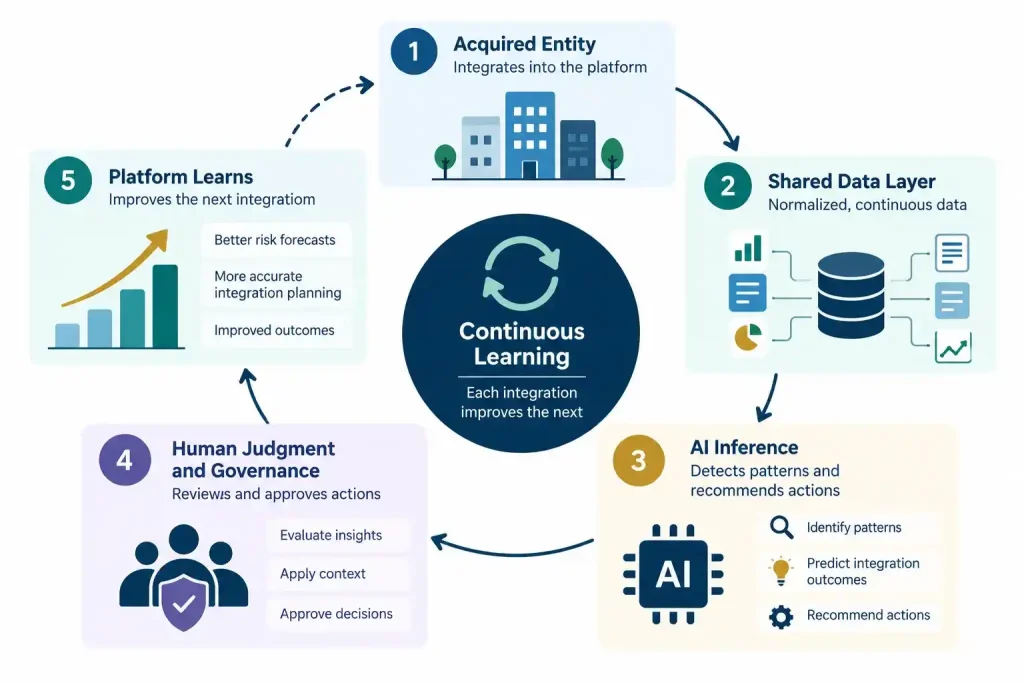
At an AI governance platform in its pre-Series A phase, an AI-first finance workflow across modeling, reporting, and diligence compressed the time from question to decision. The same logic applied across an industry roll-up could push the marginal cost of integration toward zero and raise the number of concurrent acquisitions.
New Trade-Offs for the CFO
This future carries three new tensions for any platform investment:
- Explainability: Boards must interpret probabilistic outputs, so the CFO translates machine insight into fiduciary logic.
- Data gravity: Acquired entities may resist sharing data, so the platform must prove that sharing improves local outcomes.
- Ethical drift: Algorithms that optimize margin can trigger customer defection, so guardrails and override protocols remain essential.
Some observers even foresee decentralized aggregation, where independent businesses join a common protocol of shared data standards and smart contracts without changing ownership. In any form, the CFO becomes a designer of systems and a steward of incentives, asking what to build in order to learn faster.
Five Questions for Any Roll-Up Strategy
Finance leaders weighing a platform investment can test it against five questions:
- Is the platform designed for learning, not just control?
- Do the systems reflect shared truths or federated noise?
- Can the organization absorb variance faster than it accumulates it?
- Will the platform narrative hold as the roll-up scales?
- Do decisions compound, or do they merely accumulate?
Three Key Takeaways
- A platform investment is the precondition for an industry roll-up, so shared definitions, modular systems, and aligned incentives must exist before the acquisition pace accelerates.
- Durable roll-up returns come from the declining marginal cost of integration and from cross-platform revenue, while multiple arbitrage alone fades as spreads compress.
- Integration capacity, not capital, is the binding constraint, and rate-limiting, decoupling, and buffering keep entropy from overwhelming the platform as it scales.
Disclaimer: This article is intended for informational purposes only and does not constitute legal, tax, or accounting advice. You should consult your own tax advisor or counsel for advice tailored to your specific situation.
Hindol Datta is a four-time CFO and senior finance executive with over 25 years of leadership experience across cybersecurity, SaaS, gaming, logistics, digital marketing, medical devices, consumer products, and nonprofit organizations. He has led more than $120M in fundraising and over $150M in M&A transactions while building the financial and operational systems that let complex businesses scale with confidence. He is the author of seven books in the Systems CFO Series and holds active CPA, CMA, and CIA credentials.
AI-assisted insights, supplemented by 25 years of finance leadership experience.