
Executive Summary
Most performance management strategies reward the sprint and forget the marathon. Quarterly targets become gospel, dashboards flash with urgency, and bonus cycles pull attention toward the near rather than the meaningful. In that tightening spiral, the long-range vision that justified the business begins to blur.
This article treats performance systems as a language of value, not neutral machinery. It traces five shifts, from control to coherence, from scorekeeping to behavioral design, from quarterly pressure to time stewardship, from fixed to adaptive frameworks, and from managing numbers to shaping belief. It also offers a stakeholder engagement framework that turns performance reviews into shared learning.
Moving Performance Management Strategies from Control to Coherence
Cascading metrics, tidy goal hierarchies and strict reporting rhythms create a comforting sense of order. Organizations rarely honor that order for long, because they lurch, surprise and evolve in ways no scorecard anticipates.
Most performance management strategies are designed for control instead of coherence, and control is not the same as understanding. A comprehensive framework can look elegant on launch day and calcify within two quarters. Teams hit their KPIs while missing the point, explaining variances instead of exploring causes. People begin to game the system, not out of malice, but because compliance systems invite survival tactics.
The real purpose of a performance system is to help people answer two questions. What is the organization trying to become, and how will it recognize progress along the way? Coherence of this kind cannot be imposed; it has to be cultivated through deliberate design.
Four Design Shifts That Replace Control with Coherence
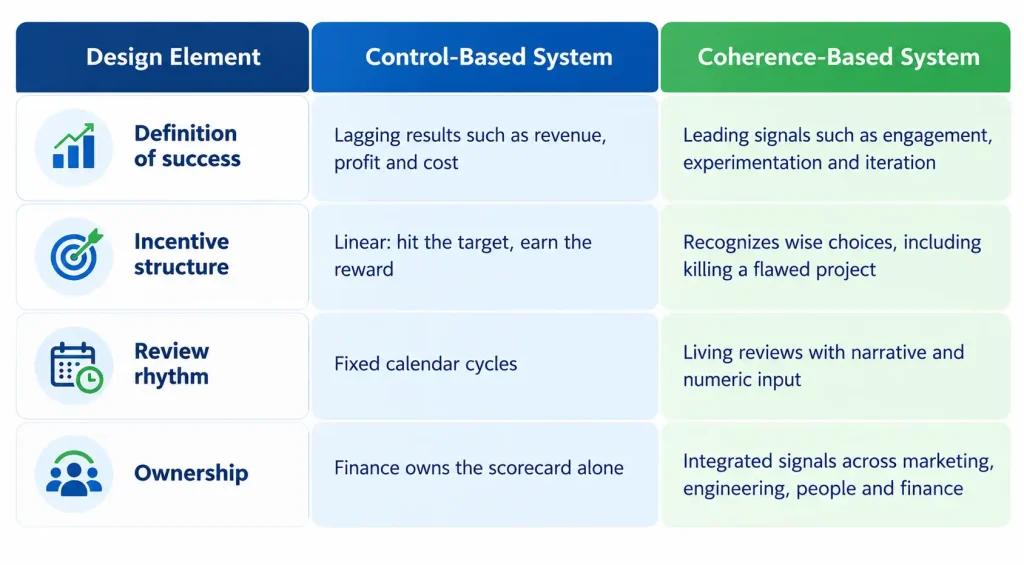
A coherent system measures what causes performance, not only what results from it. Under this model, the CFO acts less as auditor-in-chief and more as curator of meaning.
What Metrics Teach: The Behavioral Side of Performance Management Strategies
Measurement looks neutral, yet once a metric exists, teams stop asking what creates value and start asking what will move the number. A scorecard meant to serve as a map soon becomes a mirror, and the architecture becomes the agenda.
Metrics teach people what the company cares about, what earns a reward and which tradeoffs carry a cost. Effective performance management strategies accept that the signal received is not always the signal sent.
How Teams Translate Common Metrics
| Metric Design | Intended Message | Message Teams Hear |
| Cost-efficiency target | Drive discipline | Avoid risk of any kind |
| Sales quota | Build top-line momentum | Close at any cost, even at the expense of margin |
| Product launch OKR | Deliver with precision | Hit the ship date, not the quality bar |
These translations are not misunderstandings, since real people make them in real time under real pressure. Companies can chase efficiency until innovation suffocates, or pursue growth until the business model breaks.
The Blind Optimization Test for Every New KPI
One question belongs in front of every new metric before launch. If someone optimized for this number blindly, what damage could they do? The answers expose loopholes and the ethical corners people might cut under pressure. The aim is to contextualize metrics, not remove them, by pairing each KPI with a short behavioral sidebar:
- The intent behind the measure and why it matters
- The behaviors that support it in daily work
- The risks of misreading or gaming it
At a venture-backed performance marketing company that grew from $9M to $180M in 24 months, CAC, LTV and contribution margin discipline did this work. Those measures kept rapid growth from becoming growth at any price, and they reshaped how leaders discussed tradeoffs.
Balancing Short-Term Targets with Long-Term Value Creation
Finance leaders learn discipline first: hit the quarter, respect guidance and control variance. That discipline is the bedrock of trust, because markets are impatient and capital does not wait. A harder question surfaces when short-term discipline collides with long-term integrity.
Most companies answer that collision with quiet evasion. They defer investments, manage optics and adjust language while believing they are holding the line. Short-term performance is not the enemy of long-term value, but it is its most frequent saboteur. Sound performance management strategies ask the CFO to hold that tension without distortion.
Multi-Temporal Thinking and Time Stewardship
Time stewardship begins with the courage to say that a decision will hurt the quarter but help the decade. It also requires fluency in layered timelines, such as these:
- A sales push this quarter that may suppress net revenue retention next year
- A hiring freeze modeled for its effect on innovation cycles, not only on cash
- A delayed launch that preserves reputational equity worth years of revenue
At a $127M global consumer products company, inventory turns more than doubled from 3x to 7x. Demand planning and SKU rationalization drove that result, though neither paid off in a single quarter. Together they released trapped working capital and reshaped cash conversion.
A dashboard showing green across the board can still hide decay. Falling customer satisfaction and attrition in a key team rarely appear on operating scorecards. Narrative reviews in the quarterly rhythm widen the aperture, as does asking every leader what the team will forgo this quarter to protect the next.
Building Adaptive Performance Management Strategies for a Changing Business
Some fragility masquerades as rigor, since a fixed system audits well, then crumbles when a market turns or a supply chain stalls. Teams stay locked into goals that no longer make sense, while metrics punish the adjustments needed to survive.
Adaptive performance management strategies start with rhythm instead of the calendar. Real-time check-ins should serve calibration, not oversight, by asking what has changed since the goal was set. Variance then becomes something to explore instead of something to punish.
The best teams operate like jazz ensembles, with a clear structure and room for interpretation within it. When a professional services firm scaled from $12M to $63M in eight months, engagement-level profitability and utilization analytics across five business units kept that pace sustainable. Leadership could finally see where margin was leaking.
A Stakeholder Engagement Framework for Shared Ownership
Finance-owned systems drift toward tight thresholds and binary reviews. A stakeholder engagement framework distributes ownership so that teams act as participants in the system, not its subjects.
Five Stages of the Stakeholder Engagement Framework
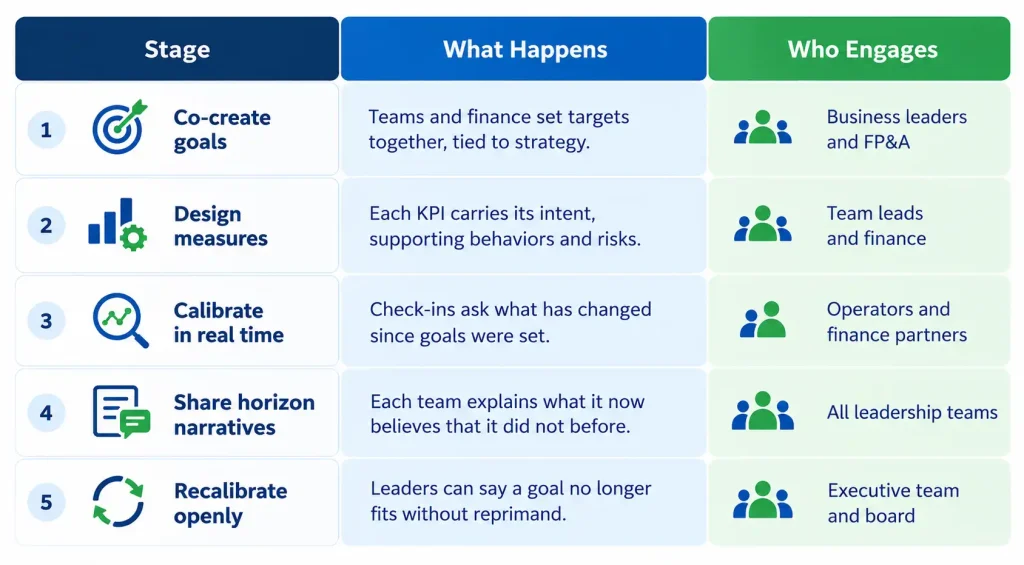
Horizon narratives, written each quarter alongside KPIs, make performance conversations richer, more honest and less defensive. The guiding principle is to design boundaries instead of walls, since boundaries hold the shape of intent while allowing movement. Many CFOs fear that such flexibility means losing control. Rigidity, however, is only inauthentic order, and real control comes from systems that hold variation and recalibrate without collapsing.
How Performance Management Strategies Shape the Finance Leader
Numbers are never neutral, because they reveal what a leader chose to highlight and what went ignored. Every phrase a CFO repeats sets a worldview, whether it defines success as hitting the target or control as explaining the variance. Responses to a miss or a surprise become leadership moments that accumulate into culture.
The most important thing a CFO manages is the organization’s relationship to performance. That relationship shapes whether teams take intelligent risks and whether they speak up early. Changing the questions leaders ask changes the culture they build:
- From asking why a result happened to asking what it teaches
- From explaining the gap to deciding what changes next time
- From fixation on point estimates to a habit of confidence intervals
- From celebrating a win to separating luck from what is repeatable
Trust follows candor more reliably than it follows optimism. In a cybersecurity and identity access management company with $30M in ARR, a driver-based forecasting engine held actuals within five percent of forecast. That record held for 8 consecutive quarters, building more board confidence than any rosy scenario.
Finance leaders begin by managing numbers, then systems, then behavior. Eventually they manage belief, the shared conviction that performance is not a scoreboard but a signal of what the company is becoming.
Three Key Takeaways
- Design performance management strategies for coherence instead of control, pairing lagging results with leading indicators so teams see what drives value.
- Treat every metric as a teaching device by testing it for blind-optimization risk and documenting its intent before launch.
- Use a stakeholder engagement framework with real-time calibration and horizon narratives, so short-term targets serve long-term value creation.
Disclaimer: This article is intended for informational purposes only and does not constitute legal, tax, or accounting advice. You should consult your own tax advisor or counsel for advice tailored to your specific situation.
Hindol Datta is a four-time CFO and senior finance executive with over 25 years of leadership experience across cybersecurity, SaaS, gaming, logistics, digital marketing, medical devices, consumer products, and nonprofit organizations. He has led more than $120M in fundraising and over $150M in M&A transactions while building the financial and operational systems that let complex businesses scale with confidence. He is the author of seven books in the Systems CFO Series and holds active CPA, CMA, and CIA credentials.
AI-assisted insights, supplemented by 25 years of finance leadership experience.



