
Executive Summary
Many investors treat value as something found through mispriced assets and clever arbitrage. Durable PE value creation works differently, because value is constructed over time, through intention and under pressure. Each stage of the private equity lifecycle demands its own judgment, governance, and pacing, and missteps in one stage echo for years.
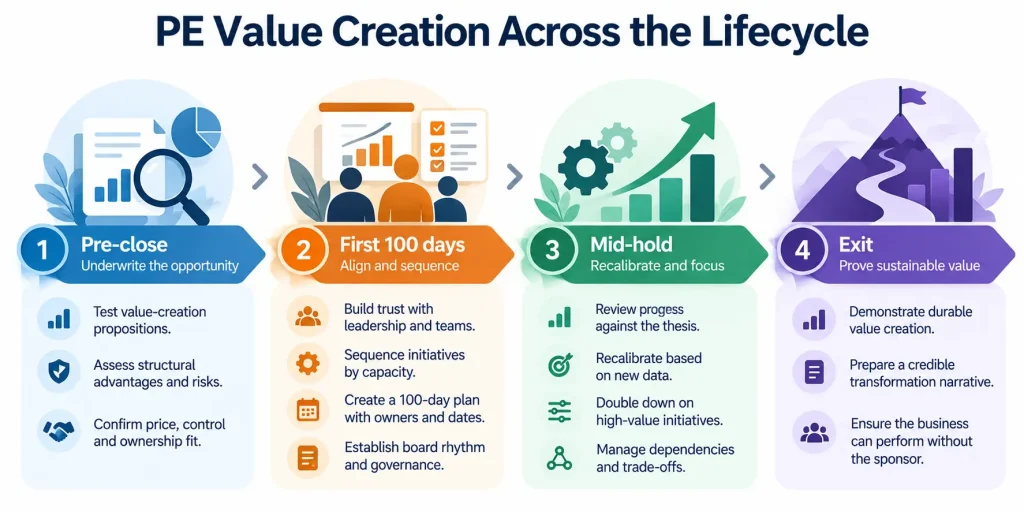
This article traces portfolio company value creation through four stages: pre-close underwriting, the first 100 days, the mid-hold years, and exit. Each section covers the decisions that matter most and the traps that erode returns. The aim is a lifecycle view that treats the close as a commitment rather than an achievement.
Why PE Value Creation Is Built, Not Found
The novice investor often treats the deal close as the high point, as if deploying capital were a strategy. From the moment the ink dries, the clock runs toward responsibility rather than return. Decisions made in year zero reverberate into year five, so investors must think in cycles instead of quarters. Each stage of PE value creation calls on a different strength, as the table below summarizes.
| Lifecycle Stage | Core Discipline | Central Question |
| Pre-close | Imagination under constraint | What will be different because this firm owns it? |
| First 100 days | Alignment and pacing | Can the organization absorb the plan? |
| Mid-hold | Recalibration and focus | Is the thesis still tested and debated? |
| Exit | Narrative authorship | Can the value survive without the sponsor? |
Every stage also forces trade-offs that no sponsor can avoid, only sequence and pace against the firm’s capacity:
- Accelerating growth may strain culture and stretch thin management layers.
- Cutting costs too quickly may erode customer experience.
- Pursuing acquisitions adds complexity the team must absorb.
Metrics matter, but they never interpret themselves, and context changes their meaning. High first-year churn may signal execution lag, or it may reflect the deliberate shedding of unprofitable customers. An EBITDA dip may point to operational trouble, or to planned reinvestment in capacity. Financial management optimizes metrics, while financial leadership reads them in context and shapes the trajectory behind them.
Pre-Close: Underwriting Portfolio Company Value Creation
Portfolio company value creation begins before any capital moves, because underwriting is belief formation under bounded rationality, not arithmetic. The data is incomplete, the projections carry bias, and the investor must still commit. Diligence supplies data, yet underwriting requires a point of view about structural advantages and hidden pathologies. That view often forms in off-script conversations with middle managers, customers, vendors, and former employees.
Turning Aspiration into Testable Propositions
The foundational question asks what will be different because this firm owns the company. Each answer must become a proposition the team can test:
- Procurement centralization: is there evidence of decentralized buying today?
- Pricing power: does churn tell a different story about elasticity?
- Salesforce effectiveness: has the conversion funnel been examined by segment and territory?
On one buy-side engagement for an IT services target, quality-of-earnings analysis surfaced material EBITDA adjustments and concentrated integration risk. Those findings converted a broad growth story into specific, priced propositions.
Price, Control, and Ownership Fit
Entry multiple acts as both threshold and trap, since a good company at the wrong price becomes a hostage situation. Competing bidders can quietly stretch margins and compress timelines, so their presence should harden the logic, not loosen it. The investor controls nothing before close yet becomes responsible for everything afterward. Anything left uninvestigated before the check clears will likely define the pain that follows. The sharper question is whether this firm has the operating talent, patience, and relational intelligence to be the right owner.
The First 100 Days of PE Value Creation
The first 100 days of private equity value creation test discipline far more than ambition. Novice owners equate speed with strategy, rushing into town halls, dashboards, and cost cuts. Pace without sequencing becomes noise, and the real goal is a tempo of change the organization can sustain.
Alignment, Pacing, and Immersion
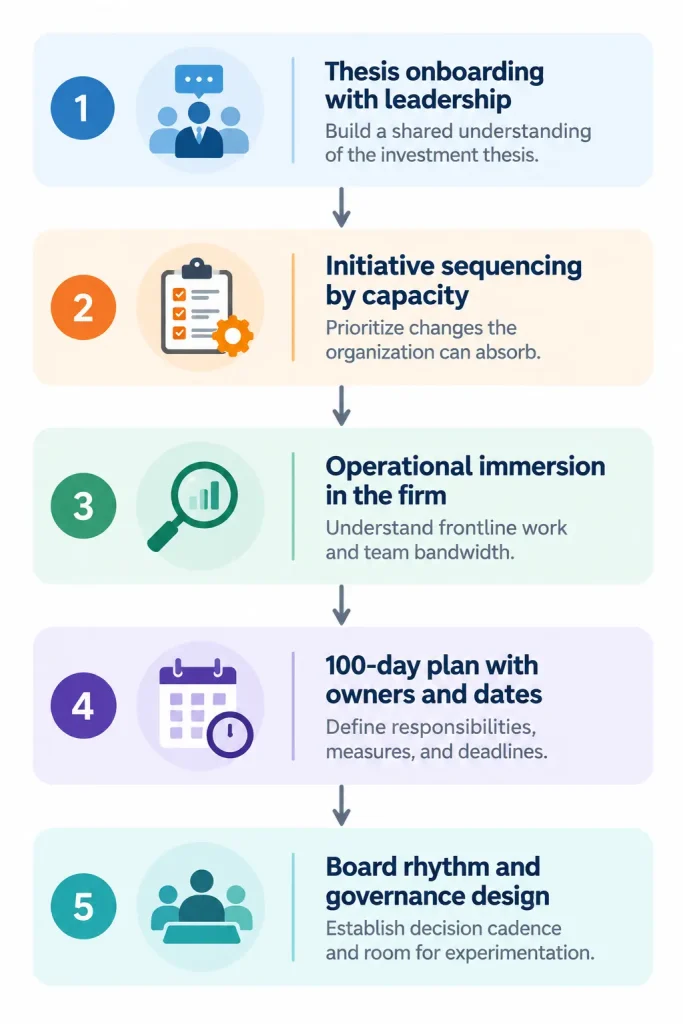
Alignment means mutual comprehension, so the thesis must move from the deal team into a shared mental model. The investor should walk leaders through why the company was bought, what success looks like, and how progress will be measured. A thesis may hold 10 levers, but the firm cannot pull them all at once. A pricing pilot in one segment may come first, while an ERP replacement waits a year. Operating partners must also walk the floor and shadow sales calls, because immersion reveals the team bandwidth that diligence could not see.
The 100-Day Plan and Relational Capital
A strong 100-day plan works as a roadmap of trust, not a checklist. It names who leads each initiative, how progress will be measured, and which decisions are due when. The first board meeting should feel like a design session that sets cadence, depth, and tolerance for experimentation. Trust carries the most weight here, since a CFO must feel safe surfacing gaps instead of hiding them. Where trust runs high, execution accelerates, and where it runs low, initiative drag compounds.
Mid-Hold: Managing Entropy and Strategic Drift
Early wins eventually give way to slower gains, unforeseen dependencies, and leadership fatigue. Entropy works quietly in this phase, blurring priorities, fading energy, and turning dashboards into ritual. Left unaddressed, it pushes the business toward mediocrity instead of outright failure.
Recalibration Through Measurement and Subtraction
Resisting entropy requires adaptive maintenance, a steady tuning of small systems rather than a dramatic overhaul. The thesis gets re-underwritten, so what worked is scaled and what failed is re-scoped. Mid-hold PE value creation depends on recalibration across four areas:
- Measurement audit: confirm each KPI still measures progress and does not distort behavior.
- Initiative pruning: kill projects that are politically safe but strategically marginal.
- Governance posture: shift the board from oversight to insight and sense-making.
- Capability audit: assess whether year-one leaders fit the demands of year three.
At a professional services firm scaling from $12M to $63M in revenue, engagement-level profitability analytics revealed where margin was quietly leaking. That kind of interpretive measurement keeps dashboards strategic instead of cosmetic.
Second-Order Effects and Culture
Private equity value creation levers interact through feedback loops, and success often creates new strain. A pricing win can flood customer support, while a sales ramp can expose supply chain gaps. At a venture-backed digital marketing company that grew from $9M to $180M in 24 months, three acquisitions added integration demands on top of core growth. The investor must act as a systemic translator, mapping these interdependencies across functions. Culture also decides whether frontline teams absorb or reject the plan, which makes it the operating substrate of execution.
Exit Strategy and the Final Stage of PE Value Creation
Exit converts years of PE value creation into an act of strategic authorship, distilling the firm’s journey into a future the next owner can continue. Timing rests where internal readiness meets external receptivity. Internally, initiatives should be delivered, the team mature, and the numbers reliable. Externally, sector multiples, active comparables, and buyer appetite must line up.
Building a Credible Exit Narrative
The best exit narratives chronicle transformation rather than fantasize about growth. They show what was found, what changed, and what new optionality exists for the next owner. Buyers seek intelligibility over perfection, and a deck that owns its mistakes builds credibility. Preparation should begin years ahead, with clean systems, consistent metrics, and audit-ready documentation. At a $30M ARR cybersecurity company, cutting the monthly close from 18 days to 10 and building ASC 606 controls carried the business through acquisition diligence.
The Human Side of the Handoff
A buyer acquires a team along with systems and cash flows, so leadership retention shapes valuation directly and protects the portfolio company value creation already achieved. Incentives must stay aligned, successors identified, and fatigue managed in the years before exit. The next owner also needs a credible next thesis, such as geographic growth after a margin-driven hold. Mature sponsors exit with grace and detachment, trusting the design they built. The final test asks whether the firm leaves with better systems, stronger leaders, and more adaptability than before.
Three Key Takeaways
- PE value creation starts before close, when the team converts each value claim into a testable proposition and asks whether it is the right owner.
- The first 100 days should set a sustainable tempo through thesis onboarding, capacity-based sequencing, and trust that lets problems surface early.
- Portfolio company value creation depends on mid-hold recalibration and an exit narrative that proves the gains are structural, repeatable, and ready for the next owner.
Disclaimer: This article is intended for informational purposes only and does not constitute legal, tax, or accounting advice. You should consult your own tax advisor or counsel for advice tailored to your specific situation.
Hindol Datta is a four-time CFO and senior finance executive with over 25 years of leadership experience across cybersecurity, SaaS, gaming, logistics, digital marketing, medical devices, consumer products, and nonprofit organizations. He has led more than $120M in fundraising and over $150M in M&A transactions while building the financial and operational systems that let complex businesses scale with confidence. He is the author of seven books in the Systems CFO Series and holds active CPA, CMA, and CIA credentials.
AI-assisted insights, supplemented by 25 years of finance leadership experience.