
Executive Summary
In the early life of a company, whoever sits closest to the problem handles the legal work, and often that is the founder. As contracts grow more complex, headcount expands, and investors demand structure, outside legal counsel becomes necessary rather than optional. The firm’s pedigree or hourly rate matters less to the quality of that engagement than how clearly the founder frames the work from the start. Outside counsel best practices begin with communication, not with credentials.
Across finance leadership roles spanning cybersecurity, consumer products, education, and public-company gaming, the pattern holds steady: legal engagements that go well are the ones where the client did the work of framing scope, risk tolerance, and timeline before the first email went out. This article lays out the six essentials of a productive relationship with outside legal counsel and shows how founders can turn what many treat as a cost center into a genuine source of strategic leverage.
Why Legal Engagements Go Sideways
Founders frequently apply less discipline to hiring outside counsel than they apply to raising capital. A founder forwards a contract with a one-line request. The email carries no context about the counterparty and no mention of urgency. It signals nothing about how much risk the company is willing to absorb. That vacuum invites exactly the outcome nobody wants: aggressive redlines and long memos. The result is a level of caution that no longer matches the founder’s actual needs.
This is not a failure of the lawyers. Attorneys operate inside a liability framework. In the absence of clear direction, they default to protecting the client from every conceivable exposure. Most outside counsel best practices exist to close that gap. The gap sits between what a founder assumes is obvious and what counsel actually knows. Consider a $30M ARR cybersecurity and identity access management company operating across five countries. One enterprise contract came back from outside counsel loaded with protective clauses. Those clauses would have stalled a price-sensitive customer’s procurement process. The finance team reframed the objective: hold risk at an acceptable level without jeopardizing the close. The revised contract came back within hours. Nothing about the lawyer’s competence had changed. What changed was the information available to work with.

The Six Essentials of a Strong Outside Counsel Engagement
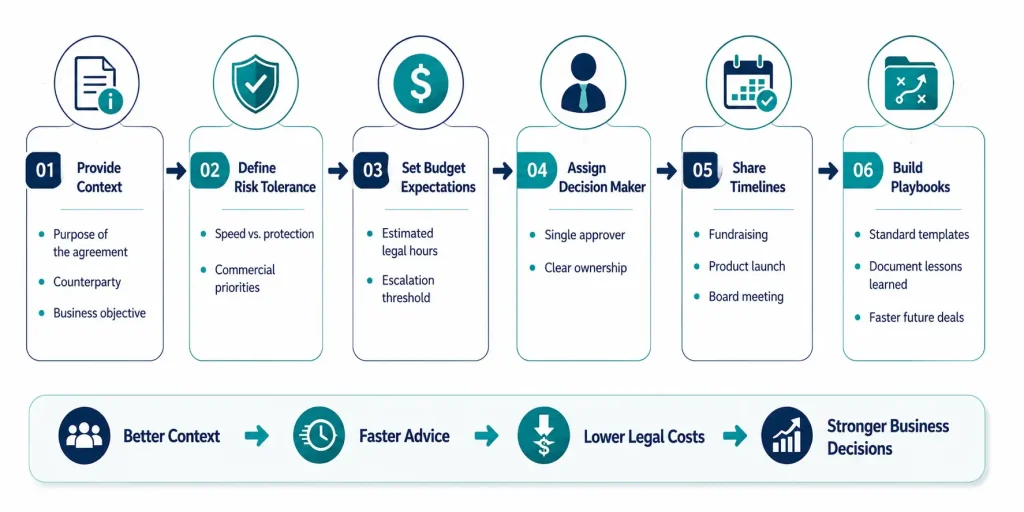
Outside counsel best practices do not demand complexity, only a small amount of upfront work from the founder on every matter. Six elements consistently separate efficient engagements from expensive, drawn-out ones.
Setting Context and Risk Tolerance
- Open with context. State what the document is for, who the counterparty is, and what the timeline looks like. A two-line summary at the top of an email can save hours of unnecessary back-and-forth.
- Define the risk profile explicitly. Some agreements call for airtight protection; others call for speed. Say so. Risk tolerance is calibrated, not binary, and outside legal counsel cannot calibrate to a preference that was never stated.
- Set a budget, even a loose one. A simple instruction such as keeping the matter under a set number of hours unless something material arises signals that scope is being watched. Left unbounded, scope tends to expand on its own.
Governance, Timelines, and Institutional Memory
- Clarify the decision-maker. Delays often occur not because counsel is slow but because comments sit unanswered while no one is designated to approve the response.
- Share timelines openly. A fundraising deadline, a board date, or a product launch is only useful information to counsel if the founder discloses it.
- Document what is learned. Recurring deal types deserve a standing playbook. A SaaS company that standardized its channel agreement template closed its next five partner deals in days rather than weeks.
Turning Outside Counsel into Strategic Leverage
Startups that get the most from legal spend tend to follow outside counsel best practices that treat counsel as a partner with visibility into the business rather than a vendor who receives documents on a need-to-know basis. Sharing the cap table, the organizational chart, and investor updates gives counsel the context to spot governance issues before they harden into disputes.
Inside a venture-backed digital marketing company that scaled from $9M to $180M in revenue across twenty-four months, the finance team led three acquisitions during that stretch, each requiring outside counsel who understood not just the transaction structure but the underlying customer acquisition and margin economics driving the deal. Keeping counsel at arm’s length from that kind of operating detail can still close a transaction, but the terms tend to be more conservative, and the diligence process tends to run longer than it needs to. Founders who treat legal engagement as a black box end up frustrated with the cost. Founders who bring counsel inside the frame tend to get sharper advice at a lower total cost, because better context preempts the clarifying questions that would otherwise consume hours.
Building Legal Discipline into Company Operations
Working with outside legal counsel well is not primarily about avoiding mistakes. It is about establishing a rhythm that an organization can rely on: a team schedules board approvals on a predictable cadence, documents equity grants cleanly as they happen, and archives fundraising terms with enough care to retrieve them without a scramble. That structure is what builds investor and board trust over time, and it is also what makes due diligence tolerable rather than traumatic. None of it happens by accident; it happens because someone applies outside counsel best practices consistently rather than only when a deal is on the table.
At a mission-driven education and research institution, the finance function was structured to run Legal alongside Finance, HR, IT, and Facilities under one operational umbrella, which meant every contract, every board resolution, and every audit committee matter moved through a single point of coordination during a $37M capital raise spanning equity and venture debt. That consolidation is not available to every company, and it is not always the right structure. But the underlying discipline it enforces, a clear owner for legal process and a predictable review cadence, is available to any founder willing to build it deliberately rather than reactively.
From Cost Center to Strategy Enabler
Legal is frequently budgeted as a line item to be minimized rather than a function that compounds in value when used well. That framing tends to break down once a company approaches an institutional milestone. During an S-1 and IPO-readiness process at a Euronext Paris-listed gaming and digital entertainment company with operations across five countries, coordination between finance, outside counsel, investment bank underwriters, and Big Four auditors over more than $100M in cross-border M&A activity was not something that could be assembled at the last minute. It had to exist already, built through years of routine engagement rather than invented under deadline pressure.
Founders do not need to wait for a crisis, a raise, or an exit to bring outside counsel into quarterly planning. Reviewing contracts before they go out rather than after they land, and using counsel’s cross-portfolio perspective to flag industry patterns early, converts legal spend from a reactive cost into a forward-looking input on strategy.
| Engagement Element | What It Prevents |
| Context up front | Overbroad redlines and unnecessary caution |
| Stated risk tolerance | Mismatched protection versus deal speed |
| Loose budget guidance | Uncontrolled scope creep |
| Named decision-maker | Stalled approvals and dead time |
| Disclosed timeline | Deadlines missed for lack of information |
| Documented playbooks | Repeated diligence on similar deal structures |
Three Key Takeaways
- Outside legal counsel cannot calibrate advice to context it was never given, so the founder’s brief, covering purpose, counterparty, risk tolerance, and timeline, does more to control cost and quality than the choice of firm or hourly rate ever will.
- Treating outside counsel as a partner with visibility into the cap table, the organizational structure, and the strategic roadmap produces sharper, faster guidance than treating counsel as a vendor who receives documents in isolation.
- The founders best positioned for a raise, an acquisition, or an exit are the ones who built legal discipline, scheduled reviews, tracked NDAs, documented playbooks, before the milestone arrived, not in response to it.
Disclaimer: This article is intended for informational purposes only and does not constitute legal, tax, or accounting advice. You should consult your own tax advisor or counsel for advice tailored to your specific situation.
Hindol Datta is a four-time CFO and senior finance executive with over 25 years of leadership experience across cybersecurity, SaaS, gaming, logistics, digital marketing, medical devices, consumer products, and nonprofit organizations. He has led more than $120M in fundraising and over $150M in M&A transactions while building the financial and operational systems that let complex businesses scale with confidence. He is the author of seven books in the Systems CFO Series and holds active CPA, CMA, and CIA credentials.
AI-assisted insights, supplemented by 25 years of finance leadership experience.